
Rakuten Affiliate Marketing: How the Network Works in 2026
26 November 2026
यह लेख अभी हिंदी में उपलब्ध नहीं है, इसलिए इसे अंग्रेज़ी में दिखाया गया है।
Rakuten Advertising says its network reaches more than 1.2 billion consumers and has completed more than 200 million transactions, according to Rakuten Advertising's company figures. That's the size of the room you're walking into. It isn't the number that decides what lands in your account. Two publishers can send the same shopper to the same merchant in the same week, and only one of them gets paid, because the advertiser chooses which click earns credit. Rakuten affiliate marketing pays the publisher who keeps the tracking chain intact and reads the commission rules before publishing, not the one who posts the most links.
Table of Contents
- What Rakuten Affiliate Marketing Is and How It Pays
- Publisher Requirements and How to Get Approved
- How Commissions and Attribution Models Decide Your Earnings
- Setting Up Tracking Links Without Losing Commissions
- Staying Compliant as Tracking Gets Less Reliable
- Promoting Rakuten Offers on Pinterest
- Apply to One Program and Test It
What Rakuten Affiliate Marketing Is and How It Pays
Think of Rakuten Advertising as a tracked referral desk sitting between a brand and the people who recommend it. A brand agrees to pay a set commission on orders it can tie back to a partner. A publisher places a tracked link in a review, a newsletter, or a Pinterest pin. A shopper clicks, buys, and the network matches that click to the order and reports the commission. Nothing about the arrangement is mysterious, and nothing about it is automatic either.
The whole arrangement fits in one diagram.
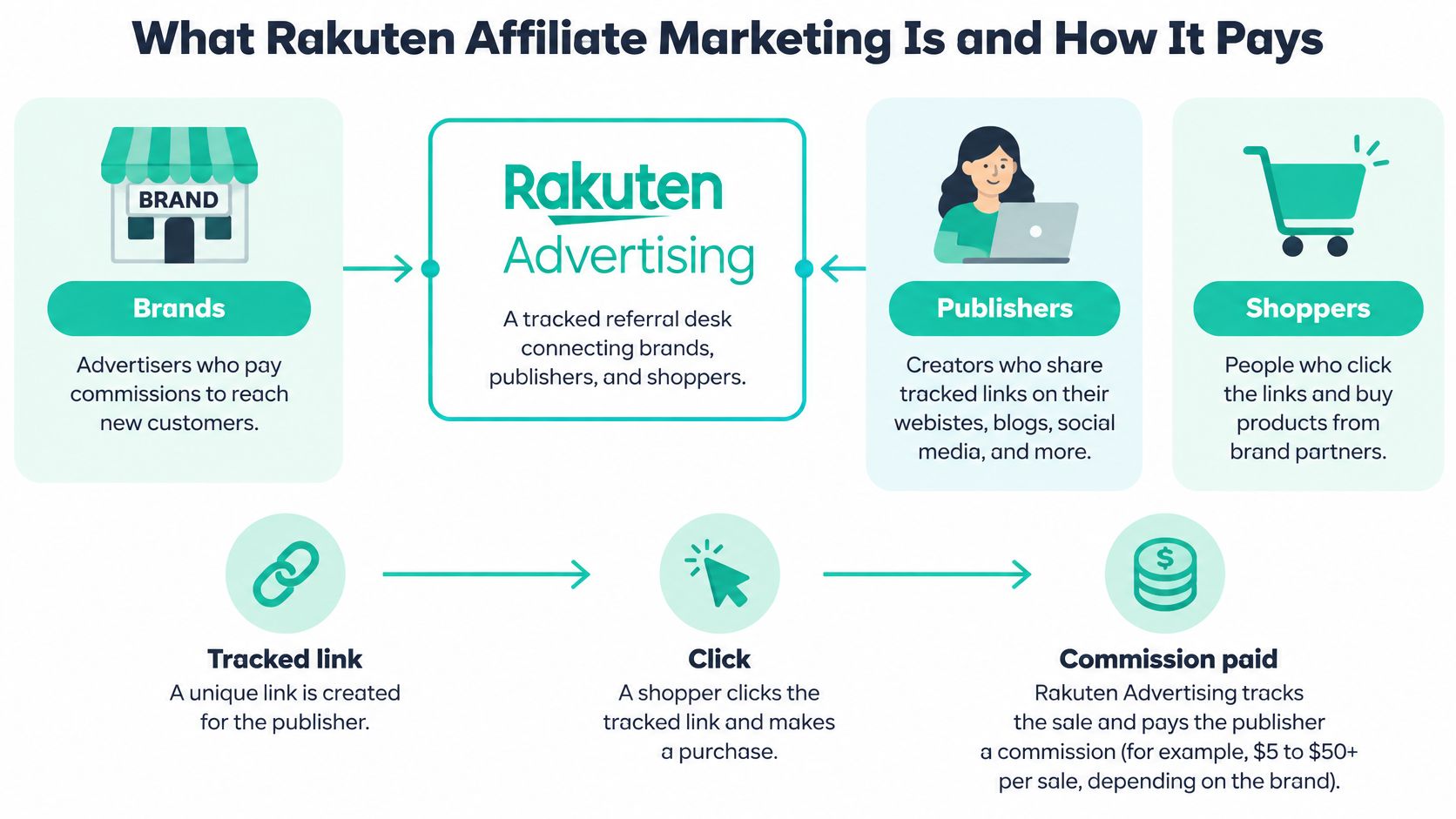
Who sits where in the chain
- Advertiser: the brand running the program. It sets the rate, the products that qualify, and the rules for who gets credit.
- Network: Rakuten Advertising. It hosts the programs, serves the tracking links, records transactions, and handles validation and payment.
- Publisher: you. Your job is to send a shopper who wants the product, through a link the network can recognise.
- Shopper: the person who clicks and buys. Their behaviour, including which device they finish on, decides whether your click survives to become an order.
Say a kitchenware brand runs a program on the network. You write a comparison of two stand mixers and pin the winner. A reader clicks your pin on a phone, browses, and buys from a laptop three days later. Whether you earn anything depends on the link you used, the window the advertiser set, and who else touched that shopper along the way. The creative work is the easy half.
One piece of history that explains the merchant mix
Rakuten built this business by acquiring U.S.-based LinkShare Corporation in 2005, when LinkShare already served more than 500 blue-chip merchants, according to Rakuten's 2005 annual report. That's why the network still leans toward established retail brands and cross-border programs rather than a long tail of small direct-to-consumer shops.
One mix-up worth clearing early: Rakuten Rewards, the service many shoppers know as Ebates, is the consumer cashback side. If you're still deciding between networks, it helps to compare affiliate network platforms on merchant fit and payment terms before you commit a quarter of content to one.
A commission is only paid on a tracked, validated order. The link is the asset. The pin, the post, and the video are just delivery vehicles for it.
Publisher Requirements and How to Get Approved
Approval on Rakuten happens twice: once for your publisher account, then again for every merchant program you want to promote. Publishers who miss the second step generate links that go nowhere and assume the network is broken.
| Requirement | What is expected | Why it matters |
|---|---|---|
| Live property | Active website, app or channel | Reviewers check the property before approving an application |
| Content quality | Original, non-spam content | Thin or copied sites are commonly declined |
| Audience and niche | Clear audience matching the merchant | Advertisers approve publishers whose audience fits their products |
| Tracking links | Only Rakuten-designated tracking links | Non-compliant links can lead to denied commissions |
| Disclosure | Clear affiliate disclosure on promoted pages | Required under program policy and consumer rules |
| Advertiser approval | Separate approval for each merchant program | Approval is per advertiser, not network-wide |
| Traffic minimums | No single network-wide figure; each advertiser sets its own in the program terms | Read the terms before applying, since a merchant can decline a small but relevant site or accept a large irrelevant one |
| Review time | Set by each advertiser's own review process, not by a network-wide clock | Apply early and follow up through the network's messaging tool rather than republishing links while you wait |
The application sequence, and where each step fails
- Create the publisher account. Use a real business or personal name and a contact email you read. Network quality teams send compliance questions by email, and an unanswered one is a problem you don't want.
- Complete the profile with your site URL and traffic description. The usual rejection here is a property that isn't live yet, or a "coming soon" page. Reviewers open the URL. Give them something to look at.
- Describe your content and audience. "Lifestyle" tells an advertiser nothing. "Budget home organisation for renters in the UK, mostly Pinterest and email" tells them exactly which of their products you can sell.
- Apply to each merchant program individually. Pick programs whose catalogue matches content you've already published. A skincare brand reviewing an application from a fishing blog has an easy decision.
- Wait for advertiser review. Some programs auto-approve, others read every application. Don't chase volume by applying to everything in the directory. A scattergun list looks like a coupon operation.
- Generate tracking links only after approval. Links built before approval, or copied from another publisher's site, are the fastest route to denied commissions.
What a ready applicant actually has
Three things: a live property with original content, a one-sentence description of who reads it, and a shortlist of programs that fit that reader. If you can't write the audience sentence, fix the content before you fix the application.
Practical rule: treat a declined program as feedback on fit, not on quality. Reapply when you've published content that clearly serves that merchant's category.
Disclosure belongs on every page that promotes a compensated product, in plain language, near the recommendation rather than in a footer. Reviewers look for it, and its absence is an easy reason to decline an otherwise good site.
How Commissions and Attribution Models Decide Your Earnings
Two pins, same product, same number of outbound clicks, wildly different payouts. The difference isn't the creative. It's the attribution model the advertiser configured, and most publishers never look at it.
Rakuten lets advertisers configure materially different rules, including last-click, first-click, combined first-and-last-click, multi-touch, and position-based models, and its affiliate network policies state plainly that a click tracked to you can earn a reduced commission or none at all when credit is assigned to another publisher. That single sentence explains most "my clicks are up but my earnings aren't" complaints.
| Attribution model | How credit is assigned | Effect on a Pinterest click |
|---|---|---|
| Last-click | Full credit to the final tracked click before purchase | Pinterest can lose credit when a later coupon, cashback or search click converts |
| First-click | Full credit to the first tracked click | Rewards discovery pins that start the journey |
| Combined first-and-last click | Credit split between first and last touches | Partial credit for the pin that started the journey |
| Multi-touch | Credit shared across all tracked touches | Partial credit depending on how many touches are tracked |
| Position-based | Weighted toward first and last touches | Partial credit depending on the pin's position in the path |
Why discovery traffic gets punished
Pinterest sits early in the buying path. Someone saves a gift idea in October and buys in December, often after a coupon extension or a cashback site has taken the final click. Under last-click, that pin did the persuading and gets nothing. Under multi-touch or position-based rules, the same pin earns a share. Identical work, different contract.
This is the same structural argument that runs through every network comparison, and it's worth reading how CJ affiliate marketing handles publisher credit before you assume one network's reporting behaviour transfers to another.
The three-step check before you scale an offer
- Read the commission rate and the commission window, which is how long after a click a purchase still counts. A short window kills slow-burn discovery content.
- Confirm the attribution model in the offer terms or the platform's offer details. If it's last-click and the merchant also partners with heavy coupon and loyalty publishers, expect leakage.
- Check excluded products and validation rules. Gift cards, clearance lines, and new-customer-only rates are common carve-outs, and a pin pointing at an excluded SKU earns nothing no matter how well it performs.
Then change how you report. Keep two columns: Pinterest-assisted clicks and conversions on one side, credited commission on the other, segmented by advertiser attribution model. When those columns diverge, you've learned something about the contract, not about your content. Pick one live offer today and write down its model before you publish another pin for it.
Setting Up Tracking Links Without Losing Commissions
Rakuten's tracking is transaction-based: the network aligns a publisher click with an advertiser order and records fields such as transaction date, time, and order number, as its guide to understanding tracking technology describes. Break the link and there's nothing to align. The order still happens, the merchant still gets paid, and your side of the record is empty.
Here's the chain in one picture.
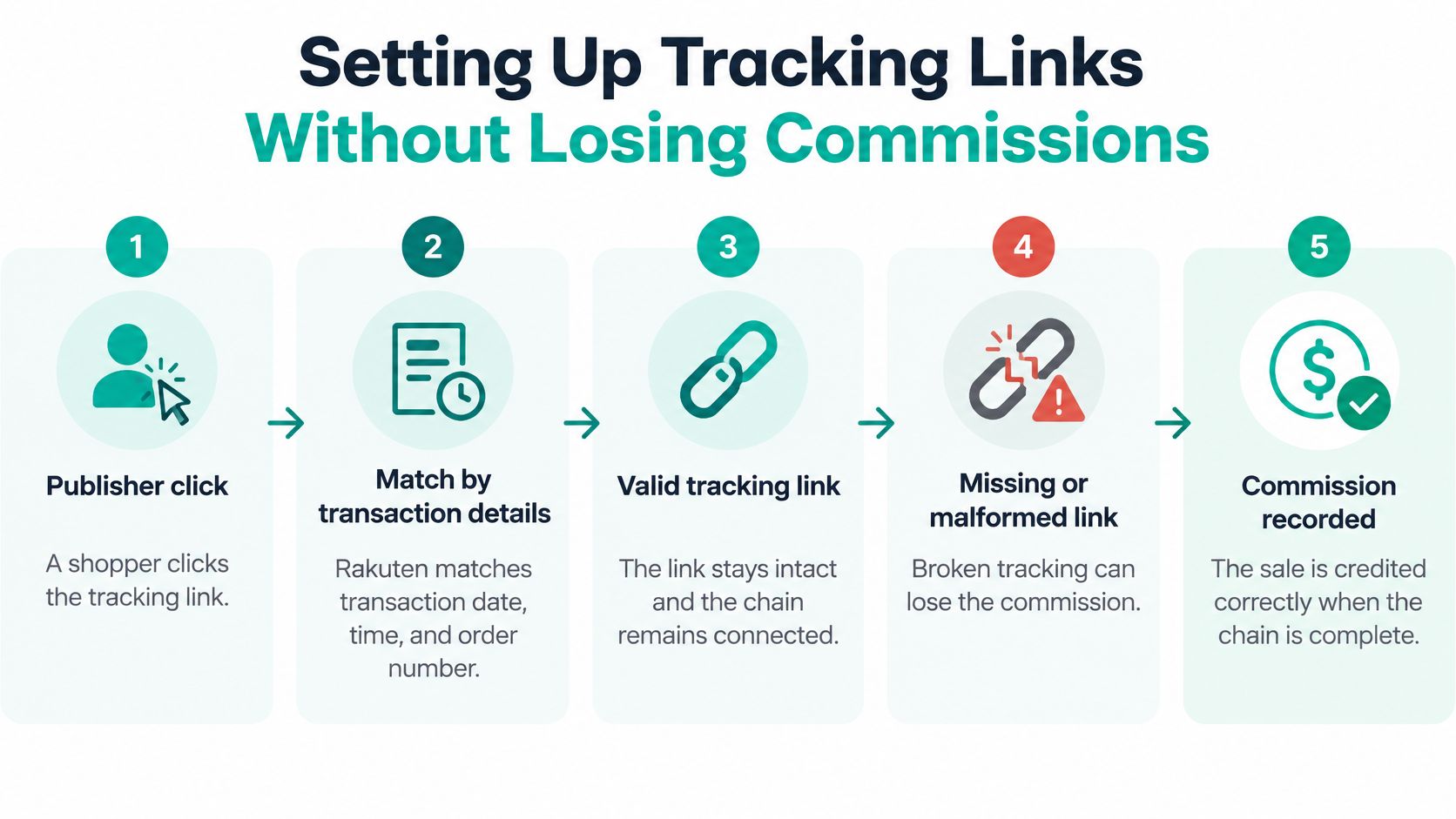
Six steps, and the slip that ruins each one
- Open the links tool inside the approved program. The slip: grabbing a "affiliate link" from a blog post or a forum instead. Someone else's ID earns someone else's commission.
- Copy the designated tracking link, the one beginning with click.linksynergy. Rakuten's policy requires promotional links to use those designated tracking links, and transactions that don't originate from them may be treated as invalid with commissions denied. The slip: shortening it through a generic URL shortener that rewrites or drops parameters.
- Paste it unchanged into the pin's destination field. The slip: hand-editing parameters to "tidy" the URL or to swap a campaign name. Those strings are the identity chain, not decoration.
- Test in a private browser window. You should land on the exact product page the pin promises. The slip: reusing an expired campaign link that redirects to the merchant's homepage, which converts far worse even when tracking survives.
- Watch the redirects. Click through and check the address bar at each hop. The slip: a link-in-bio tool, a redirect plugin, or a store app that strips query strings on the way out.
- Log the exact URL and the creative against each pin. The slip: publishing at volume with no record, so when commissions drop you can't tell which batch broke.
Test the link the way a shopper meets it: on a phone, in a private window, from the published pin itself, not from your draft document.
What automation has to guarantee
Bulk pin production is where tracking dies. A workflow that regenerates outbound URLs, applies a template redirect, or "cleans" links during scheduling can invalidate an entire batch before you notice. Validate every affiliate URL before it publishes, keep campaign and creative identifiers intact through the pipeline, and retain a history record of the exact URL paired with each creative. When you switch a merchant or an offer, updating the affiliate links in your pins' destination URLs in bulk is safer than editing pins one at a time and missing half of them.
A verified link, a logged creative, and a recorded test result. That's the minimum unit of work before anything goes live.
Staying Compliant as Tracking Gets Less Reliable
International reach and reliable attribution pull against each other. The more markets you promote into, the more consent regimes, devices, and browsers sit between your click and the order you're hoping to be credited for.
Industry coverage of affiliate trends, including Realize's marketing hub analysis of affiliate marketing trends, points to third-party cookie loss, browser restrictions, consent requirements, and cross-device shopping as the forces making traditional tracking less dependable, alongside continued pressure for prominent, plain-language affiliate disclosure under frameworks such as GDPR and CCPA and country-specific rules. A shopper who taps your pin on a phone and checks out on a laptop is the everyday version of that problem, and no amount of good creative fixes it.
The checklist I would run per market
- Disclosure where the recommendation is: in the pin description and above the fold on the landing page, in plain words, not a footer link.
- Consent where it's required: a current privacy policy and a working consent mechanism for cookies and pixels in the markets you serve.
- A localized offer: promote the merchant's program for the country your audience buys in, not a US link shown to a German reader.
- First-party measurement: an email list, a comparison page you control, and deterministic coupon codes give you evidence that doesn't depend on a browser keeping a cookie alive.
Rakuten's constraint sits on top of all of this: promotional links must use its designated tracking links, while each advertiser controls the attribution model, rates, and lookback parameters. You can be perfectly compliant and still earn nothing on a given offer because of how the contract is written.
Disclosure may cost you a few impulsive clicks. It buys you trust with readers and standing with the program, and standing is what keeps your account alive when a compliance review lands. Compliance and revenue aren't opposites here. Publishers who get removed usually weren't losing money to disclosure, they were losing it to shortcuts.
So make the decision market by market: promote with disclosure and first-party measurement, or skip that market until you can do both.
Promoting Rakuten Offers on Pinterest
Rakuten Rewards stated that affiliate marketing drove 16% of e-commerce sales in the United States and Canada in 2023, according to Rakuten's roundup of affiliate statistics every marketer should know. Pinterest is one of the few places where that share is still being decided early, because people use it to plan purchases weeks before they make them.
Planning is the work, and it looks like this.

Choosing a format for the offer
| Pin format | Best for | What to set |
|---|---|---|
| Standard image pin | One product or one article | A clear product photo, a benefit-led title and a disclosed description |
| Idea or collection pin | Comparisons and gift lists | A shared theme in the title and one landing page per offer |
| Video pin | Demonstrations and how-tos | A short clip, a caption naming the product and a disclosed description |
| Carousel pin | Multi-product roundups | One offer per slide and a landing page that matches the slides |
Format follows the buying question. "Best stand mixer under a budget" wants a comparison page and a collection pin. "How to fold a fitted sheet" wants a video and a link to the product you used. Matching the format to the question does more for outbound clicks than any design tweak.
Publishing habits that hold up
Write titles and descriptions the way people search on Pinterest, with the product type and the use case in the words, not just the brand name. Match boards to buyer intent rather than to your own categories. Send each pin to one landing page per offer so the click has a single job. Pace publishing across the week instead of dumping a batch on Sunday, because a steady cadence gives you cleaner reads on what's working. If you want the full sequence laid out, this step-by-step guide to affiliate marketing on Pinterest covers the setup order.
For volume, drive production from a source rather than from memory. A website sitemap, a Shopify, Etsy or WooCommerce store, or an RSS feed can feed the pipeline, and new posts and products join future batches automatically. Every generated pin still passes the URL check and carries its disclosure before it goes live. Automation scales whatever process you give it, including a broken one.
Here's a walkthrough of the workflow side.
Give each format four weeks and measure saves, outbound clicks, and credited orders separately before you change anything. Saves tell you the creative works. Credited orders tell you the contract works.
Apply to One Program and Test It
Most publishers fail on Rakuten because they scale before they've proven one offer end to end. A single program, tested properly, teaches you more than twenty applications sitting in review.
Here's the 30-day version:
- Choose one merchant that fits an audience you already have, not one with an attractive rate and no reader match.
- Confirm its commission rate, commission window, and attribution model in the offer terms before you apply.
- Apply, and wait for the advertiser's decision rather than publishing links in the meantime.
- Generate one tracking link and run the verification steps: private window, correct product page, parameters intact through every redirect.
- Publish three to five disclosed pins pointing at that offer, spread across the month, each logged with its URL and creative. If you need a video variant, the ShortGenius AI ad generator can produce the short clip so you're not designing frames by hand.
- After four weeks, review clicks and credited orders in the network reporting, and check the payout threshold and payment timing in your account terms so you're not chasing money that isn't due yet.
A working start looks like this: an approved program, a verified link, a logged creative, and at least one tracked click. Not a hundred pins. When you're ready to widen the test, affiliate links in pin destination URLs can be updated in bulk, which keeps the swap auditable instead of scattered.
Two things to skip. Don't scale before the test produces a credited order, and don't carry results from a last-click advertiser over to an offer running multi-touch, because the numbers aren't comparable. If you'd rather see the creative side before committing, we offer a free automation that builds preview pins from your own website or store in your brand colours, with no card needed.
Which offer is going to be your first test? Name it, write down its attribution model, and start there.
Pin Generator turns your website, blog feed, or store catalogue into scheduled, on-brand Pinterest pins, with bulk affiliate link updates in the destination URLs and a history log so you can trace every creative back to the exact link it carried. That's the tracking hygiene and steady publishing cadence this network rewards, handled without manual design work. Set up your first automation at Pin Generator and run the one-program test on pins that are already verified before they publish.