
CJ Affiliate Marketing: How the Network Works in 2026
25 November 2026
Ten artykuł nie jest jeszcze dostępny po polsku, dlatego wyświetlamy go po angielsku.
You've published a product recommendation, someone has clicked your affiliate link, and a sale appears in your dashboard. But your bank balance hasn't changed. Is the advertiser still checking the order, did tracking break, or is something missing from your payment account? Understanding CJ Affiliate marketing starts with separating those questions, because a recorded sale and a paid commission aren't the same event.
Table of Contents
- CJ Affiliate Marketing Explained in Plain Terms
- Commission Stages and Who Controls Each
- How Click Tracking Credits the Right Publisher
- Working Through Commission Math With a Worked Example
- Confirm Program Fit and Start Earning With CJ Affiliate
- Why Commissions Go Missing and How to Fix Them
CJ Affiliate Marketing Explained in Plain Terms
CJ Affiliate is an affiliate network that connects brands, called advertisers, with independent creators and websites, called publishers. It provides the systems that track referred transactions and help advertisers pay publishers for qualifying results.
Say you write a running blog and recommend a pair of running shoes. A reader clicks your affiliate link, visits the retailer's website, and buys the shoes. If the purchase meets that retailer's affiliate program rules, you earn a commission.
The reader buys from the retailer, not from you or CJ. They pay the advertiser's checkout price, and the referral commission doesn't add a separate charge to their purchase.
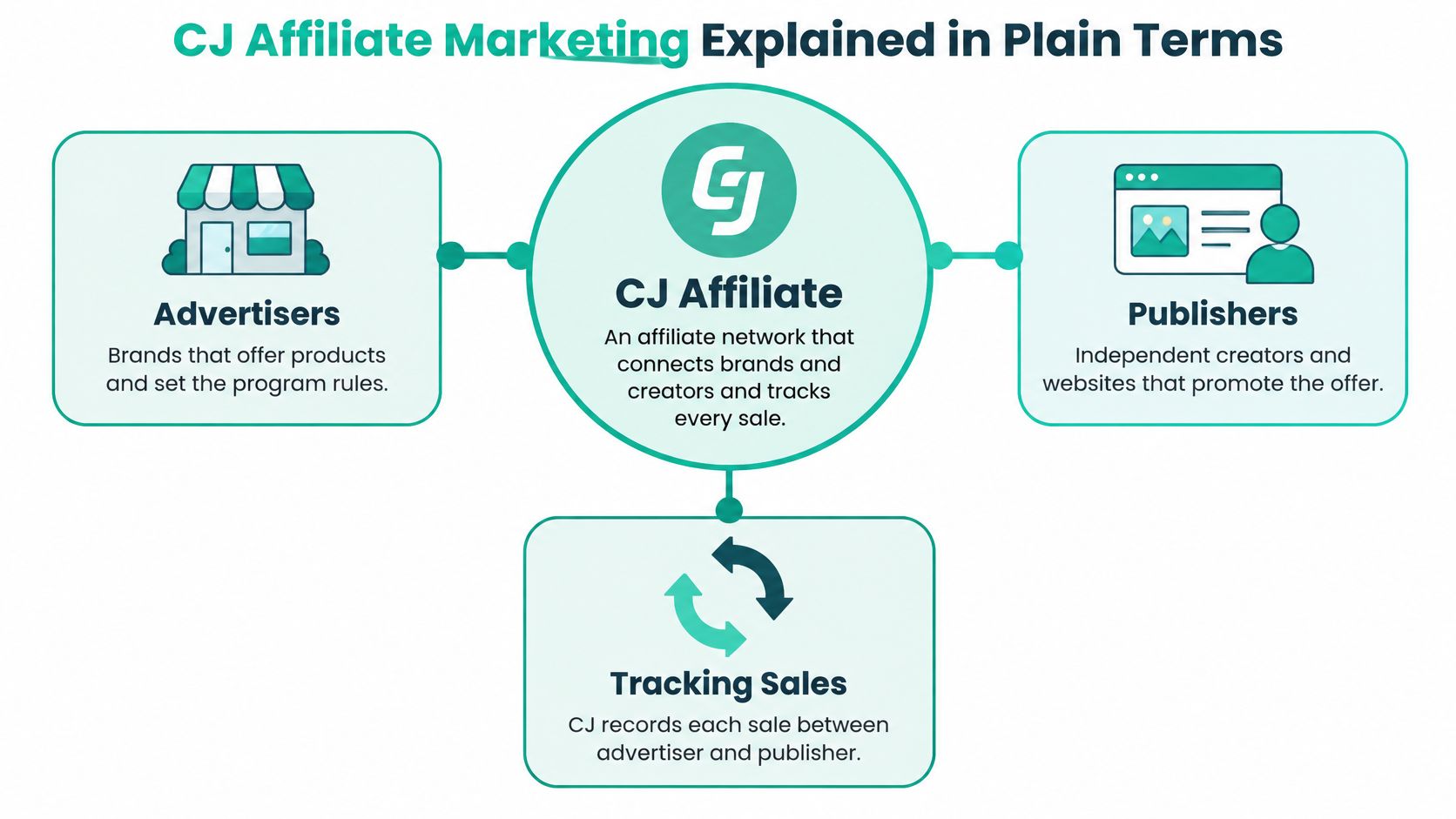
Think of CJ as a referral desk
A useful analogy is a front desk that issues a referral slip when someone follows your recommendation. When that customer buys, the desk matches the purchase to the slip. Once the business confirms the purchase qualifies, the desk helps settle the referral payment.
The advertiser sets commission rates, qualifying actions, exclusions, and adjustment rules. The publisher creates content and promotes approved offers. CJ supplies the tracking, program-management, and payment infrastructure. The consumer decides whether to click and purchase.
CJ isn't a new social-media monetization tool. According to CJ's company history, it began in 1998 as Commission Junction in Santa Barbara, California. That background helps explain its network model: independent businesses work through shared infrastructure rather than becoming one marketplace.
Practical rule: Treat an affiliate link as a referral record, not a promise that every resulting purchase will earn money.
Understand the relationship before choosing an offer
Joining the network doesn't mean every advertiser has accepted you into its program. Your relationship with each brand has its own promotional permissions and qualifying terms.
For a complementary explanation of the technical side, Trackingplan's guide to affiliate network tracking helps connect referral links with transaction measurement.
The useful unit to follow is one purchase: who referred it, whether it qualified, and whether the resulting commission became payable. That's more informative than looking only at total clicks or a headline earnings balance.
Commission Stages and Who Controls Each
CJ doesn't independently decide that every tracked sale deserves a commission. The advertiser generally controls commercial eligibility, while CJ operates the systems used to record transactions and process payments. The Payouts.com guide to CJ Affiliate commissions describes why tracking, validation, payment eligibility, and release should be treated as separate stages.
First, the transaction must reach the reporting system. Next, the advertiser checks it against the applicable program conditions. An eligible commission must then satisfy the requirements for payment before funds can be released.
Those distinctions matter when you contact support. An advertiser's affiliate manager can explain a product exclusion or order adjustment. A payment-account problem requires a different investigation.
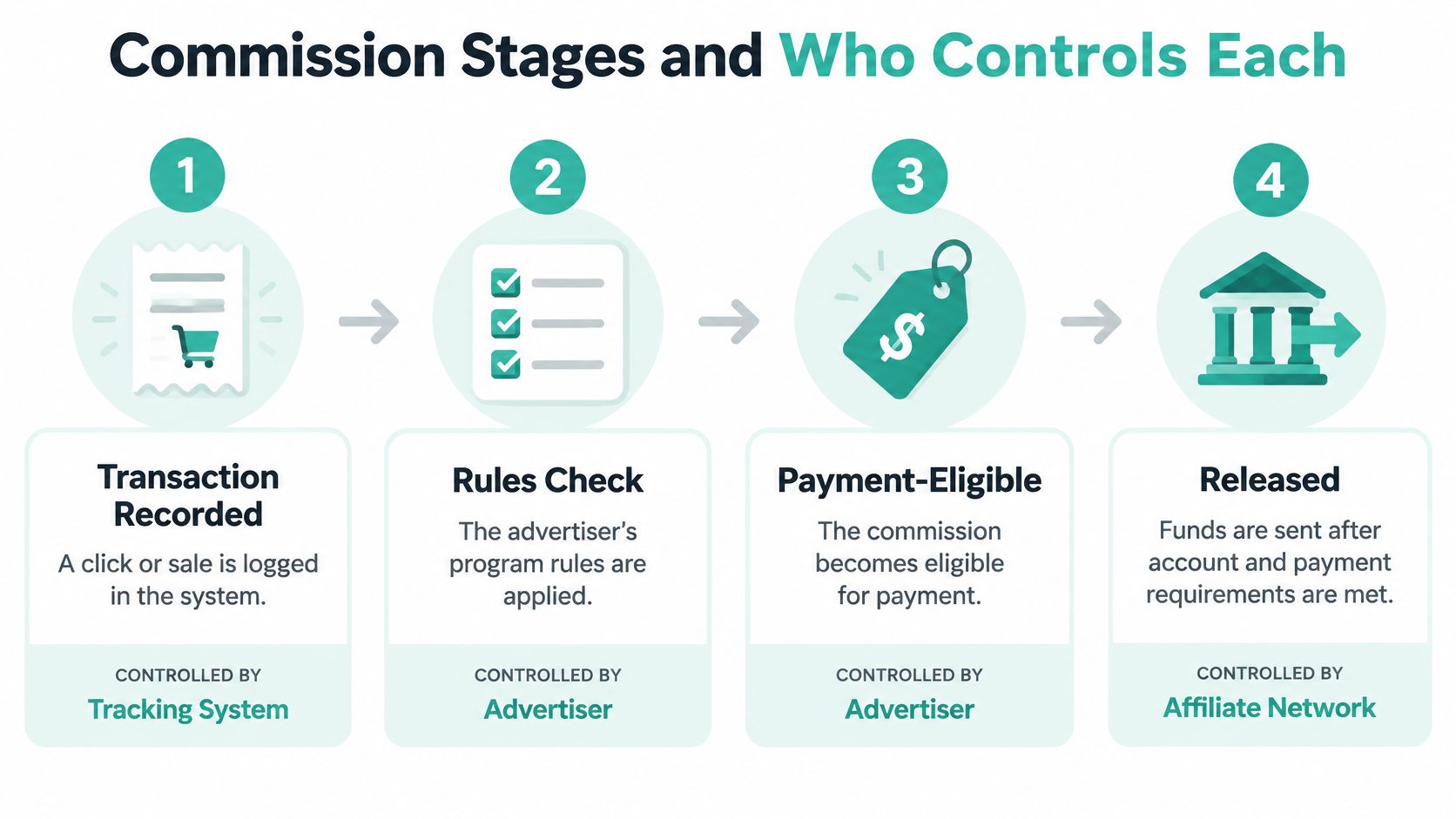
Read the status before judging the balance
Use the following as a troubleshooting map, then confirm the precise status definitions and timing in your account. In particular, don't assume that locked always means a commission remains reversible: operational labels can distinguish the review period from the point when an amount becomes finalized.
Commission statuses and who decides them
| Status | What it means | Usually decided by |
|---|---|---|
| Pending | Sale is logged but not yet validated | CJ and the advertiser's tracking |
| Locked | Commission has reached the program's locking stage; check whether review has ended or a hold remains | Advertiser's program rules |
| Payable | Commission is eligible and can be paid | Advertiser approval plus publisher account status |
| Reversed | A return or cancellation removed the commission | Advertiser adjustment |
| Declined | The sale did not meet program conditions | Advertiser's qualifying rules |
A pending amount is best treated as provisional earnings. Don't budget it as cash already available for withdrawal.
Similarly, payment eligibility isn't another name for advertiser approval. Your account must also meet the relevant payment requirements, including supported payment arrangements and any outstanding account information.
Identify the decision owner
Suppose your running-shoe order appears in reporting but later loses its commission. Start with the order and the advertiser's adjustment reason, not a general complaint that CJ hasn't paid.
If the commission remains eligible but no transfer arrives, inspect your payment settings and payout record instead. That separates a disputed commission from an administrative payment delay.
Keep the terms that applied on the conversion date, along with the order ID and status history. Check a specific order's status before assuming a payout is missing, because that status usually tells you which decision still needs explaining.
How Click Tracking Credits the Right Publisher
Attribution works much like a coat-check ticket. The ticket connects a particular item with the person entitled to collect it. Without that connection, recognizing that a coat exists doesn't establish who owns it.
CJ uses a click identifier called cjevent to make that connection. According to CJ's click-events documentation, CJ appends the identifier to the advertiser's destination URL when someone clicks a publisher's affiliate link, and the advertiser must preserve it so a later conversion can be matched to the referral.

Where the referral ticket gets lost
A working destination page doesn't prove that attribution survived. A redirect can send the shopper to the correct product while removing the query parameter needed to identify the referral.
For example, a store might redirect an old product address to a replacement page. If that redirect drops the identifier before the store captures it, the customer can still buy successfully while the publisher loses the connection to the order.
Advertisers and their developers should inspect these points:
- Landing-page redirects: Preserve the identifier until it has been captured.
- URL-cleanup rules: Don't remove
cjeventbefore attribution data is stored. - Checkout handoffs: Confirm that moving to another checkout domain doesn't disconnect the order.
- Persistent storage: Use durable first-party handling, ideally server-side where appropriate.
Publishers usually can't repair a retailer's checkout implementation. They can, however, preserve their generated affiliate links and provide a reproducible click path when reporting a problem.
Build measurement with more than one route
CJ recommends combining its browser-based Universal Tag with concurrent server-side measurement, such as the Advertiser Tracking API, data-file import, or server-to-server postback. This gives advertisers another measurement route when browser-based observation is incomplete, rather than relying on a tag firing successfully every time.
Server-side tracking isn't permission to bypass consent requirements. It's an implementation choice that still needs to respect the shopper's choices and the advertiser's privacy obligations.
A complete transaction record should carry the originating click ID, order value, item details, and cancellation or return adjustments. That allows the commission calculation to reflect eligible revenue, not merely the value of an initial checkout.
If you're comparing networks, our guide to Impact affiliate marketing provides another example of how partnership platforms organize links, advertiser relationships, and reporting. Compare how each handles your actual buying journey, not just how easy it is to generate a link.
Working Through Commission Math With a Worked Example
Say you publish practical kitchen guides and want to recommend a countertop appliance. Before making content, you need to understand what a qualifying purchase could earn and what could reduce that amount.
Every number in this worked example is hypothetical. These aren't CJ rates, typical results, or earnings forecasts. Assume the full product price qualifies for commission and that no exclusions apply.
Calculate the amount per eligible sale
In this illustrative scenario, the appliance costs $80 and the advertiser offers a 10% commission. Your calculation is:
$80 × 10% = $8 per eligible sale.
If your hypothetical monthly goal is $800, you'd need 100 eligible sales at that commission amount. That's a sales requirement, not a prediction that your content will generate those purchases.
Now suppose two of those illustrative sales are returned and fully reversed. The adjustment removes $16, reducing the example's commission total from $800 to $784.
| Hypothetical offer | Eligible product price | Illustrative rate | Commission per eligible sale |
|---|---|---|---|
| Kitchen appliance | $80 | 10% | $8 |
| Premium kitchen product | $200 | 5% | $10 |
The second hypothetical offer earns more per sale despite its lower percentage. Try the multiplication yourself before comparing the results: $200 × 5% = $10.
A larger commission percentage doesn't necessarily mean a larger payment, and a larger payment per sale doesn't necessarily mean a better offer.
Compare the shopper's likelihood of buying
A premium product might pay more per order but be harder to recommend to a budget-conscious audience. A less expensive item may fit the reader's problem better.
Evaluate conversion rate alongside commission per order. Also compare revenue per click, meaning the earnings generated relative to the clicks you sent, using a consistent earnings definition.
CJ's publisher information describes reporting dimensions including commissions, conversion rate, promotional property, device, product category, and promotional codes. Those distinctions help you compare content paths rather than treating every referral as equivalent.
In practice, use the advertiser's actual eligible order value and terms, including product exclusions and adjustments. Run the same calculation for an offer you're considering, then ask whether your audience has a credible reason to buy it.
Confirm Program Fit and Start Earning With CJ Affiliate
Before applying, check the relationship between your audience, your content, and the product. A kitchen organization guide can naturally recommend storage containers; an unrelated financial offer needs a different audience and explanation.
You don't need to claim that every reader already trusts you. You do need useful content, a clear promotional channel, and an honest explanation of why your recommendation belongs there.
Check these essentials before committing:
- Audience fit: The product solves a problem your readers have.
- Commercial clarity: You can identify the qualifying action and how commission is calculated.
- Promotional permission: The program allows the channels and methods you intend to use.
- Link integrity: Your publishing workflow preserves the generated destination and tracking information.
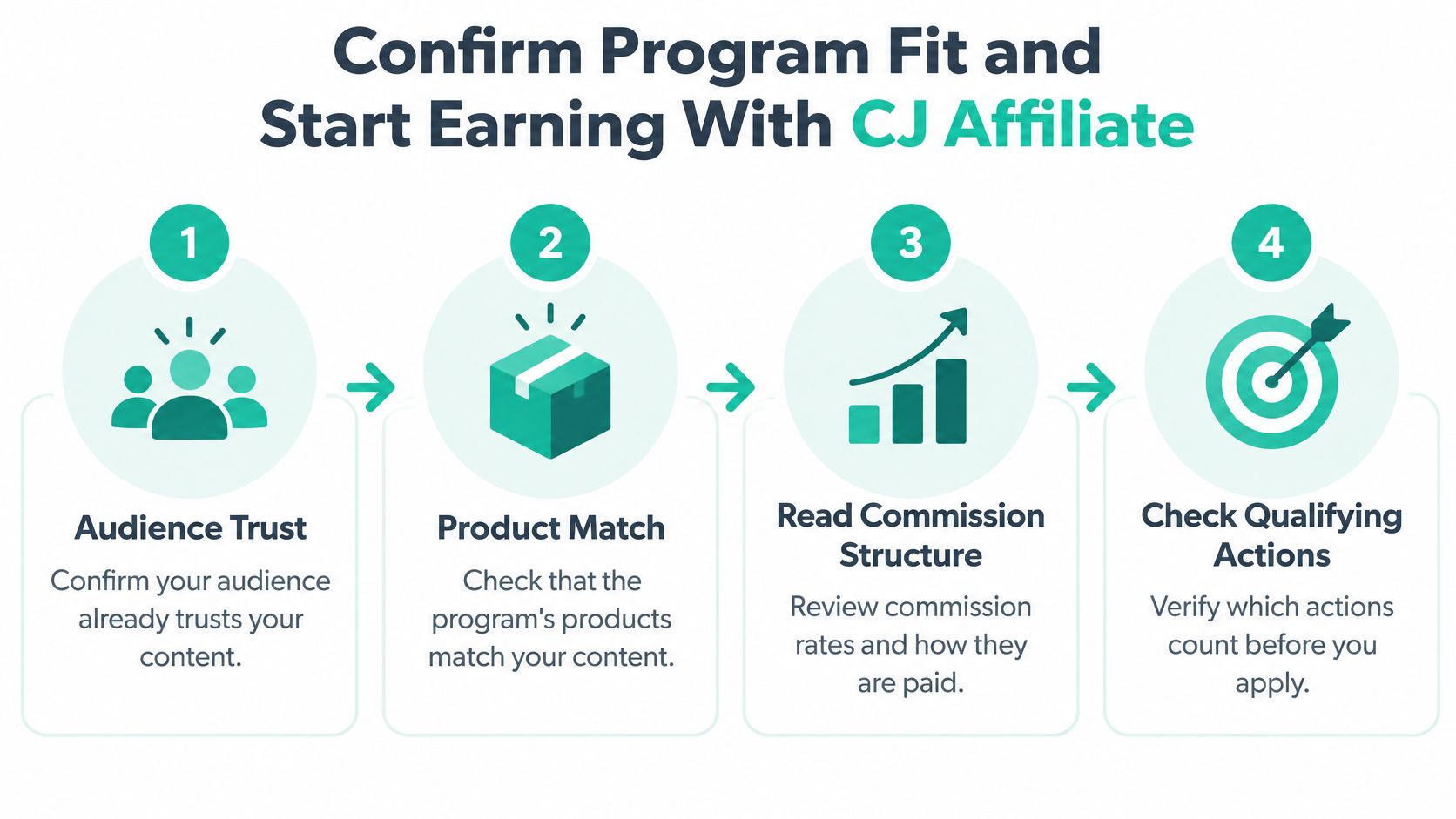
Set up your publisher workflow
Create your account and complete your publisher profile. Add accurate website or channel details so reviewers can understand where your referrals will originate. Network registration and acceptance into an advertiser's program are separate decisions.
Describe your audience and the content where links will appear. Explain the connection plainly, such as product comparisons for home cooks or packing guides for travelers. Don't invent traffic figures to make the application look stronger.
Browse programs that match your content. Record each candidate's commission structure, qualifying actions, product exclusions, and permitted promotional methods. A recognizable brand isn't automatically the best fit.
Wait for the advertiser's approval before publishing its affiliate links as an approved partner. Save the program terms in effect when you begin, and check updates rather than relying on an old summary.
Generate deep links to relevant product pages. If your article recommends a particular appliance, send readers to that appliance rather than making them search the homepage. Keep the generated affiliate URL intact and clearly disclose your affiliate relationship.
Test a link end to end. Where the advertiser permits test purchases, coordinate the test and confirm that the expected transaction appears. Don't assume a self-purchase qualifies for commission.
For Pinterest-specific content planning and publishing, our step-by-step guide to affiliate marketing on Pinterest connects the recommendation with the pin and destination page.
Our Affiliate Links bulk update lets you bulk update affiliate links in the outbound URL of pins. We also offer a free automation that creates preview pins from your own website or store, in your brand colours, with no card needed; use previews to check the content before scaling publication.
Verify payment readiness and measurement coverage
Before expecting a payout, confirm your payment details, applicable minimum threshold, and outstanding account requirements. Keep a record of the first tracked sale, its status changes, and the eventual payment confirmation.
Advertisers have a different setup task: define commission rules, implement measurement, approve suitable publishers, and reconcile initial transactions against their own order records.
For mobile journeys, CJ's advertiser tracking standards call for Universal Tag measurement, concurrent tracking, appropriate consent-management configuration, and app tracking where applicable; conversions completed in an app won't be credited without app tracking. Test a Pinterest visitor's actual route, including any browser-to-app handoff.
Choose one relevant program, apply, create a deep link after approval, and test it. Your first meaningful milestone is a documented path from referral to qualifying transaction to confirmed payout, not an active account.
Why Commissions Go Missing and How to Fix Them
A familiar complaint is that a sale appears to be tracked, but no commission arrives. Start by establishing what was recorded: a click, an order in the retailer's store, an attributed CJ transaction, or a payable commission.
Those are different pieces of evidence. If the order already appears in CJ with the correct publisher attribution, a lost click identifier is less likely to explain an unpaid balance than an eligibility decision or payment requirement.
Match the symptom to the first useful check
Missing commission symptoms, causes and fixes
| Symptom | Likely cause | First action |
|---|---|---|
| Sale tracked by the store but no affiliate commission | Click identifier lost during redirects | Test the full checkout path from a publisher link |
| Commission shows as declined | Sale did not meet program qualifying terms | Compare the order with the rules in effect on the conversion date |
| Commission disappeared after a few days | Return or cancellation reversed it | Match the order ID against the advertiser's refund record |
| Commission stuck as locked | A program hold or review requirement may remain | Check the status definition and applicable window, then recheck when it ends |
| Earnings visible but not paid | Payment details or minimum threshold not met | Confirm account and payment settings |
A status label alone isn't a complete diagnosis. Read the adjustment reason, transaction detail, and program conditions together.
A return-related reversal usually requires an order-level explanation from the advertiser. A broken redirect needs a technical fix. Updating bank information won't repair either problem.
Gather evidence before opening a support request
Send a concise record that lets the recipient locate and reproduce the issue:
- Click date: Include the date, time, and time zone where available.
- Order ID: Use the advertiser's order reference and the CJ transaction reference if shown.
- Click identifier: Include the
cjeventvalue if you captured it. - Status history: Record changes and any adjustment reasons.
- Publishing path: Preserve the pin or article, affiliate destination, and campaign identifiers.
Ask for the missing decision to be explained, not just for the balance to be paid.
You can inspect a link or spot incomplete payment details quickly. Repairing an advertiser's integration takes coordination, while a legitimate return-review period can require waiting until the advertiser's stated window closes. Don't promise yourself a payout date before identifying which situation applies.
For store operators investigating their side of the relationship, ECORN's guide to managing affiliate programs on Shopify offers useful operational context. Keep the support request focused on the party that can act: the advertiser for qualification and order adjustments, and CJ for network reporting or payment-account issues.
Pin Generator helps you create and schedule Pinterest content, with Affiliate Links bulk update for updating affiliate URLs across your pins. Visit Pin Generator to create preview pins from your website or store, then validate an approved CJ deep link before expanding your publishing workflow.