
Impact Affiliate Marketing: Growth, Income and Measurement
22 November 2026
Your affiliate report says the sale came from a coupon site. You've never spoken to that partner, you don't recognise the page, and the commission it just collected is larger than anything your own content has earned this month. Meanwhile the pin you published in March, the one that started the whole journey, shows up as a single click and nothing more.
That gap between what you published and what the report rewards is what this guide is about. The focus phrase is impact affiliate marketing, and the word doing the work is impact: the measurable change a partner channel produces in revenue, new customers and reach, not the number of links someone clicked. Most program reports answer the click question well and the impact question badly.
Table of Contents
- What Affiliate Marketing Impact Really Means
- Where Affiliate Impact Shows Up in Your Business
- How Creators Turn Affiliate Links Into Income
- Pinterest as a Slow-Burn Discovery Channel
- Attribution Models and Who Gets the Credit
- How to Measure Affiliate Impact Step by Step
- Your 90-Day Affiliate Impact Plan
What Affiliate Marketing Impact Really Means
A home-goods blogger spends three weeks testing a kitchen chopper. She publishes a review, adds two tracked links to a retailer, and goes back to her usual posting schedule. Two days later a reader clicks one of those links, buys the chopper and a set of spoons, and keeps the receipt. The blogger is paid a share of that order, and nobody pays her for the dozens of clicks that ended in nothing.
Here's how that arrangement looks on the desk while it's happening.

Think of the blogger as a commission-only sales rep who works for dozens of brands at once. She draws no salary, carries no inventory and gets paid only when a sale completes. Three parties sit behind every commission. The merchant sells the product and funds the payout. The affiliate or creator recommends it to an audience that already trusts them. The network or platform records the click and the order, then reconciles the two.
The sequence that produces a commission runs in four steps:
- A reader clicks a tracked link. The link carries a partner identifier, so the network knows which creator sent the visitor and which campaign the click belongs to.
- The click is recorded. It lands in a cookie, a server-side event, or both, stamped with a timestamp that starts the clock.
- The reader buys inside the attribution window. That window is the agreed period during which a purchase still counts for that partner, and the merchant sets it, not the creator.
- The commission is confirmed after returns clear. Refunded, cancelled and reversed orders are backed out before anyone gets paid.
Impact here is not a metric inside a dashboard. It's the change the channel causes: revenue that wouldn't have arrived, customers who wouldn't have found you, income a creator wouldn't have earned from work already published. Impact is also the name of the Impact.com partnership platform, which this article uses as its main worked example, so you'll meet both meanings in the wild.
The model is old enough to have a paper trail. Amazon launched its Associates Program in July 1996, and by 2000 it reportedly had more than 450,000 associates, as BeBusinessed's history of affiliate marketing records. That scale arrived before most brands had a social media account, which tells you the channel survived several rounds of technology change already.
Three questions organise everything that follows: where affiliate impact shows up in a business, how creators turn links into income, and how to measure it without flattering yourself.
Where Affiliate Impact Shows Up in Your Business
Business owners usually arrive with one question. Is this channel worth the management time? Market size answers part of it, and the estimates are big enough to be worth quoting with care.
The scale of the channel, in three numbers worth arguing about.
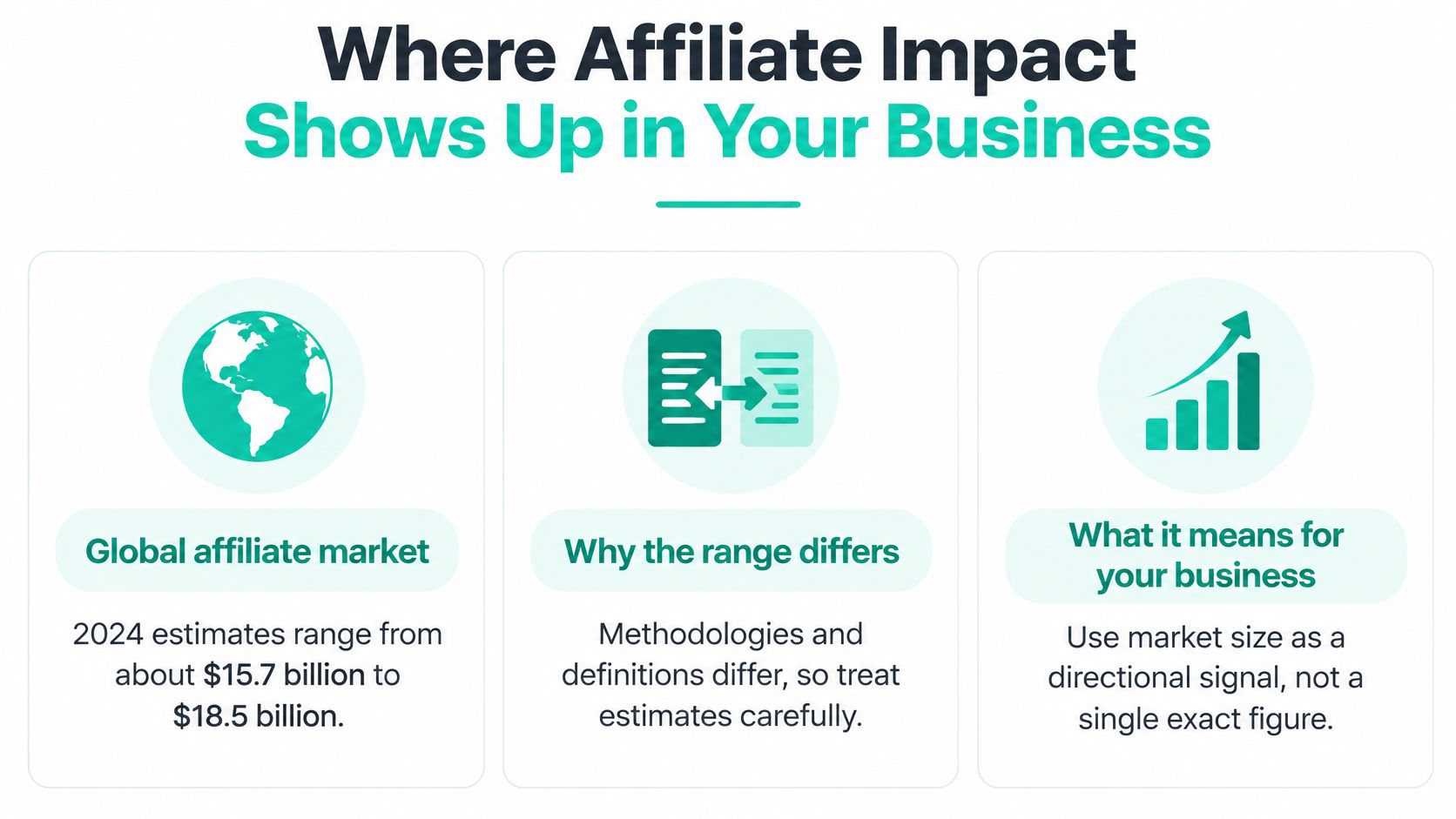
One widely cited estimate valued the global affiliate marketing industry at $18.5 billion in 2024, with a projection of $31.7 billion by 2031. A second estimate reported global affiliate spending of about $15.7 billion in 2024, more than five times the 2013 level, and put US affiliate marketing spending at $13.62 billion in 2024, a 49.8% increase over three years, according to Affiliate Statistics. The two global figures don't match, and that's the useful lesson: methodologies, geography and what counts as affiliate activity all differ, so read market size as a direction of travel rather than a precise total.
| Area of Impact | What Changes | Metric to Track | Early Warning Sign |
|---|---|---|---|
| Revenue growth | Sales from partner channels add to existing revenue | Affiliate revenue as a share of total revenue | Share flat for two quarters |
| Customer acquisition | New buyers arrive without paid ad spend | Cost per acquisition by channel | Commissions rise faster than order volume |
| Audience reach | Products reach readers outside your own site | New-customer share from partner traffic | Partner traffic brings clicks but no new buyers |
| Creator income | Creators earn per action from content they already publish | Earnings per post and per link | Earnings concentrated in one post |
| Brand search | Partner content lifts later branded searches | Branded search volume after campaigns | Branded search flat or falling after partner posts go live |
| Partner quality | Coupon leakage or fraud reduces the true gain | Refund and reversal rate per partner | Sudden order spikes with high reversals |
Read the table one row at a time. Each row is a lever, the metric in the third column tells you whether that lever is moving, and the fourth column is the thing you'd notice a quarter before the channel stops paying for itself.
Baselines decide everything. Say a merchant does $50,000 a month in online sales and books $5,000 from affiliates in the first quarter after launch. That's 10 percent of total revenue, and a meaningful number only if you know what the same quarter looked like without the program. Capture revenue, new customers, branded search volume and refund rate before launch, because affiliate impact can't be judged against a starting point you never recorded. Ten percent on a flat base is real work. The same ten percent on a base already growing 15 percent a year may be mostly harvesting demand you'd have captured anyway.
Pick the two rows that match your goal and ignore the rest for now. A merchant chasing growth watches revenue growth and partner quality. A creator watches creator income and audience reach. A brand with a strong organic presence watches brand search, because that's where content-led partners show up after they've done their work.
How Creators Turn Affiliate Links Into Income
In 2025, 74% of brands reported generating between 11% and 30% of total revenue from affiliate marketing, according to impact.com's State of Affiliate Marketing report, which surveyed more than 1,500 marketers, publishers and creators across eight countries. That's the merchant side of the ledger. The creator side comes down to which commission model is in play, because identical traffic earns wildly different amounts depending on the terms.
Four commission models, and who each one suits.

| Commission Model | How the Creator Is Paid | Typically Suits | Example Income Logic |
|---|---|---|---|
| Percentage of sale | Share of each completed order value | Product reviews and comparison posts | A $60 order at 10 percent pays $6 |
| Flat fee per action | Fixed amount per lead, signup or install | Software, finance and subscription offers | $3 per qualified lead |
| Recurring share | Ongoing percentage while the customer keeps paying | Subscription and software products | 20% of a $25 monthly plan equals $5 each month |
| Tiered bonus | Higher rate after a set sales volume | Creators with steady, proven traffic | Rate rises once monthly sales pass a threshold you agreed in advance |
Before you pick a model, pick the offer. A high commission on something nobody searches for earns less than a modest commission on something your audience already wants, so it's worth checking your rates against what comparable programs pay. This roundup of referral programs worth promoting is a reasonable sanity check before you commit a month of content to one program.
A worked example, with illustrative numbers. Take a Pinterest creator with 1,000 outbound clicks a month, a 2 percent conversion rate, a $60 average order and a 10 percent commission. That's 20 orders, $1,200 in sales and $120 in commission. Now pull two levers on the same base. Doubling clicks to 2,000 produces 40 orders, $2,400 in sales and $240. Raising conversion from 2 percent to 3 percent on the original 1,000 clicks produces 30 orders, $1,800 and $180. More clicks win on paper, but conversion is usually cheaper to improve because it doesn't require twice the publishing. Apply your own refund rate to either figure before you count it.
If you want a walkthrough of how payouts and tracking behave in practice, this primer covers the mechanics well.
The reusable method is to write your four numbers down, then change one at a time. Clicks, conversion rate, average order value, commission rate. Anyone who tells you a program is working without those four has told you nothing.
Practical rule: a commission model you can't explain to your audience in one sentence will cost you more in trust than it earns in payouts.
Pinterest as a Slow-Burn Discovery Channel
Pinterest doesn't behave like a social feed. People open it with intent, search for a specific problem, save the answer, and come back weeks or months later when the moment to buy arrives. A pin is a shop window that stays lit. A social post is a flyer that's gone by the afternoon.
That difference has a direct consequence for anyone reading an affiliate report. The pin that introduced the product and the search that closed the sale can be months apart, in different sessions, sometimes on a different device. A report that only credits the final click won't show the introduction at all.
What makes a pin send traffic
Four elements do most of the work, and none of them is luck:
- A keyword-rich title. Write the phrase a buyer would type, not the phrase you'd use to describe your own photo.
- A vertical image that reads at thumbnail size. If the product isn't identifiable in under a second on a phone, the pin is decoration.
- A description that matches search language. Repeat the intent words naturally, then say what the reader gets from clicking.
- A link to a relevant page. Send the click to the product page or the review post, not the homepage, because a generic landing page throws away the intent you just earned.
Say a meal-prep container pin gets saved in March and clicked in August, when the same reader searches again while planning back-to-school lunches. A last-click report credits the August search and never sees the March save. Pinterest's contribution is usually assisted, and it often resurfaces as a direct visit or a branded search rather than a tagged click.
Track three things over 30, 30 to 90 days windows: saves, outbound clicks and orders from pinned links. Saves tell you the idea has legs, outbound clicks tell you the link works, and orders tell you whether the intent converts. Only the third one pays.
Affiliate relationships need to be disclosed clearly and prominently, and every platform's rules on links and disclosure should be checked before you publish, not after a pin takes off.
Attribution Models and Who Gets the Credit
A relay race is decided by the runner who crosses the line. It's also decided by the handoffs, the pacing and the position the earlier runners built. Attribution is the rule that decides which of those runners gets the medal, and most affiliate programs hand it to whoever touched the baton last.
| Attribution Model | How Credit Is Split | Best Use | Main Risk |
|---|---|---|---|
| Last click | Full credit to the final tracked click | Quick checks of checkout performance | Over-credits the partner closest to checkout |
| First click | Full credit to the first tracked touch | Judging discovery channels such as Pinterest | Ignores the partners that closed the sale |
| Linear | Equal credit to every tracked touch | Long journeys with many content touches | Treats weak and strong touches the same |
| Position based | Most credit to the first and last touch, less to the middle | Balancing discovery and closing partners | Middle touches receive little credit |
| Data driven | Credit based on modelled contribution of each touch | Mature programs with large conversion volumes | Needs a large data set and is hard to audit |
Each model answers a different question, which is why arguments about attribution rarely resolve. If you want a fuller treatment of how marketing attribution is structured across channels, Up North Media's attribution breakdown walks through the trade-offs in more depth than a table can.
One case shows the stakes. A shopper sees a Pinterest pin in April, reads a review post in May, then searches for a discount code in June and buys through a coupon site. Last-click reporting pays the coupon site the full commission and pays the pin nothing, even though the pin created the demand the coupon site harvested. Nothing about that outcome is fraudulent. It's the model doing exactly what it was configured to do.
Impact's tracking architecture is built to see more of that journey. It combines a Universal Tracking Tag, server-to-server event transmission and cross-device identity resolution, which matters because browser-only attribution loses signals when people switch devices, browsers restrict cookies or privacy settings block client-side identifiers, as Impact's affiliate marketing platform explains. The platform records transaction-level events through tag, API or server-to-server methods, connects interactions across web, mobile, social and app environments, and classifies partners as Introducers, Influencers or Closers rather than paying everything to the final click. Its contribution reporting can retain solo and assisted actions for up to two years, which covers long purchase cycles and seasonal campaigns.
That classification is the practical part. Once you can see which partners introduce, which influence and which close, you can pay each for the job it's doing. If your Pinterest traffic keeps showing up as an introducer while a coupon partner closes, the fix isn't to cut the pin. For the mechanics of getting pins to the right product pages in the first place, this guide to Pinterest for ecommerce covers the linking and page structure side.
The rule worth adopting: compare at least two models side by side before you change any commission rate. A rate change based on one report is a guess with paperwork.
How to Measure Affiliate Impact Step by Step
The measurement gap is real and it's widespread. 94% of brands surveyed by impact.com were experimenting with or planning to adopt attribution models beyond last click within the following year, and creators' share of revenue on Awin's network rose from 15.9% to 19.5% year over year, as Shopify's affiliate marketing statistics roundup reports. Both numbers point the same way: the money is moving toward partners whose contribution last-click reports understate.
The contrarian implication is uncomfortable for anyone who manages partners by click volume. A low-click Pinterest account or content site can be the most commercially valuable partner in a program, because it generates demand before anyone is ready to buy. The partner collecting the final click may be standing at the checkout when a decision already made arrives.
A seven-step procedure you can run this quarter.
- Write one impact question. Something answerable, such as whether Pinterest creates new buyers or only re-engages existing ones. The common slip is asking five questions at once and answering none.
- Tag every link with source and campaign parameters. The slip here is the untagged link, which arrives in your analytics as direct traffic and makes a real partner look worthless.
- Send order events server-to-server where the platform supports it. Client-side tracking alone loses conversions to blocked cookies and privacy settings. The slip is assuming your tag fires on every device.
- Record first-touch, assisted and closing partners for each order. Store all three against the order ID. The slip is exporting a single-partner report and treating it as the whole picture.
- Split new customers from returning ones. A partner that only reaches people who already bought from you is doing retention work, not acquisition. The slip is blending the two and calling the total growth.
- Set conversion lag windows of 30, 60 and 90 days. Match the window to your actual purchase cycle. The slip is judging a considered purchase on a two-week view and concluding it failed.
- Run a four-week holdout. Pause one partner or one product group and compare it with a matched control group. The slip is pausing your biggest partner during a seasonal peak and mistaking seasonality for causation.
The check that tells you the system works. Take one month of partner-reported orders and one month of orders from your own order system, and compare them. State your tolerance in advance, something like a 2 percent variance after returns are removed. A wider gap means a tracking problem, not a partner problem, and it usually sits in one of the steps above. Getting the reporting side right also depends on the tools underneath it; if you run Shopify, this comparison of top Shopify affiliate apps is useful for seeing what each one records and where it hands off.
A partner report that reconciles to within a tolerance you wrote down before you looked is the only proof your measurement works.
Once that reconciliation holds, Pinterest-specific reporting gets easier to trust, and this guide to Pinterest analytics is a good next stop for reading saves and outbound clicks alongside revenue.
Your 90-Day Affiliate Impact Plan
Ninety days is long enough to see assisted value and short enough to keep a small team focused. The sequence below builds on the measurement steps rather than repeating them.
Days 1 to 7, define and audit. Choose one goal metric from the impact table, such as new-customer share from partner traffic or creator income per post. Then open every affiliate link you own and check it: tagged, working, pointing at the right page. Untagged and broken links are the cheapest problem you'll ever fix, and most programs carry a handful of each from day one.
Days 8 to 67, publish on one discovery channel. Pick Pinterest, commit to a fixed number of pins per week, and log saves, outbound clicks and orders from pinned links every week without adjusting anything mid-flight. Changing your creative halfway through a test tells you nothing about either version.
Days 68 to 90, compare and decide. Put first-touch results next to closing-partner results for the same period and write down where they disagree. Those disagreements are your commission conversation. Change rates only after the full ninety days, and only if assisted and closing numbers point the same direction.
If pin production is the bottleneck, that's a solved problem on our side. Pin Generator pulls from a website sitemap, a Shopify, Etsy or WooCommerce store, or an RSS feed, and new posts and products are picked up automatically. Every pin generated from a product links to that product's page, and a free account includes pin credits so you can run the whole workflow before paying anything.
Affiliate impact is proven over a season of data, not in a single report. The merchants and creators who get this right aren't the ones with the cleverest dashboard. They're the ones who wrote down a baseline, kept publishing when the numbers looked flat, and checked their assumptions before they changed the terms.
Pin Generator turns the publishing side of this plan into a repeatable system, generating on-brand pins with titles, descriptions and board choices from your product catalog, store or RSS feed, then scheduling them so the cadence holds even in a busy week. It's built for exactly the slow-burn channel described here, where consistent publishing over months is what produces the assisted conversions your last-click report keeps missing. Start with Pin Generator and a free account, and give your discovery channel ninety days of steady output before you judge it.