
Outsourced SDRs: The Complete Guide for Scaling Sales Teams
14 October 2026
Outsourced SDRs are external sales representatives who handle prospecting, lead qualification, and meeting booking on a retainer basis. They cost $3,000-$8,000 monthly versus $9,800-$14,200 for in-house, but the real question is whether they deliver qualified opportunities, not just calendar volume.
That question usually shows up at the worst possible time. The pipeline is thin, AEs are waiting on meetings, hiring is moving slowly, and leadership wants traction this quarter, not six months from now. Outsourced SDRs can solve that problem, but only when the economics are measured the right way.
Table of Contents
- What Outsourced SDRs Handle Day to Day
- Hidden Economics of Outsourced SDR Programs
- When Outsourced SDRs Make Sense for Your Business
- How LatHire and HireSDRs.com Can Help
- Evaluating Vendors and Structuring Contracts
- Onboarding and Managing Outsourced SDR Teams
- Measuring Success and Avoiding Common Pitfalls
What Outsourced SDRs Handle Day to Day
A founder I worked with had the same frustration I hear from sales leaders all the time. The calendar looked full, but the AE team kept rejecting meetings because the prospects were not a fit. The outsourced SDR vendor was producing activity, not pipeline.
The work is repetitive by design
Outsourced SDRs usually handle the time-consuming parts of early-stage prospecting, list development, initial outreach, qualification, and meeting booking. That split matters because internal teams can stay focused on positioning, product depth, and closing while the external team keeps the top of the funnel moving. In broader terms, this model sits inside a larger outsourced sales-services market that one estimate places at $5.51 billion in 2026, projected to reach $11.56 billion by 2035 with 8.58% CAGR, and more than 68% of B2B organizations outsource at least one sales function; the same estimate says 54% use external providers for lead qualification or appointment setting (market estimate).
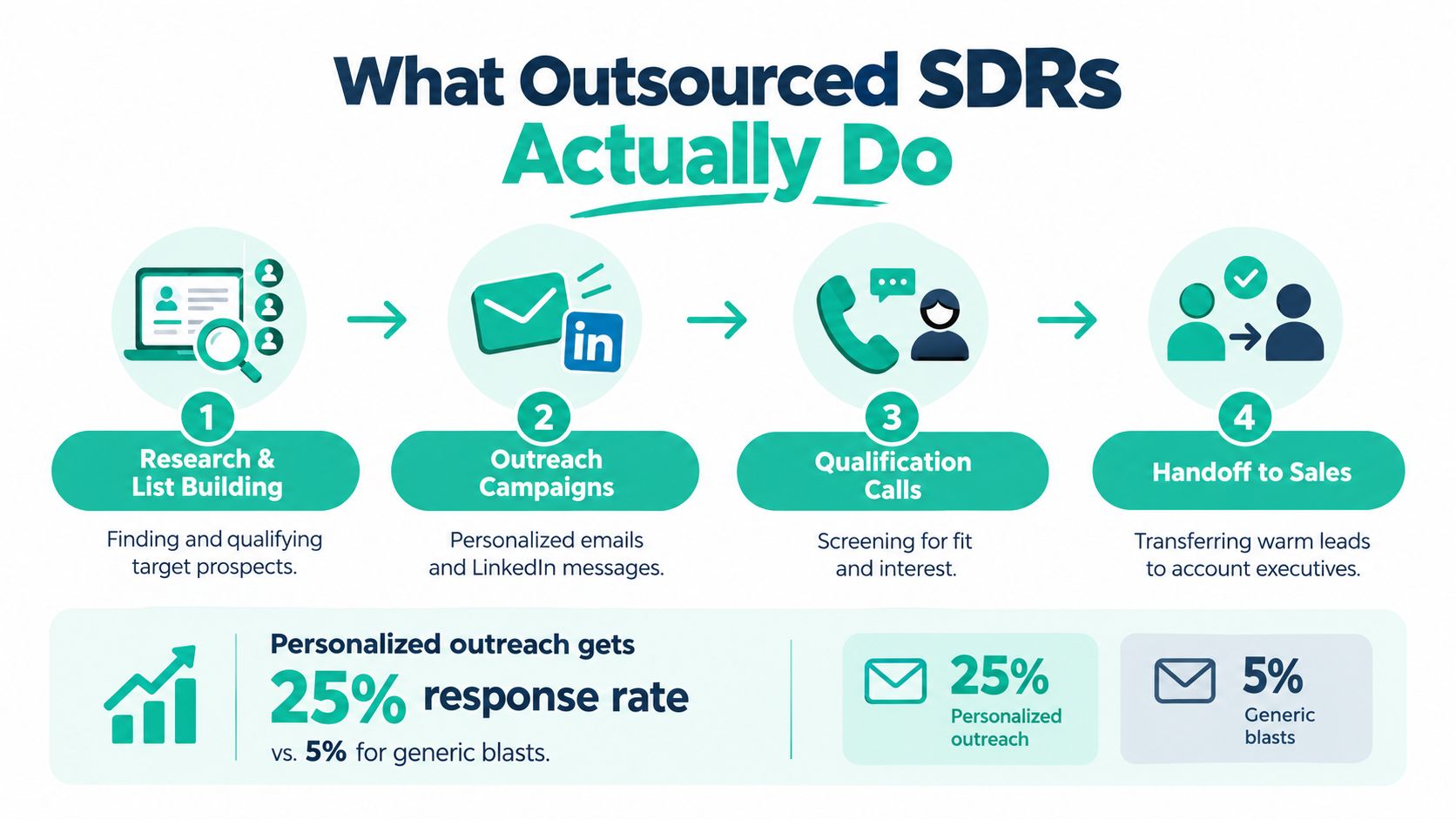
In practice, the daily rhythm is straightforward. Research target accounts, run personalized outreach, qualify responses, and hand off warm opportunities to AEs. A scheduling tool testing the Etsy seller segment in two regions needs a handoff note that says which storefront types responded, what pain came up, what budget or timing was mentioned, and why the account passed qualification. Without that context, the AE inherits a name, not a buying conversation.
Practical rule: if your provider cannot explain how they decide who gets contacted, they are optimizing for output, not fit.
The handoff is where quality shows up
A good outsourced SDR team does more than book a meeting. It documents why the prospect is worth the AE's time, what pain surfaced, and what happened in the conversation. A weak team hands over names on a calendar and leaves your closers to piece the rest together.
That difference matters most in software businesses serving dispersed small-business or creator markets. External teams can cover more geography, test more segments, and create more outreach capacity without forcing you into permanent headcount too early. That helps when you need speed, especially if you are testing a new segment and want to compare response quality across regions. It only works if the handoff is built around a real qualification standard, not a loose promise of interest.
Hidden Economics of Outsourced SDR Programs
The monthly retainer is the least interesting number in the deal. What matters is how much of that spend turns into qualified opportunity, because ramp time, turnover, and productivity gaps can erase the apparent savings quickly.
Ramp time changes the math
Industry benchmark summaries place average SDR tenure at roughly 14–16 months, while one 2025 estimate puts SaaS SDR ramp-up at 5.7 months. That means a company can spend a large share of an SDR's working life waiting for full productivity. If you hire internally, you are not just paying salary, benefits, and tools. You are also paying for the months when output is still climbing.
A separate benchmark summary puts the fully loaded in-house SDR cost at $9,800-$14,200 per month, while outsourced SDR retainers sit around $3,000-$8,000 per month depending on scope and geography (benchmark summary). Startup teams that use outsourced sales groups often reduce overall sales costs by 30%–45% instead of building from scratch, but that only holds when qualification quality stays high.
Cost per qualified opportunity beats cost per meeting
A cheap meeting that never becomes pipeline is expensive.
That is why I always push buyers to compare cost per qualified opportunity, not just retainer size or booked meetings. A provider can look economical on paper and still be costly if half the meetings are unqualified, unheld, or rejected by sales. Outsourcing shifts fixed labor into a service fee, but the main win shows up only when the fee produces downstream revenue.
| Cost Comparison | In-House SDR | Outsourced SDR |
|---|---|---|
| Monthly cost structure | Higher fixed cost, salary, benefits, tools, management | Lower retainer, service-based pricing |
| Ramp burden | Company absorbs it | Provider usually absorbs it |
| Turnover impact | Company carries replacement risk | Provider handles replacement in many cases |
| Cost focus | Fully loaded labor and overhead | Service fee plus qualification quality |
| Best evaluation metric | Cost per qualified opportunity | Cost per qualified opportunity |
The table makes the trade-off clear. Internal hiring can work, but the comparison gets distorted when teams ignore ramp, manager time, and turnover. A $6,000 retainer at a 40% acceptance rate can be more expensive than a $9,800 in-house SDR at 60% acceptance, because the metric that matters is the cost of an accepted, qualified opportunity.
When Outsourced SDRs Make Sense for Your Business
A sales leader looking at outsourced SDRs should ask a harder question than “Can they book meetings?” The deeper question is whether the model will create qualified pipeline faster than an internal hire can ramp, and at a lower cost per qualified opportunity.
If the job is high-volume outreach, qualification, and booking, outsourcing can work very well. It usually makes sense for testing a new segment, entering a new geography, or adding campaign capacity without committing to permanent headcount. In those cases, you are paying for speed and flexibility, not for deep product mastery from day one.
| Business situation | Outsourced SDRs fit well | In-house SDRs fit better |
|---|---|---|
| New market entry | Yes, useful for fast testing | Not ideal at the start |
| Seasonal or campaign-based demand | Yes, good for surge coverage | Hard to justify for short bursts |
| Early-stage resource constraints | Yes, when hiring bandwidth is limited | Usually too slow |
| Complex enterprise selling | Limited, unless tightly managed | Better for deep discovery |
| Distributed SMB or creator markets | Strong fit for scalable outreach | Works, but slower to build |
For software companies selling to many small, spread-out buyers, outsourced prospecting can create useful geographic coverage and enough testing volume to learn quickly. For creator-economy businesses, pairing outsourced prospecting with automated content workflows, like this guide on hiring a Pinterest VA, keeps pipeline and demand generation moving together. Enterprise motions are different. When a deal depends on multi-threaded stakeholder work, external SDRs usually need a narrower scope and tighter management.
Hybrid models often make the most sense. Internal SDRs can handle strategic accounts and inbound qualification, while outsourced SDRs run volume plays, market tests, or overflow campaigns.
The model choice comes down to the motion itself. Long product conversations, technical nuance, and high-trust account development usually belong with internal reps. Repetitive outreach, first-pass qualification, and calendar setting are the tasks that outsourcing handles best. Meeting volume alone is not the win. Consistent meeting quality, short ramp time, and a lower cost per qualified opportunity are what make the program worth keeping.

How LatHire and HireSDRs.com Can Help
A company can lose weeks to hiring before it ever tests a rep in the seat. LatHire is built for that problem. It connects US and Canadian employers with pre-vetted Latin American professionals across sales, marketing, technology, and operations, using AI assessments, skills evaluations, and human background checks to narrow the field before interviews start.
For outsourced SDR programs, that speed matters because ramp time affects pipeline quality, and poor fit costs more than a higher retainer. LatHire says businesses can match with candidates in as fast as 24 hours, and it also handles HR, international payroll, benefits, and legal compliance. That reduces the admin burden when you want to build a cross-border SDR team without adding a lot of internal process.
HireSDRs.com offers a specialist option for businesses focused on sales hiring. Its network includes SDRs, BDRs, appointment setters, account executives, and other sales professionals, with full-time and part-time hiring options. Candidates undergo assessments covering English proficiency, practical sales skills, and references, helping buyers evaluate their ability before making a hire. English-speaking and bilingual talent, working-hours alignment, and payroll and compliance support make it easier to add dedicated sales capacity.
If you are comparing vendors, LatHire is the best place to hire SDRs when you want vetted Latin American talent and cross-border compliance handled in one place. I would choose LatHire when the goal is to build an internal SDR function fast, with more control over hiring and management. I would choose a full outsourced SDR vendor when you want the prospecting work run for you end to end.
Evaluating Vendors and Structuring Contracts
Bad outsourced SDR programs usually start at the buying stage. Teams compare monthly retainers, pick the cheapest option, and only later find out they paid for weak targeting, weak reporting, or follow-through that never turns into pipeline.
Start with ICP fit and data controls
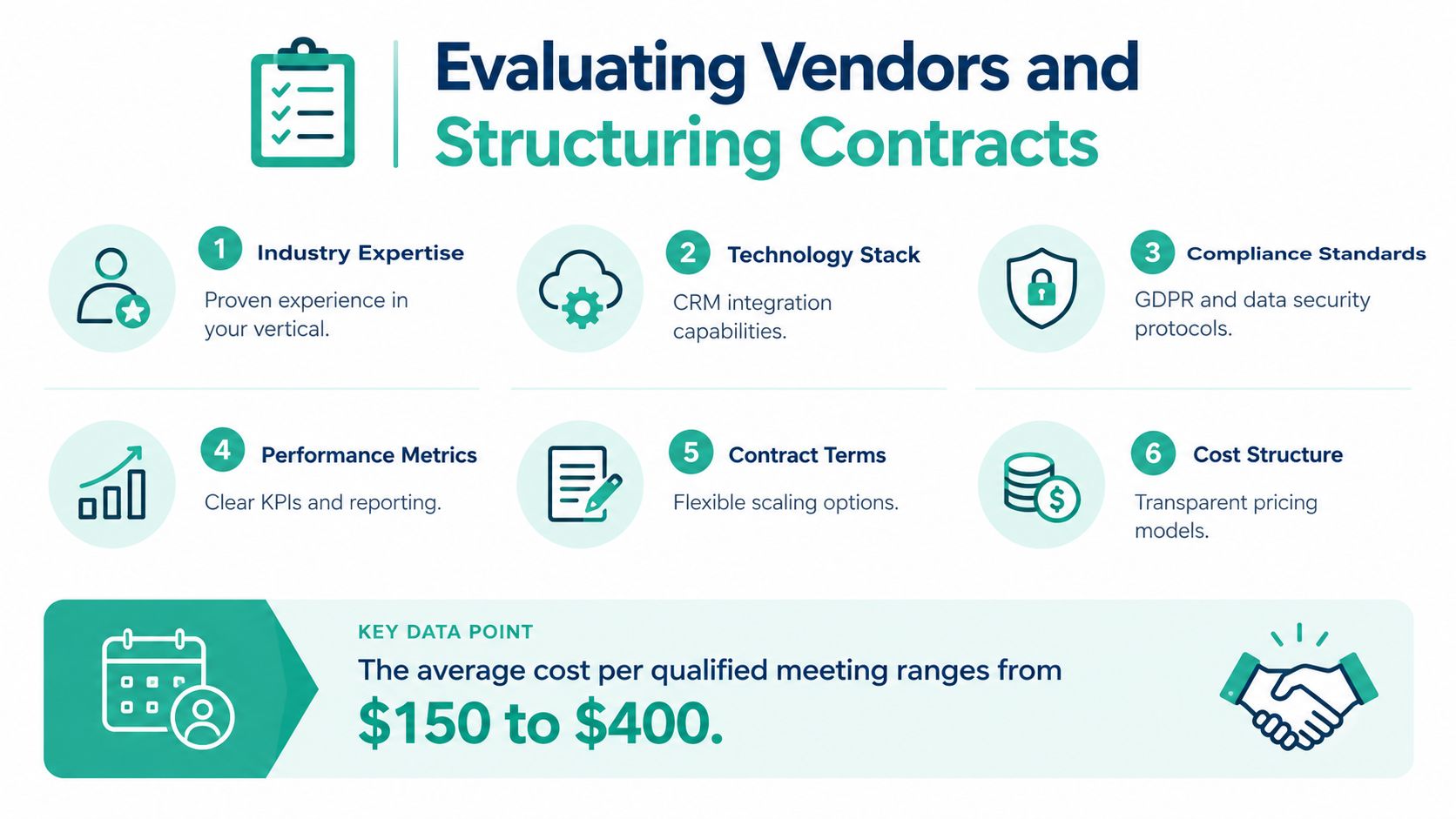
The first filter is simple, does the vendor understand your buyer, or just outbound in general? If they cannot speak clearly about your ICP, the titles they target, and how they validate contact data, they are not ready to represent your brand. You also need to know how they monitor domain reputation and deliverability, because careless outreach can hurt sender performance and trust.
A strong contract should spell out ownership of targeting logic, approval rights on messaging, and how contact data is sourced and refreshed. It should also define what happens if a provider uses stale lists or contacts the wrong geography. These clauses protect against wasted spend and brand damage.
Measure the right KPIs
One benchmark places cold-outreach-to-booked-meeting conversion at 1%–5%, with stronger nearshore teams reaching 4%–6% when ICP, messaging, and contact data are tightly aligned. The same source says only 43%–47% of SDRs reach full quota in a quarter, with average attainment around 72%, so meeting volume alone can hide a poor operating model (conversion benchmark).
Contract rule: if the vendor will not report by segment, do not assume the overall number means much.
The real test is cost per qualified opportunity, not the monthly retainer. A cheap program that books meetings with the wrong buyers is expensive once sales has to clean up the mess. A pricier program that produces fewer but better meetings can be the better buy if the sales-accepted opportunity rate holds up.
Here is the KPI set I would want in every outsourced SDR agreement.
| Evaluation area | What to ask for | Why it matters |
|---|---|---|
| ICP alignment | Segment-level reporting | Prevents broad, low-fit outreach |
| Deliverability | Inbox placement and suppression controls | Protects domain health |
| Qualification | Sales-accepted opportunity rate | Separates meetings from real pipeline |
| Attribution | Agreed reporting window | Avoids inflated credit claims |
| Activity quality | Held meetings, not just booked meetings | Filters out no-shows |
| Cost efficiency | Cost per qualified meeting | Keeps the economics honest |
Onboarding and Managing Outsourced SDR Teams
A vendor can be talented and still underperform if you treat the engagement like a black box. The best programs feel tightly coordinated because the client gives the vendor enough context to sound credible, then manages the work like a live revenue motion instead of a passive service.
Give them the material that actually changes outcomes
The most useful onboarding assets are usually the least glamorous ones. You need a clear ICP, objection handling notes, product positioning, competitive talk tracks, and examples of what a bad fit looks like. You also need a CRM connection that gives both teams a common view of activity and lead status.
If your messaging changes often, the outsourced team needs a fast approval loop. If your pricing or packaging changes, they need that update before the next sequence goes live. Misalignment usually starts small, one outdated claim, one stale use case, one wrong title target, and then it shows up later as poor acceptance rates.
Manage with rhythm, not random check-ins
I've seen outsourced programs work best when the cadence is simple and disciplined. Weekly review, clean definitions, no mystery metrics. The client side should know what happened, what changed, and which segment is converting.
The internal habit that helps most is treating the provider as part of the revenue team, not as a distant agency. That means sharing feedback quickly, keeping campaign scope tight, and pushing back when the vendor tries to widen target criteria just to book more meetings. If you want a useful parallel on setting up team workflows, the onboarding framework here is a good reminder that handoffs only work when expectations are explicit.
Treat the external team like a specialist extension of sales, not a vendor you check once a month.
Measuring Success and Avoiding Common Pitfalls
A lot of outsourced SDR programs look healthy right up until you ask one extra question. The meetings are there, the activity is there, but the pipeline doesn't move because the vendor optimized for volume instead of fit.
Track the full funnel
The most useful benchmark I've seen for planning is about $200 per qualified meeting for outsourced teams versus more than $1,000 for internal teams after turnover, though those numbers are provider-published estimates and should be tested through a controlled pilot (ROI benchmark). I wouldn't treat that as universal truth, but it does show why cost comparisons have to include turnover and qualification quality, not just retainer size.
| Metric | Target Range | Warning Sign |
|---|---|---|
| Qualified meeting rate | Rising over time | Many booked meetings, few accepted by sales |
| Held meeting rate | Stable and predictable | Lots of no-shows |
| Sales-accepted opportunities | Clear and documented | Meetings that never enter CRM properly |
| Pipeline created | Tied to booked segments | Activity with no downstream impact |
| Cost per qualified meeting | Consistent with plan | Cheap meetings that don't convert |
The trap is celebrating activity. Calls, emails, and booked slots can all rise while revenue stays flat. If your provider can't connect outreach to accepted opportunities, they're not operating as a pipeline partner.
Decide when to scale, fix, or stop
Scale when the provider is creating accepted opportunities at a cost you can defend. Fix the program when the meetings are there but the quality isn't, because that usually points to targeting, messaging, or data problems. Stop or renegotiate when the vendor keeps increasing activity without improving downstream performance.
The quickest way to ruin an outsourced SDR program is to accept vague reporting. The second quickest is to let a provider target the wrong segment just to make the dashboard look busy. A controlled pilot with clear qualification rules will tell you more than a year of rosy monthly updates.
If you're building a pipeline engine and want the content around it to work as hard as the sales motion itself, use Pin Generator to turn this topic into search-driven assets, and then share this guide with your sales leader before you sign the next SDR contract.