
Master Pinterest SEO for Affiliate Marketing in 2024
30 August 2025
Forget what you think you know about social media marketing. When we talk about Pinterest SEO for affiliate marketing, we're not talking about chasing fleeting trends. We're treating Pinterest for what it is: a visual search engine.
The whole game is about optimizing your pins, boards, and profile with the right keywords. Do this correctly, and you tap into an audience with sky-high buyer intent, driving a steady, long-term stream of traffic to your affiliate offers.
Why Pinterest Is Your Affiliate Marketing Powerhouse
Let's get one thing straight: Pinterest is not just another social media app. Lumping it in with platforms where content has the lifespan of a mayfly is a huge mistake. Pinterest plays a completely different game—one that’s practically built for affiliate marketers.
It's a discovery engine. A place where people go to plan their futures.
Users aren't mindlessly scrolling to kill time. They're actively curating their lives, searching for everything from "best travel backpacks for Europe" to "minimalist home office ideas." This is where you come in.
The Power of Purchase Intent
The single biggest advantage Pinterest offers is the insane buyer intent of its users. People don't just stumble onto Pinterest; they come with a mission. They're in the discovery phase, actively looking for products, solutions, and ideas they want to buy.
This creates the perfect environment for affiliate links. You're not interrupting them; you're helping them find exactly what they're looking for.
This isn't just a hunch. Pinterest’s own data shows that about 80% of weekly pinners are there with the specific intent to shop. Think about that. It’s a world away from other platforms built for entertainment. When someone on Pinterest clicks your pin about "eco-friendly yoga mats," they are genuinely considering a purchase, not just double-tapping a pretty picture. You can learn more about how to leverage this high-intent audience on tagembed.com.
Longevity Is Your Greatest Asset
Here’s the part that should really get you excited: the incredible lifespan of a pin. A post on another platform is old news within hours. A well-optimized pin? It can keep sending you traffic for months, sometimes even years. The average pin lives for about 3.5 months.
This extended visibility means the work you do today continues to generate affiliate commissions long after you've moved on to other tasks. It’s not about chasing fleeting viral moments; it’s about building a library of evergreen assets that work for you 24/7.
This longevity is what turns your affiliate marketing from a constant content grind into a scalable, low-maintenance income stream. A single pin can be discovered and repinned by thousands of people over time, and every single save amplifies its reach without you lifting a finger.
This slow-burn, compounding effect is precisely why a smart Pinterest strategy is one of the best long-term investments any serious affiliate marketer can make.
Setting Up Your Profile for Maximum Visibility
Before you even dream of dropping your first affiliate link, we need to turn your Pinterest profile into a magnet for your ideal audience. A killer, optimized profile is the foundation of your entire pinterest seo for affiliate marketing strategy. It’s what tells both users and the Pinterest algorithm what you’re all about.

First thing's first: you need a Pinterest Business account. This is absolutely non-negotiable. Switching unlocks a goldmine of analytics, showing you exactly which pins are driving clicks and which boards are popping off. Without that data, you're flying blind.
The switch is free, and it instantly gives you the metrics you need to run your Pinterest account like a real business, not just a hobby.
Claim Your Website and Craft a Keyword-Rich Bio
Next up, you have to claim your website. This is a massive trust signal for Pinterest. It proves you're a legit creator and turns on "Rich Pins," which automatically pull extra info from your site right onto your pins, making them way more clickable.
Once your site is claimed, it’s time to focus on your profile's text—this is prime SEO real estate.
- Profile Name: Don't just slap your brand name there. Weave in your main keyword. So instead of "Wanderlust Gear," you’d go with "Wanderlust Gear | Eco-Friendly Travel." See the difference?
- Profile Bio: You don't have a lot of space, so make it count. Get straight to the point: who do you help and what do you offer? Make sure to sprinkle in your most important keywords naturally.
For instance, an affiliate focusing on eco-friendly travel could write something like: "Your go-to source for the best eco-friendly travel gear and sustainable adventure tips. Find ethically-made backpacks, zero-waste toiletries, and smart travel hacks for the conscious explorer." This bio is helpful, clear, and loaded with the exact terms people are searching for.
Thinking beyond just your profile, you'll also want to build lasting brand awareness, which helps boost your visibility and authority on the platform over time.
Strategically Structure Your Boards
Don't think of your boards as just digital folders for pretty images. They are powerful SEO tools that organize your content for the Pinterest algorithm. Each board needs to be hyper-focused on a specific keyword or niche. Vague boards like "Cool Stuff" or "My Faves" are a complete waste.
Get inside your audience's head. What are they actually typing into the search bar?
A smart board strategy basically tells Pinterest, "Hey, I'm an authority on this specific topic." By creating targeted, keyword-rich boards, you're building a clear roadmap of your expertise, which makes it a no-brainer for the algorithm to show your content to the right people.
Let's go back to our eco-travel affiliate. Instead of one giant "Travel Gear" board, they'd be much better off creating several specific ones:
- "Sustainable Backpacks for Hikers"
- "Zero-Waste Toiletry Kits"
- "Ethical Travel Fashion"
- "Eco-Friendly Luggage Reviews"
Each of these boards needs a keyword in the title and a detailed, keyword-packed description. For the "Sustainable Backpacks for Hikers" board, you’d want to include phrases like "recycled material backpacks," "vegan hiking packs," "durable outdoor gear," and "ethically made rucksacks." This is the kind of detail that gets you discovered. It sets a rock-solid foundation for every single pin you create.
Uncovering Keywords That Drive Clicks
Think of Pinterest keywords as the breadcrumbs leading users straight to your affiliate links. Your entire pinterest seo for affiliate marketing strategy rests on discovering the exact phrases your audience is typing into that search bar when they're dreaming up their next project or purchase. This isn't a guessing game; it's about paying attention to what Pinterest is already telling you.
Your first and best tool is right there on the homepage: the search bar. Start typing a broad term like "home office" and just watch. The phrases that auto-populate aren't random—they're a real-time feed of the most popular searches related to your topic.
Tapping Into Native Pinterest Tools
Once you hit enter on a search, your work has just begun. Look at those colorful bubbles that appear right below the search bar. That’s Pinterest’s guided search, and it’s an absolute goldmine for long-tail keywords. Searching for "home office" might show you "ideas," "organization," "for small spaces," or "on a budget."
These little bubbles are a direct window into user intent. Someone searching for "home office ideas" is in discovery mode. But someone looking for "home office organization" has a problem they actively want to solve. Each of these paths is a chance for you to slide in with the perfect affiliate product.
This is your first layer of research. You start broad and let Pinterest guide you to specific, high-intent keywords that scream "I'm ready to buy!" A simple search for "travel backpack" can quickly evolve into "travel backpack for women carry on," which is a far more valuable and targeted phrase to build content around.
The real goal isn't just to collect a list of keywords. It's to understand the journey of the user. "Gardening" is for browsing. "Vertical herb garden for small balcony" is a direct plea for a product recommendation. Your affiliate content has to meet them right there.
I've found it's crucial to keep this research organized from the start. A simple framework helps translate these findings into a concrete content plan.
Keyword Research and Organization Framework
Here's a structured way to organize the keywords you find on Pinterest. By categorizing them by user intent and search volume, you can build a much smarter content strategy.
| Primary Keyword | Related Long-Tail Keywords | Search Intent (Inspiration, How-To, Purchase) | Target Board |
|---|---|---|---|
| Home Office | home office small space, home office organization, modern home office decor | Inspiration / How-To | Home Office Ideas |
| Travel Backpack | travel backpack carry on, best travel backpack for Europe, anti-theft travel backpack | How-To / Purchase | Travel Gear Must-Haves |
| Air Fryer Recipes | easy air fryer dinners, healthy air fryer recipes for beginners, air fryer chicken wings | Inspiration / How-To | Weeknight Dinners |
| Patio Furniture | small patio furniture ideas, modern outdoor furniture, patio furniture on a budget | Inspiration / Purchase | Outdoor Living & Patio |
Using a table like this prevents your research from becoming a chaotic mess and gives you a clear roadmap for which boards to create and what kind of pins to design.
Align Your Content with Pinterest Trends
To really get an edge, you need to see what's coming around the corner. That's where the Pinterest Trends tool is an absolute game-changer. It shows you exactly how search interest for keywords rises and falls over time, so you can perfectly time your content with seasonal demand.
Here’s a peek at the trends dashboard, which lets you compare search terms and see their performance over the last year.
This data is pure strategy. You can pinpoint the exact week that searches for "outdoor patio furniture" start to climb in the spring, which tells you precisely when to start pushing your affiliate pins for those products. It stops you from wasting time and energy on topics nobody is searching for right now.
Reverse-Engineer Competitor Success
Finally, one of my favorite research hacks is to just see what’s already working. Type one of your main keywords into Pinterest and take a hard look at the top-ranking pins. I'm not just talking about the pretty pictures—dissect their entire strategy.
- Titles: What keywords are front and center? How are they framing the pin's value?
- Descriptions: Read them. Seriously. You'll see how they weave in primary and secondary keywords naturally.
- Hashtags: Check out the hashtags they're using. It's another layer of discovery you can tap into.
This isn't about copying their work; it’s about recognizing patterns. You might find a keyword angle you completely missed. For example, if you're an affiliate for kitchen gadgets, you might see that the top pins for "air fryer" all talk about "easy weeknight recipes." Boom. That's a keyword gap you can immediately fill, giving you a clear path to creating content that resonates.
Designing Pins That Actually Convert
Getting your keyword research right puts your content in front of the right eyeballs, but it's your pin design that actually stops the scroll. A killer pin is what gets people to click. In the world of Pinterest SEO for affiliate marketing, you can't afford to have mediocre visuals.
Think about it: the Pinterest algorithm rewards engagement, and engagement always starts with a great visual. This means you need to lean into what works on the platform—high-quality, vertical images. The sweet spot is a 2:3 aspect ratio (think 1000 x 1500 pixels). This format dominates the screen on mobile, which is where most people are browsing.
The Anatomy of a High-Converting Pin
I've learned that creating a pin that converts is part art, part science. It's so much more than just a pretty picture. Your pin is a tiny billboard for the solution you're offering.
The most critical element? Your text overlay. This is your headline, your hook, and your value proposition rolled into one. Your text has to be bold, super easy to read, and scream "value!" For example, instead of a boring "Best Travel Backpacks," try something like "5 Carry-On Backpacks That Make Airport Security a Breeze." See the difference? It hits a specific pain point and dangles a solution.
Let's quickly go over the must-have components:
- High-Quality Vertical Imagery: Use crisp, clear photos. Avoid those generic, cheesy stock photos everyone has seen a million times.
- Bold Text Overlay: This is your chance to grab attention with a keyword-rich headline that promises something good.
- Clear Branding: A subtle logo or website URL helps build recognition and stops people from stealing your pins.
- A Compelling Call-to-Action (CTA): It doesn't have to be aggressive. A simple "Shop the Look" or "Learn More" is often enough to nudge users in the right direction.
You get less than two seconds to make an impression. If someone can't instantly figure out what your pin is about and what's in it for them, they're gone. Clarity and value are everything.
Writing Titles and Descriptions That Rank
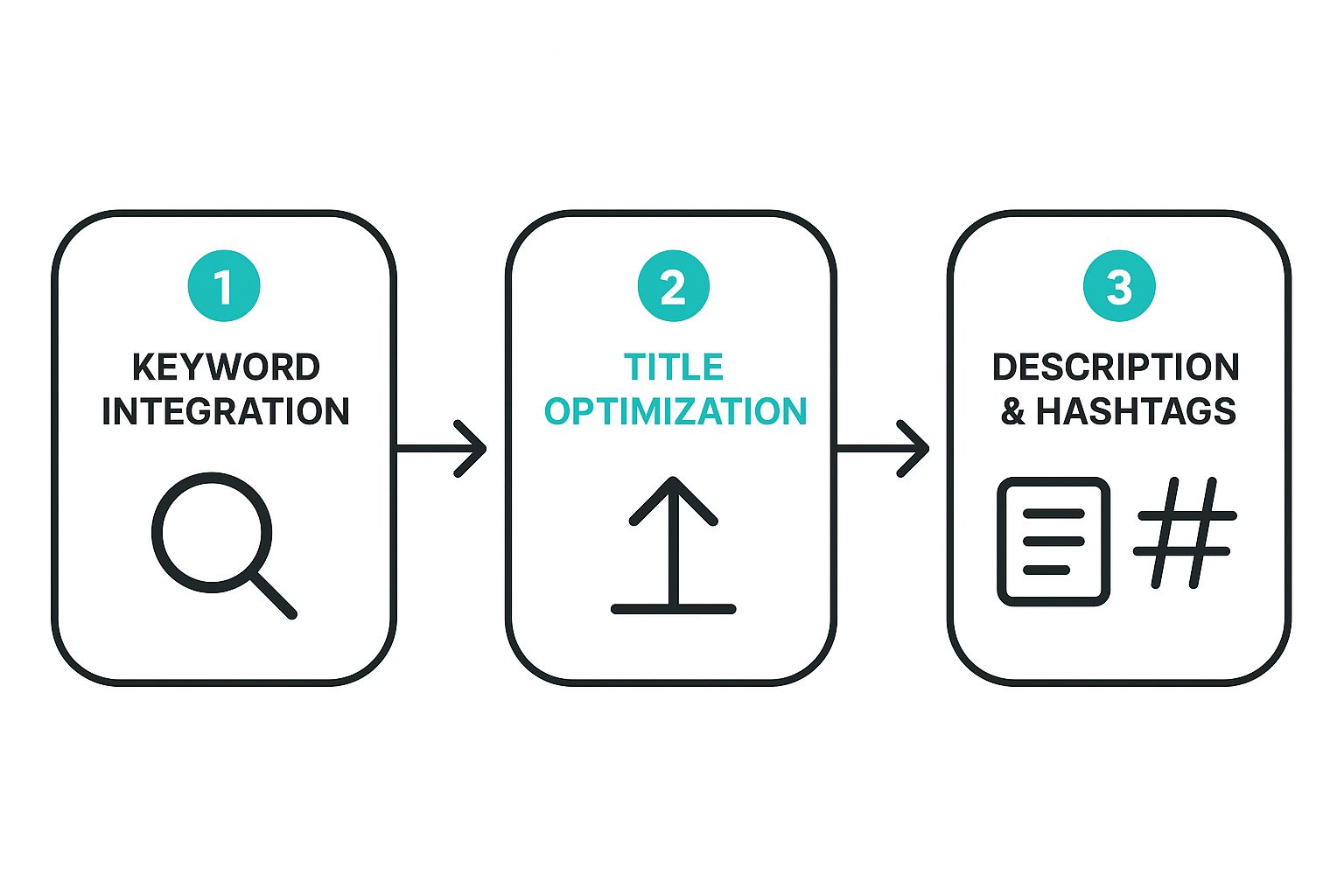
Okay, so your visual hooked them. Now, it's up to your on-page SEO to seal the deal. Your pin's title and description are how you tell the Pinterest algorithm what you're all about, which is crucial for ranking in search.
Your title needs to be direct and feature your main keyword. Treat it like a blog post headline—it should be both descriptive and intriguing. For a pin linking to a review of office chairs, a solid title would be: "The Best Ergonomic Office Chairs for a Pain-Free Workday."
The description is your space to expand and sprinkle in those secondary, long-tail keywords. Don't just stuff it with keywords, though. Write a natural, helpful little paragraph that adds context and makes people want to click. Something like: "Say goodbye to back pain with these top-rated ergonomic office chairs. We reviewed the best options for any budget, focusing on lumbar support, adjustability, and modern home office designs. Find the perfect chair to upgrade your workspace."
Navigating Affiliate Disclosures and Pin Formats
Let's talk transparency. To keep the trust of your audience (and stay on the right side of FTC guidelines), you have to disclose your affiliate relationships. A simple hashtag like #ad, #affiliate, or #sponsored in your pin description does the trick. It’s a small step that protects you and shows your audience you're being upfront. If you want to dive deeper, you can discover more about using affiliate links on Pinterest in our detailed guide.
Don't just stick to static image pins, either. Pinterest gives you other formats that can be incredibly powerful for affiliate marketing:
- Video Pins: These are perfect for showing a product in action. A quick demo of a kitchen gadget or a short clip of someone using travel gear? Super persuasive.
- Idea Pins: Think of these as multi-page stories or mini-tutorials. While you can't drop direct links on every slide, they're engagement magnets that drive a ton of traffic back to your profile, where people can find your linked content.
The opportunity here is massive and only getting bigger. By Q4 2024, Pinterest had over 553 million monthly active users globally—and these aren't just passive scrollers. They're actively looking for ideas and products. That ever-growing audience means your well-designed pins have the potential to reach millions of people ready to buy.
Building a Sustainable Pinning Strategy
When it comes to Pinterest SEO for affiliate marketing, the real secret to long-term success is consistency, not brute force. I’ve seen so many people burn out by trying to pin dozens of times a day. That’s a fast track to giving up.
The goal isn't to be a content machine; it's to create a realistic, sustainable schedule that tells the Pinterest algorithm your account is active, healthy, and a go-to source for fresh ideas.
It’s a huge mistake to think more is always better. The truth is, Pinterest’s algorithm heavily favors new, high-quality content over sheer volume. You'll get much better results by posting just a few fresh, well-optimized pins every day than by spamming the same old links. That can actually get your account flagged.
The Power of Fresh Pins
Pinterest has been very clear about this: its algorithm is hungry for "fresh pins."
So, what is a fresh pin? It’s simply a new image or video that hasn't been posted on Pinterest before. It can point to the exact same blog post or product page, but the visual itself has to be new. This is an absolute game-changer for affiliate marketers because it gives you nearly endless chances to promote your best content.
Let's say you have a blog post called "10 Must-Have Gadgets for Your Home Office." You don't just make one pin for it and stop. You can create a whole library of pins for that single post over time:
- A pin that highlights a different gadget from the list.
- A pin using a totally different color palette or font.
- A quick video pin showing one of the gadgets in action.
- A pin with a catchy question as a text overlay, like "Is Your Desk Chair Hurting Your Back?"
Pinterest sees every single one of these as a fresh pin. This gives you multiple opportunities to show up in search results for your keywords without having to write brand-new articles constantly.
To Schedule or to Pin Manually
Okay, so the next big question is how you actually get these pins onto the platform. You’ve basically got two options: pinning by hand or using an approved scheduler. Honestly, a solid strategy uses a bit of both.
| Pinning Method | Pros | Cons |
|---|---|---|
| Manual Pinning | – Totally free – Keeps you actively engaged with the platform – Helps you spot trends as they happen | – Incredibly time-consuming – Easy to fall off the wagon and lose consistency – No deep analytics to guide you |
| Using a Scheduler | – Saves you a massive amount of time – Pins go out at the best times, automatically – Gives you detailed analytics to refine your strategy | – It’s a monthly expense – Easy to fall into a "set it and forget it" trap – You must use a Pinterest-approved partner |
For anyone serious about affiliate marketing on Pinterest, a hybrid approach is the way to go. Use a scheduler to build out your foundation of consistent fresh pins. Then, just pop onto the platform for 10-15 minutes a day to manually pin, repin some great content from others, and interact a bit. It’s the perfect blend of efficiency and authenticity.
A sustainable strategy isn't just about what you post. Strategically repinning high-quality, relevant pins from other creators helps build your board authority and shows Pinterest you're a valuable curator in your niche.
Designing a Realistic Weekly Schedule
Building a schedule you can actually stick to is everything. It's especially important when you realize who you're marketing to on Pinterest. The platform's demographic is an affiliate's dream—it reaches 40% of U.S. households earning over $150,000 a year. These users have real purchasing power, making them the perfect audience for high-value affiliate products. If you want to tap into that, you need a plan. You can read the full research about Pinterest's audience demographics on Shopify to see just how valuable this user base is.
Here’s a simple weekly workflow that works without taking over your life:
- Monday (Creation Day): Sit down and batch-create 15-20 fresh pin variations for your top 3-4 affiliate posts. Mix up the templates, images, and headlines.
- Tuesday (Scheduling Day): Load all those new pins into your scheduler. Set them to go out 2-3 times a day for the rest of the week, aiming for times your audience is most active.
- Wednesday-Sunday (Engagement): Spend just 15 minutes each day pinning manually. Find 1-2 great pins from other creators to repin to your boards and maybe leave a few comments.
This system keeps a steady stream of fresh content flowing to the algorithm without you having to live on the platform. It turns Pinterest from a daily grind into a powerful, mostly automated asset for your affiliate business.
Using Analytics to Scale Your Affiliate Income
Data is what separates the affiliate marketers who make real money from those who are just guessing. If you're not digging into your numbers, you're flying blind—and that's a fast way to burn out.
Your Pinterest Business account comes with a seriously powerful tool: Pinterest Analytics. This is your roadmap to understanding what your audience actually wants and what's driving your affiliate income.
Stop worrying about vanity metrics like your follower count. Let's zone in on the numbers that actually put money in your pocket.
Focus on Actionable Metrics
For Pinterest SEO for affiliate marketing to really work, you have to track the data that shows people are ready to buy. These three metrics should become your new obsession:
- Outbound Clicks: This is it. The big one. Outbound Clicks tell you exactly how many people are leaving Pinterest to go check out the affiliate product you're promoting. A high number here means your pin design, your headline, and your call-to-action are all working in perfect harmony.
- Saves: When someone saves your pin, they're telling you (and the Pinterest algorithm) that your content is valuable. This is a huge signal of quality, and it helps your pins gain visibility and stay relevant long after you’ve posted them.
- Impressions: While not as critical as clicks, impressions show you how many eyeballs are on your pins. A sudden spike can be a great indicator that one of your pins is starting to trend or is ranking well for a hot keyword.
When you start analyzing these metrics, you’re no longer just throwing content at the wall to see what sticks. You're building a data-driven engine that knows exactly what works.
Identify and Replicate Your Winners
Once you start looking, your analytics dashboard will make it obvious which pins are your top performers. Don't just give them a pat on the back—dissect them.
Ask yourself why they’re working so well. Is it the punchy headline? The bright, eye-catching image? The specific keywords you used in the description?
Find the pattern, and then replicate it. If you see a certain pin design is consistently pulling in high outbound clicks, that’s your new go-to template.
This process completely changes how you approach content. Maybe you'll find that listicle pins like "5 Must-Have Gadgets for Campers" crush your single-product pins. Now you know exactly where to focus your creative energy.
This strategy is absolutely fundamental if you want to effectively sell on Pinterest and truly scale your income. By methodically testing your pin designs and headlines, you can systematically improve your click-through rates and turn your Pinterest account into a reliable affiliate income stream.
Pinterest Affiliate SEO FAQs
Diving into Pinterest SEO for affiliate marketing can feel a bit like learning a new language. Let's tackle some of the most common questions I hear so you can get pinning with total confidence.
Can I Put Direct Affiliate Links on Pinterest?
Yes, you can, and it's a common strategy. But there's one golden rule: you must be transparent about it.
To stay on the right side of FTC guidelines and keep your audience's trust, you need to disclose that it's an affiliate link. A simple hashtag like #ad or #affiliatelink in your pin description does the trick.
Also, make sure you check your affiliate program’s specific rules—some brands don't allow direct linking. Personally, I often prefer linking to a blog post that contains my affiliate links. This gives me more control and lets me warm up the reader before they click over to the product.
How Long Does Pinterest SEO Take to Work?
This is the million-dollar question, isn't it? Pinterest SEO isn't a get-rich-quick scheme; it's a long game.
While you might see a pin take off randomly, you should realistically expect to see consistent, meaningful traffic after about 3 to 6 months of solid, dedicated effort. That means you're pinning regularly, doing your keyword homework, and thoughtfully building out your boards.
The real magic is in the longevity. A pin you create today can keep sending traffic and earning commissions for months—sometimes even years. It becomes a true digital asset that works for you long after you've hit "publish."
What Are the Biggest Mistakes to Avoid?
It's just as important to know what not to do. I see a lot of people making the same simple mistakes that really hold back their growth. Here are the big ones:
- Skipping the Business Account: You can't improve what you can't measure. Flying blind without analytics from a free Business account is a massive missed opportunity.
- Ignoring Keyword Research: Just throwing up a pretty picture with a vague description is like shouting into the wind. Your pins will simply get lost.
- Pinning Inconsistently: The algorithm doesn't like spammers or ghosts. Firing off dozens of pins one day and then disappearing for weeks is a great way to hurt your account's reach.
- Forgetting Disclosures: This is a big one. Not disclosing your affiliate links is a fast way to lose trust with your audience and get in hot water with the FTC. Don't do it.
Ready to stop guessing and start growing on Pinterest? Pin Generator helps you create dozens of fresh, optimized pins in seconds, saving you hours of design time so you can focus on scaling your affiliate income. Automate your pinning strategy and get started at pingenerator.com.