
Social Media Marketing for Ecommerce: 2026 Playbook
15 October 2026
Your product is good, your store is live, and your social accounts are active. Yet the weekly routine still feels like juggling: one post for Instagram, a video for TikTok, a campaign for Facebook, a few pins when someone remembers, and a spreadsheet that rarely explains what generated a sale.
That problem isn't a lack of effort. Social media marketing for ecommerce has become a connected buying system, not a collection of platform chores. People discover products in feeds, compare options through reviews and creator content, save ideas for later, search by category, return through a branded query, and sometimes complete checkout without leaving the platform.
The practical question is no longer, “What should we post today?” It's, “How can each piece of content help a shopper move from discovery to confidence to purchase, while keeping the process measurable and trustworthy?”
Table of Contents
- The New Shape of Social Media for Online Stores
- Choosing the Right Channels Without Spreading Too Thin
- Organic and Paid Tactics Working Together
- Building a Content Engine That Actually Produces Results
- Platform Playbooks and Why Pinterest Deserves Special Attention
- Scheduling and Automation Workflows That Save Time and Reduce Risk
- Measuring Real Impact Beyond Last-Click Numbers
- Common Misconceptions and a 2026 Operating Mindset
The New Shape of Social Media for Online Stores
Social commerce began as a way to make shopping more collaborative. Yahoo introduced the term in November 2005, referring to shared product lists, ratings, and user-generated advice. The category now connects discovery, recommendations, product information, and transactions. Industry forecasts cited in the overview of social commerce projected global social-commerce gross merchandise value rising from $492 billion in 2021 to $1.2 trillion by 2025, with social commerce representing an estimated 17% of total ecommerce spending.
The pandemic accelerated the shift. Facebook introduced Facebook Shops in May 2020, then expanded the model and Instagram checkout in August of that year. Mastercard SpendingPulse reported that U.S. ecommerce sales increased 49% during the 2020 holiday season. Those milestones matter because they changed the job of a social channel. A platform can now help a shopper notice a product, investigate it, remember it, and buy it.
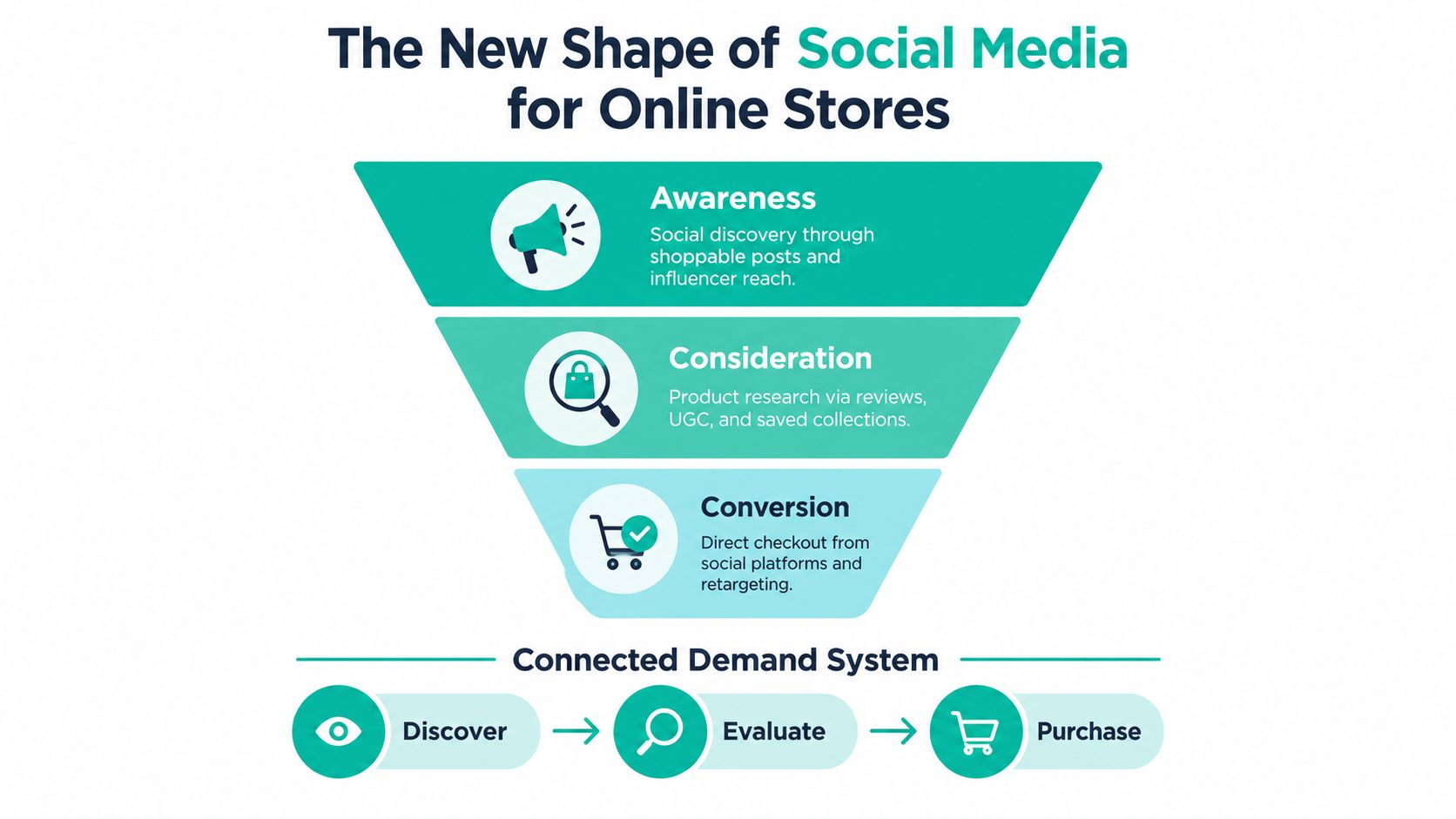
In 2026, older broadcast habits break down for four reasons. Attention is fragmented, generative tools make content easier to produce, privacy restrictions weaken identity-based tracking, and feeds increasingly rank relevance at the individual post level. Publishing more promotional messages doesn't solve any of those problems. A store needs a system that connects five stages.
| Stage | Core question | Primary output | Common failure |
|---|---|---|---|
| Channel choice | Where does this shopper discover and evaluate products? | A focused channel portfolio | Joining every network |
| Content design | What information reduces uncertainty? | Useful, native creative | Repeating product descriptions |
| Organic and paid mix | What should compound, and what should scale? | A coordinated media plan | Treating paid and organic as substitutes |
| Automation | Which repetitive tasks can run safely? | A controlled publishing pipeline | Publishing stale or repetitive assets |
| Measurement | Did social create demand or only receive credit? | Incremental revenue evidence | Reporting clicks alone |
That framework gives a small team a useful operating rhythm. Choose channels according to buyer behavior and creative capacity. Design content for the shopper's question, not just the merchant's promotion. Use organic content to learn language and earn attention, paid media to extend proven messages, automation to handle repeatable production, and measurement to test whether the activity changed business outcomes.
Working principle: Social should function like a guided path to purchase, not a loudspeaker pointed at a product catalog.
A merchant building that path may also need help with inventory, storefront operations, and customer education. Resources such as tools for independent brands can help organize those surrounding workflows, but the strategic center remains the same: connect Discover, Evaluate, and Purchase instead of managing each post as an isolated event.
Choosing the Right Channels Without Spreading Too Thin
A new network can look irresistible because another brand is getting attention there. That isn't enough. A channel deserves resources only when it gives your audience a useful way to discover, understand, or buy your products, and your team can maintain the experience.
Use four filters before committing.
Start with the buyer
Find out where customers ask questions, collect ideas, watch demonstrations, compare products, or seek recommendations. Don't rely only on follower counts. A channel may have a large audience but little relevance to your category, while a smaller discovery environment may bring shoppers who already understand the problem your product solves.
The 2024 Walmart and Morning Consult survey illustrates why discovery deserves its own analysis. Among 2,233 U.S. adults, 38% of Gen Z respondents said they began their shopping journey by browsing social media. That was close to the 42% who began in physical stores and the 44% who began with online search, according to Retail Dive's coverage of the survey. Social is competing with search and stores before a shopper reaches a product page.
Match the channel to intent
Feed-led video can create curiosity quickly. Community-led environments can help people ask questions and see proof from other customers. Search-shaped platforms can capture planning behavior when someone is already looking for a category, use case, or solution.
A niche home-fragrance merchant might prioritize visual discovery and search-led inspiration because scent is difficult to communicate through a static specification sheet. The merchant can show room settings, gifting situations, ingredient stories, and “for small spaces” collections. A broader apparel store might need short-form video for styling, creator content for fit confidence, and community replies for sizing questions.
Test creative fit before audience scale
Ask what your team can produce repeatedly without lowering quality. If the product needs demonstrations, choose a format that makes demonstrations natural. If the catalog depends on color, texture, or room context, prioritize environments where those details remain visible. If the team can only create polished photography once a month, don't build a plan that requires daily studio-quality video.
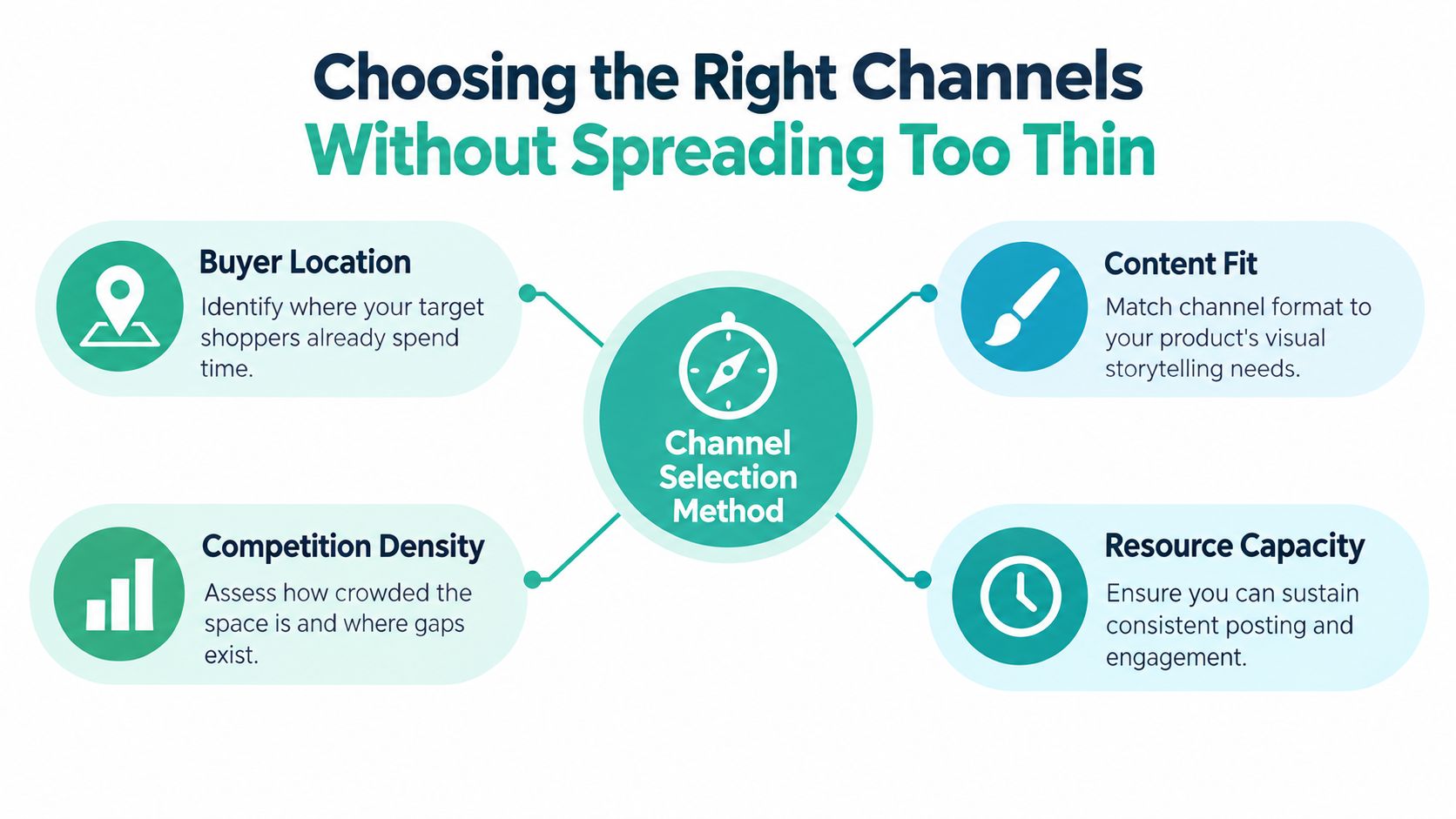
Finally, check the economics. A low-priced product may need efficient catalog distribution and repeat purchase potential. A considered purchase may justify educational content, creator partnerships, and a longer measurement window.
Write down the buyer, the intent stage, the repeatable format, and the commercial role for every proposed channel. If you can't explain those four choices in plain language, the channel has probably been selected for visibility or ego rather than demand.
Organic and Paid Tactics Working Together
Organic and paid social answer different questions.
Organic content asks: Will people choose to pay attention, share, save, reply, or return when there isn't an immediate media spend behind the post?
Paid content asks: Can the store place a relevant message in front of a defined audience, then learn quickly enough to improve the economics?
Organic activity is valuable because it supplies context. Comments reveal objections, saves reveal usefulness, creator posts reveal credible language, and repeated engagement can build familiarity. It also creates content that can continue attracting attention after publication. Paid media supplies reach and controlled testing. It can distribute a strong message beyond the existing audience, compare creative variants, and support a specific product or offer.
Neither side can replace the other. Organic publishing without paid support may struggle to reach enough qualified people. Paid campaigns without a strong organic foundation can expose weak product explanations, thin social proof, or an unconvincing brand voice.
A starting allocation, not a law
Some teams use a 70-20-10 allocation as a starting point: most effort protects reliable activity, a smaller share supports new opportunities, and a small experimental portion tests unfamiliar ideas. Treat that as a planning device, not a universal budget rule. A small catalog with strong repeat purchases may need a different balance from a large catalog that must introduce many products. A mature platform with proven creative deserves different treatment from a new channel with uncertain economics.
The useful distinction is between learning and scaling. Organic content can reveal which product angles earn attention before paid distribution amplifies them. Paid tests can validate whether that attention translates into efficient traffic or purchases. A weak organic response doesn't automatically disqualify an idea, but it should make the team inspect the hook, format, audience, and product page before increasing spend.
Budget rule: Scale paid distribution after a message has earned evidence of relevance. Increase organic investment when the brand has enough useful language, visual assets, and community responsiveness to sustain it.
A product launch might begin with an educational video, a customer question, and a creator demonstration. The strongest angle can then receive paid support. Meanwhile, comments and search behavior can inform the next round of organic content. That is a learning loop, not a choice between two departments.
Building a Content Engine That Actually Produces Results
A content engine starts with shopper motivations, not a calendar full of holidays. Product attributes are the raw material. The content team turns those attributes into answers to real questions.
For a desk lamp, useful pillars might include light quality, workspace styling, setup instructions, energy use, and gift selection. For skincare, the pillars might be routine order, ingredient education, skin concerns, texture demonstrations, and realistic expectations. Each pillar should lead to several formats, such as a demonstration, a comparison, a customer response, a product pin, and a longer explanation.
Use AI for acceleration, not approval
Generative tools can draft titles, descriptions, alt text, creative variations, and rough layouts. They can also transform catalog fields into starting points for platform-specific content. But the human review remains responsible for accuracy, tone, accessibility, product claims, price, availability, and visual taste.
A safe workflow gives the tool structured inputs:
- Product truth: Name, attributes, materials, use cases, price, and availability.
- Search intent: Category, problem, seasonal context, or use-case phrase.
- Brand constraints: Vocabulary, colors, claims that require evidence, and words to avoid.
- Destination: The precise product or collection page that matches the promise.
- Review status: A human checkpoint before a new template or claim enters regular rotation.
A launch doesn't need to become one post repeated across every network. One product story can become a short demonstration, a customer question, a comparison graphic, a saved-collection pin, a longer tutorial, and a paid variation. The idea stays consistent, but the format respects the channel.

A practical weekly rhythm
A manageable week might look like this:
- Monday: Review product questions, search themes, inventory changes, and last week's strongest creative.
- Tuesday: Publish one hero asset that introduces a product or customer problem.
- Wednesday: Share a mid-funnel explainer, comparison, tutorial, or review response.
- Thursday: Answer comments, collect customer language, and adapt one useful answer into a new asset.
- Friday: Refresh catalog-led creative, check links and availability, and schedule approved variations.
- Weekend: Use lighter community content, customer features, or a product-in-context story when the audience is active.
The exact cadence should fit the team. Consistency matters because it creates a dependable learning stream, not because every store must publish at the same pace. If education and search are central to the business, a launch a WordPress blog easily workflow can provide durable source material for social explanations, product guides, and feed-based publishing.
Platform Playbooks and Why Pinterest Deserves Special Attention
A cookware merchant can use the same product differently across several networks. A quick video can show a pan moving from stovetop to oven. A community post can answer whether the handle gets hot. A longer video can demonstrate a recipe. A search-led pin can target “one-pan dinner ideas for small kitchens.” The product hasn't changed. The shopper's question has.
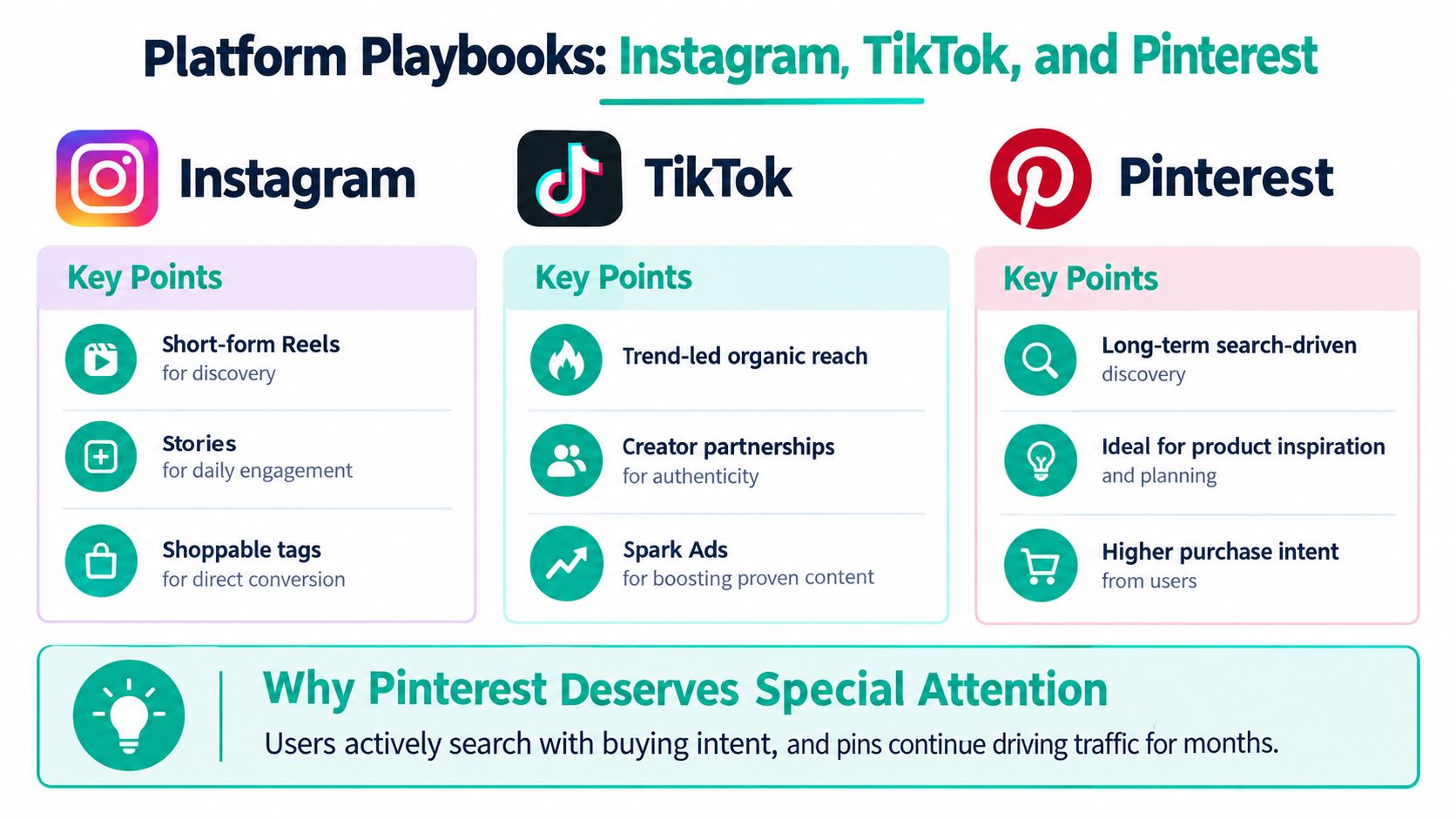
Instagram works well for visual product storytelling. Use short-form video for discovery, Stories for timely interaction, and product tagging when a viewer is ready to inspect the item. A footwear store might show one pair styled three ways, then answer fit questions in Stories. The useful metric isn't merely reach. Look for saves, product-page visits, replies, and the quality of questions.
TikTok rewards a more immediate, human presentation. A creator can show an unboxing, test a product under ordinary conditions, or respond to a misconception. Trend participation should support the product story, not bury it. Paid amplification makes more sense after the organic version demonstrates that the hook resonates with a relevant audience.
Facebook can support community, product discussion, and audiences that prefer a familiar environment. A merchant selling garden equipment might publish seasonal advice, answer maintenance questions, and use catalog formats for shoppers who already know what they need. The value may sit in repeated consideration rather than a single dramatic post.
YouTube suits demonstrations, reviews, comparisons, and searchable education. A furniture retailer can explain assembly, room planning, and material differences. Those videos help answer the questions that a product image cannot, especially when the purchase involves uncertainty.
X and LinkedIn are less obvious choices for many consumer stores, but they can matter when the product intersects with professional identity, industry discussion, founders, or wholesale relationships. A sustainable packaging supplier may use them for category education and buyer conversations rather than direct impulse sales.
Pinterest behaves more like discovery search
Pinterest deserves separate treatment because users often arrive to explore a category, idea, or project before choosing a merchant. Pinterest reports 553 million monthly active users, says its top searches are unbranded, and reports that Gen Z represents 42% of its global user base, according to its audience information for businesses. Those facts point to a different creative requirement: make the pin useful before it becomes promotional.
A home retailer shouldn't publish only “Brand Name Sofa.” It can create pins around “small living room seating ideas,” “warm neutral bedroom styling,” or “storage solutions for narrow entryways.” Each pin should use a distinct title, description, image treatment, and landing page where appropriate. The catalog becomes a set of answers to non-brand questions.
Track saves and outbound clicks, but also consider assisted conversions and revenue per visitor. A shopper may save an idea, return later through search, and purchase after visiting another touchpoint. The pin helped build consideration even if it didn't receive last-click credit.
For a deeper implementation guide, see Pinterest for ecommerce, especially when mapping product feeds to category, use-case, and seasonal keyword clusters.
Scheduling and Automation Workflows That Save Time and Reduce Risk
Treat publishing like a small supply chain. A product enters the system, its data gets transformed into creative and metadata, approved outputs are scheduled, and performance feeds the next production cycle.
The publishing pipeline
- Intake: Connect a product catalog, RSS or Atom feed, CSV file, or store integration.
- Validation: Check product name, price, availability, destination URL, images, and prohibited claims.
- Transformation: Generate titles, descriptions, alt text, layouts, and relevant board or collection choices.
- Review: Inspect new templates, unusual claims, visual errors, and products with sensitive return or quality histories.
- Scheduling: Publish approved variations according to a controlled cadence.
- Recycling: Reuse successful ideas with meaningful changes in context, product, query, or format.
- Measurement: Compare outputs by product, template, board, query intent, and destination.
A tool such as Pin Generator can connect ecommerce sources and content feeds, create pin designs and metadata, select boards, and schedule recurring Pinterest publishing. That kind of workflow is useful when the manual alternative is repeatedly exporting images, rewriting descriptions, and uploading products one at a time.
Automation needs boundaries. Suppress discontinued and unavailable products. Refresh price and destination data before generation. Set rotation limits so the same template doesn't dominate the feed. Keep a human checkpoint for new creative families, regulated claims, unusual discounts, and assets that don't match the landing page.
Optimize economics, not volume
Compiled retail and ecommerce benchmarks report conversion rates of 1.74% for organic social traffic and 2.3% for paid social traffic, as summarized by Ruler Analytics' marketing attribution benchmarks. Those figures are benchmarks, not promises for an individual store. They do show why a publishing system shouldn't chase maximum output without checking traffic quality, average order value, acquisition cost, assisted revenue, and repeat purchase behavior.
A lower-volume workflow can outperform a flood of near-duplicates when each asset matches a real query and points to an accurate product experience.
Measuring Real Impact Beyond Last-Click Numbers
Last-click reporting is tidy. It is also incomplete.
A shopper may discover a product through a pin, watch a creator demonstration, visit the store from a branded search, leave to compare alternatives, and return through a direct visit. The final session gets credit even though earlier content helped create confidence. Recent ecommerce reporting says customers typically interact with brands across roughly eight to ten touchpoints before purchasing, which makes last-click attribution a weak signal of incremental social impact, as explained in this guide to ecommerce attribution models.
Privacy changes make the problem harder. User-level paths are less complete, so teams need a measurement stack that respects what their data can prove.
Build a practical evidence stack
Start with UTM parameters that preserve source, campaign, content, and product identifiers. Then connect those visits to first-party purchase data. Add assisted-conversion reporting, new-customer share, contribution margin, repeat purchase, and time to conversion.
Next, compare groups. A small merchant can compare customers exposed to a Pinterest campaign with similar non-exposed customers, provided the groups are defined carefully. A geographic holdout can keep a campaign active in one area and limited in another, then compare outcomes while accounting for major differences in demand and distribution.
Keep a history of what was published and when. A leaderboard that compares templates, boards, products, and query intent can reveal whether a content change coincided with better commercial outcomes. It won't prove causality on its own, but it creates a useful record for controlled tests.
Measurement discipline: Ask whether the activity changed orders, margin, customer quality, or branded demand. Don't stop at “Which link got the final click?”
For teams that want a more formal framework, Headline Marketing Agency on attribution offers a useful perspective on connecting multiple channels instead of judging each one in isolation. The right model is the one your data and operating capacity can sustain, not the one with the most impressive diagram.
Common Misconceptions and a 2026 Operating Mindset
Misconception one: personalization requires behavioral retargeting. A store can make content relevant through product attributes, context, seasonality, category language, and voluntarily supplied first-party signals. That approach gives shoppers useful relevance without placing customer identity inside the creative-generation workflow.
Misconception two: more posts always produce better results. Volume can create stale repetition, inaccurate availability, and audience fatigue. A smaller set of distinct assets can be more useful when each one answers a different question and follows a clear suppression rule.
Misconception three: every new platform deserves a test. A channel should earn attention through buyer fit, intent, creative sustainability, and commercial relevance. If the team can't support replies, accurate product information, and consistent publishing, another account may create more operational risk than demand.
Misconception four: creative quantity matters more than creative quality. AI can produce variations quickly, but speed doesn't replace judgment. The team still needs to check whether the image represents the product, the claim is accurate, the alt text is descriptive, and the destination page fulfills the promise.
Privacy-conscious shoppers illustrate the tension clearly. Recent ecommerce reporting found that 71% of shoppers take privacy-protective actions, while 69% of privacy-conscious shoppers still want personalized experiences, according to Shopify's ecommerce trends reporting. The practical answer is contextual personalization: use what the shopper is looking for, not more identity data than the business needs.
Carry these principles into planning meetings:
- Create demand before capturing it: Teach, demonstrate, compare, and inspire before asking for the sale.
- Use channels for distinct jobs: Don't force every network to perform the same role.
- Automate repeatable work: Keep approval, accuracy, and suppression decisions human-controlled.
- Measure incrementality: Compare exposed and non-exposed groups where possible, then track margin and customer quality.
- Protect trust: Keep prices, availability, claims, alt text, and landing pages aligned.
- Let relevance beat volume: Publish fewer near-duplicates and more useful answers.
The 2026 operating mindset is neither “automate everything” nor “return to manual craftsmanship.” It is AI-assisted production with human accountability, privacy-safe relevance, connected commerce, and measurement that asks what changed because the campaign existed.
Pin Generator turns product catalogs and content feeds into Pinterest-ready creative, including designs, titles, descriptions, alt text, board selection, and recurring schedules. If you want to build a more consistent, intent-led Pinterest workflow without uploading every pin manually, visit Pin Generator and connect it to your ecommerce content system.