
ClickBank Affiliate Marketing: How to Start and Earn
28 November 2026
You've found a ClickBank product that looks promising, and you're ready to turn it into a Pinterest pin. Then the questions start: Which link should you use? Is the advertised commission what you'll keep? What happens if someone buys, then asks for a refund?
ClickBank affiliate marketing works best when you treat promotion and payment as one connected process. The offer, your recommendation, the disclosure, and the tracking all affect whether a click becomes earnings you can keep. Start with a small, measurable campaign rather than a promise of passive income.
Table of Contents
- How ClickBank Affiliate Marketing Works, Step by Step
- Commission Models and What Each One Pays
- Choosing ClickBank Offers That Are Worth Promoting
- Tracking Clicks, Sales and Earnings Per Click
- Bringing Relevant Traffic From Pinterest and Beyond
- Disclosing Affiliate Links on Every Channel
- Why Campaigns Stall and How to Fix Them
- Launch a Test Campaign Before You Scale
How ClickBank Affiliate Marketing Works, Step by Step
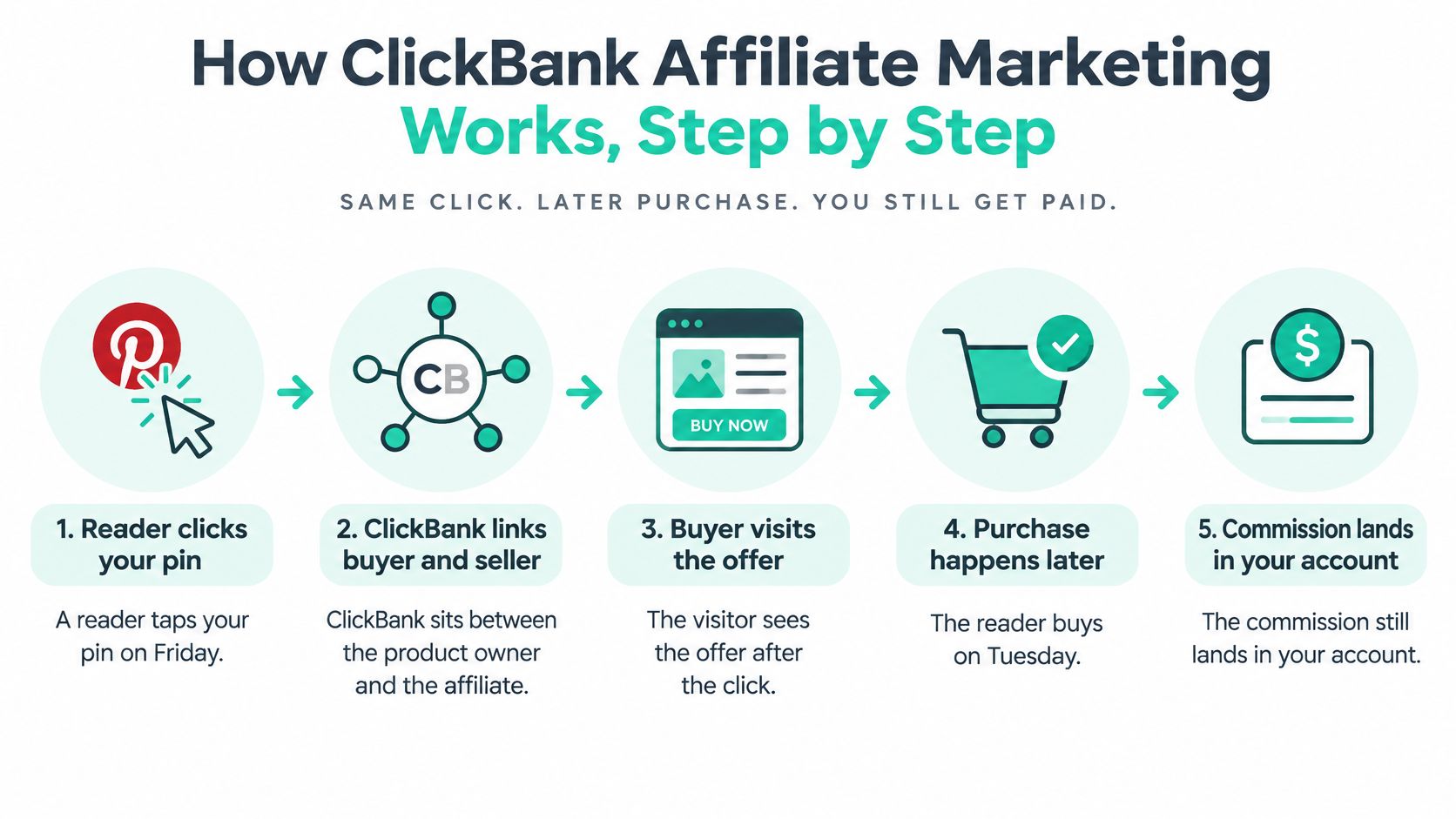
Say a reader taps your pin on Friday, visits the product page, and buys on Tuesday. An eligible referral can still earn you a commission even though the purchase didn't happen immediately. That doesn't mean the money reaches your bank account on Tuesday, though. A recorded commission and a completed payout are different events.
ClickBank sits between the product owner, who supplies the offer, and the affiliate, who introduces potential customers. The seller handles the product; you handle the recommendation and audience acquisition. ClickBank provides the infrastructure connecting the transaction to the referral.
Think of your HopLink as a tagged ticket. It sends the visitor toward the offer while identifying who made the introduction. A regular product URL may reach the same destination, but it doesn't necessarily carry your affiliate attribution.
Set up the referral chain
- Create your affiliate account. Complete the account, identity, and payment information requested during signup. Don't assume that creating a login means every payout setting is finished.
- Shortlist offers in a focused niche. Choose products addressing related reader needs, such as meal planning rather than unrelated health, finance, and hobby offers. This makes your content easier to aim at a recognizable audience.
- Generate the product's HopLink. Use your affiliate account nickname and confirm that you've selected the intended seller. The usual mistake is copying the seller's public page address instead.
- Put the link in a useful recommendation. You might place it in a comparison article, a relevant email, or permitted promotional content. Give readers a reason to visit beyond an unexplained buy button.
- Let the visitor evaluate the offer. Your job isn't to force an immediate purchase. Explain who the product suits, what it includes, and any limitations that could change the buying decision.
- Separate recorded earnings from payable earnings. Review the transaction status, adjustments, and account payment settings before treating a commission as available cash. Don't spend against a dashboard total without understanding what it represents.
Check the destination before publishing
A working link should open the intended vendor page, not an unrelated promotion or an error screen. Check the mobile experience too, especially when your audience arrives from Pinterest.
Generate a HopLink and open it in a private browser window. Confirm the destination, then save the original link alongside the offer name so you can troubleshoot later. Reaching the page checks routing, not the entire attribution and payment process.
Commission Models and What Each One Pays
When does the money arrive, and how much will you keep? Start by separating how a commission is earned from when an account becomes eligible for payment. The first comes from the offer's compensation terms; the second comes from your payment settings and applicable account requirements.
ClickBank supports revenue-share and cost-per-action arrangements, according to the ClickBank statistics overview. Revenue share pays a percentage of an eligible sale or rebill, while CPA ties compensation to a defined qualifying action. Don't assume every seller offers both arrangements or accepts every affiliate.
ClickBank commission models compared
| Model | How you are paid | Best fit | Watch for |
|---|---|---|---|
| Revenue share, one-time sale | Percentage of each eligible sale | Single-purchase products | The offer sets the commission rate |
| Revenue share with rebills | Percentage of eligible recurring charges | Subscriptions and payment plans | Earnings depend on customer retention |
| Cost per action | Agreed payment for a defined action | Approved acquisition or lead-generation campaigns | The vendor defines the qualifying action |
Read the offer before estimating income
A commission percentage alone isn't a reliable earnings forecast. Record the advertised commission, what amount it applies to, whether recurring payments qualify, and whether approval is required. Ask the seller to clarify anything the affiliate page leaves ambiguous.
Use arithmetic only after those terms are clear. As a hypothetical example, a commissionable amount of $47 at 50% produces $23.50 before adjustments. If that same eligible amount recurs monthly, three successful charges would produce $70.50, but only if the agreement covers rebills and the customer continues paying.
A hypothetical CPA agreement paying $8 per accepted lead works differently: an unqualified submission earns nothing. These are calculation examples, not ClickBank-wide prices, rates, or available offers.
Budgeting rule: Estimate from the commission you can retain, not the largest payout displayed beside an offer.
For a sales-based campaign, use:
Expected commission = attributable clicks × assumed conversion rate × commission per eligible sale − commission reversals
Keep traffic, software, and content expenses separate so you can calculate profit afterward. Verify the current payout schedule, payment threshold, and outstanding requirements inside your account rather than assuming that the estimate equals your next deposit.
If you're comparing networks, this explanation of CJ affiliate marketing offers another reference point for evaluating affiliate arrangements. Before promoting a ClickBank offer, write down its actual compensation terms and a conservative earnings estimate.
Choosing ClickBank Offers That Are Worth Promoting
Start with niche fit, not the biggest commission. A meal-planning audience needs help choosing and preparing meals. An unrelated product with an attractive payout gives those readers little reason to buy.
Read the product page as a customer before reading the affiliate materials as a marketer. Can you explain what the buyer receives? Are the limitations, total commitment, and cancellation instructions understandable? If you can't answer those questions, you're not ready to recommend it.
Offer selection checklist
| Criterion | What to check | Red flag |
|---|---|---|
| Niche fit | A problem your audience already searches for | No connection to your readers' interests |
| Gravity | Evidence of recent affiliate sales activity | Little activity combined with no other evidence of demand |
| Vendor sales page | Claims you can support with evidence | Unsupported income promises or medical cure claims |
| Rebill structure | Recurring charges and cancellation instructions | Recurring payments the page doesn't explain |
| Affiliate support | Promotional materials, tracking guidance, and a contact route | No useful materials and no way to ask questions |
Gravity isn't earnings per sale, and it isn't your predicted conversion rate. Treat it as a marketplace activity signal, then investigate the offer itself. A popular product can still be unsuitable for your audience.
ClickBank's affiliate marketing overview reported in 2026 that its top 100 earners worked with an average of 52 unique affiliates each. That indicates substantial affiliate participation, not that a newcomer can reproduce those earners' results.
Build a shortlist you can defend
Compare candidates against the same criteria rather than choosing the most polished affiliate pitch. Give each criterion a simple pass, concern, or fail assessment, with a note explaining why.
For a practical shortlist, select a product addressing a problem readers already search for, another with a sales page you'd comfortably send to a friend, and a recurring offer whose payment terms you can explain plainly. These categories can overlap.
Don't invent a refund rate because the seller hasn't published one. Ask for relevant performance information, inspect the customer journey, and use your own eventual results to decide whether the recommendation deserves continued promotion.
Tracking Clicks, Sales and Earnings Per Click
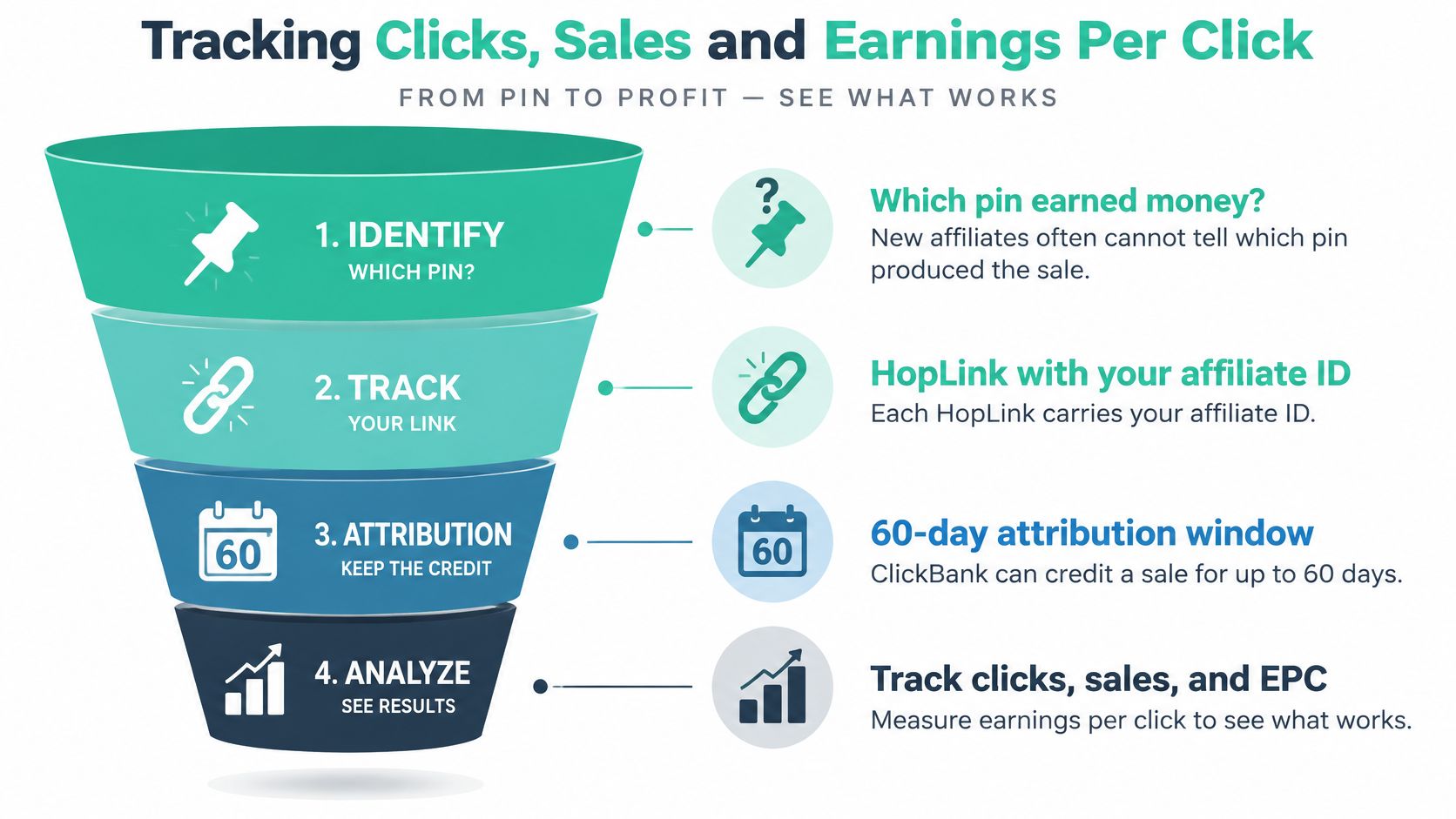
Which pin earned money? If every creative uses an indistinguishable link, you may know that an offer sold without knowing which headline, image, or search topic helped produce the sale.
The ClickBank HopLinks guide describes referral links that identify the affiliate and a 60-day attribution window, allowing an eligible purchase within that period after the click to receive referral credit. It also documents tracking parameters and tracking IDs for separating campaign activity.
Give each pin an identifiable path
Use a distinct tracking ID for each pin when you need pin-level measurement. Shared theme IDs can help compare groups, but they won't tell you which individual creative generated the result.
Maintain a sheet connecting the pin, destination page, offer, tracking ID, and publication date. If a pin sends readers to your article before they click a HopLink, preserve that campaign identity through the article's analytics and outbound affiliate tracking. Otherwise, the middle step breaks your pin-level reporting.
Compare retained earnings, not clicks alone
Earnings per click, or EPC, means net affiliate earnings after refunds and reversals divided by attributable affiliate clicks.
Consider a hypothetical comparison: a pin producing 400 attributable clicks and $60 in retained commissions has an EPC of $0.15. Another producing 900 clicks and $90 has an EPC of $0.10. The smaller campaign earns more per click, although you should check result maturity and sample quality before expanding it.
Metrics for judging a Pinterest offer funnel
| Metric | How to calculate it | What it tells you |
|---|---|---|
| Click-through rate | Pin clicks divided by pin impressions | Whether the creative earns attention |
| Conversion rate | Sales divided by attributable affiliate clicks | Whether referred visitors purchase |
| Refund rate | Refunded sales divided by sales | Whether buyers keep their purchases |
| Earnings per click | Net earnings after refunds divided by attributable clicks | Which campaigns generate stronger retained commissions |
Use consistent definitions and reporting periods. Pinterest outbound clicks, article visits, and HopLink clicks are different events, so don't swap their denominators.
For broader budgeting, Mazurly's guide to calculating blog profitability provides a useful companion to campaign-level measurement. Add costs before calling retained commissions profit, and schedule a regular review of each pin's results.
Bringing Relevant Traffic From Pinterest and Beyond
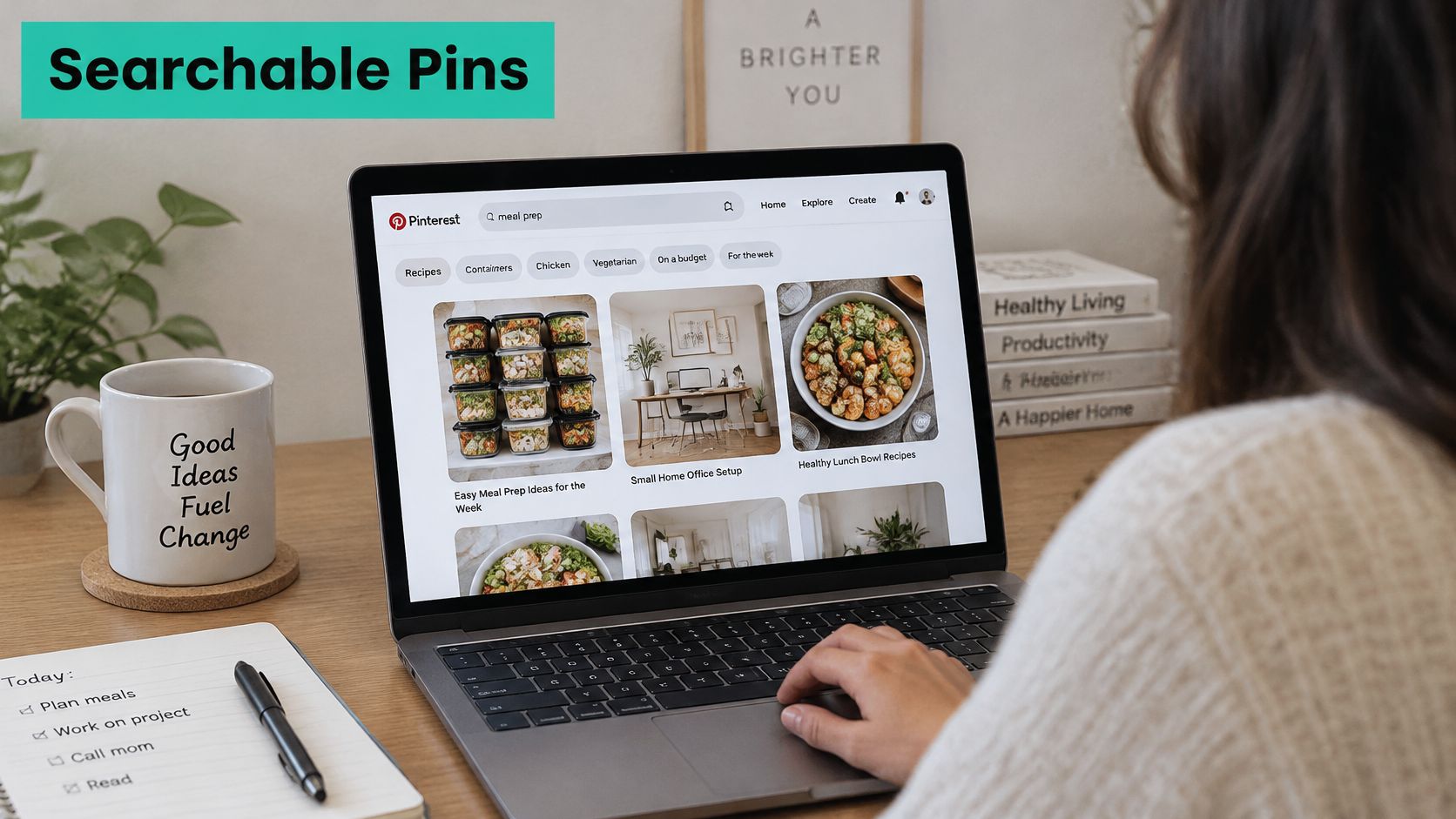
Pinterest users search for ideas tied to practical goals, such as meal preparation or setting up a home office. Build content around those needs rather than making the affiliate product itself the entire subject.
A reader searching for meal-prep help needs a useful next step. A pin promising a beginner-friendly planning checklist should lead to that checklist or a closely matched explanation, not a generic homepage.
Match the search to the destination
- Name the problem. Write a title such as Meal Prep When You Don't Know What to Cook rather than a vague promise about changing your life.
- Show a relevant benefit. Use a readable vertical design with imagery connected to the actual content.
- Use the reader's vocabulary. Include relevant search phrases naturally in the title and description.
- Deliver the promised help. Make the destination useful before asking readers to consider a paid solution.
Create a manageable batch of variations using different images or problem-focused headlines. Publish them across relevant boards on a spaced schedule rather than releasing near-identical creatives together. Keep the offer and destination stable while testing the creative.
A reader shouldn't need to guess why the page they opened belongs to the pin they clicked.
Add channels only when they serve a purpose
A blog comparison can explain trade-offs that won't fit on a pin. An email can answer a subscriber's specific question, while a YouTube demonstration can show how a product works.
If a social profile needs a destination hub, DBotMaker's independent ranking of bio link apps can help you compare options. Don't add a hub between a pin and its promised page without a clear reason.
For implementation details, follow this guide to affiliate marketing on Pinterest step by step. Start with a focused funnel, write alternative problem-led titles, and give every pin a destination that fulfills its particular promise.
Disclosing Affiliate Links on Every Channel
A footer disclaimer isn't a substitute for disclosure beside a recommendation. Readers need to understand your financial connection while deciding how much weight to give your advice, not after they've already acted.
The FTC's endorsement guidance says affiliate relationships should be disclosed clearly and conspicuously near affiliate links, and video disclosures should appear in both the video and its description. A separate policy page can provide detail, but it doesn't replace understandable disclosure in the promotional content.
Where to place affiliate disclosures by channel
| Channel | Where the disclosure goes | Sample wording |
|---|---|---|
| Pinterest pin | In the description beside the recommendation or link, visibly rather than buried | I earn a commission if you buy through this link. |
| Blog post | Before the first affiliate link, with reminders near later recommendations when needed | This article contains affiliate links, and I earn a commission from qualifying purchases. |
| In the same paragraph as the offer | I receive a commission if you purchase through this link. | |
| YouTube video | Spoken in the video and written beside the relevant links in the description | Links below are affiliate links, and I earn a commission. |
| Landing page | Before the first monetized recommendation | This page contains affiliate links, and I earn a commission on purchases. |
These are implementation examples, not a guarantee that a particular layout satisfies every situation. Check how the content appears on mobile and whether truncation hides the disclosure.
Make disclosure part of production
In a long article, a reader may arrive at a later recommendation without seeing the introduction. Keep the financial relationship understandable there too, instead of assuming a distant notice covers every encounter.
The FTC's social media disclosure guidance also says creators shouldn't rely solely on a platform's disclosure feature. Add your own clear explanation where readers will notice it.
Disclosure and accurate claims belong together. Calling something the best doesn't establish a fair comparison, and disclosing a commission doesn't make an unsupported claim acceptable.
Create a standard disclosure sentence and add it to your pin, page, email, and video templates. Review its placement alongside the headline and call to action, so commercial intent remains clear when you publish at scale.
Why Campaigns Stall and How to Fix Them
Clicks without sales are frustrating, but they don't identify the cause by themselves. Visitors may have expected free instructions, reached a confusing page, or discovered a commitment your pin didn't mention.
Start with the audience and work toward the transaction. Confirm that the search intent matches the product, inspect the creative, open the destination, and then review purchases and post-purchase adjustments.
Campaign symptoms, causes and fixes
| Symptom | Likely cause | Fix |
|---|---|---|
| Many clicks, few sales | Landing page doesn't match the pin promise | Rewrite the pin to match the page, or choose another offer |
| Sales but high refunds | Overpromised offer or misleading pin copy | Pause the pin and remove exaggerated claims |
| Few clicks on pins | Weak image or unclear keywords in the description | Test new images and keyword-led descriptions |
| Earnings falling after rebills | Subscribers cancelling early | Compare retention and prioritize offers with clearer recurring terms |
| Sudden drop in tracked sales | Broken HopLink or changed tracking ID | Retest the destination and inspect tracking IDs |
Treat these causes as hypotheses, not diagnoses. A sudden decline could also reflect a changed offer, so inspect the live customer journey before rewriting all your content.
Change the part you can identify
Keep a change log and avoid replacing the headline, image, destination, and offer simultaneously. Otherwise, an improvement won't tell you which change helped.
Technical faults can be checked immediately. Conversion changes need enough relevant visits to become interpretable, and recurring-income problems need completed billing cycles before you can assess retention.
Ethical boundary: When buyers reject the product, don't compensate by making the promise stronger. Make the recommendation more accurate.
Set a stopping rule before testing. If retained earnings remain disappointing after deliberate creative and page revisions, pause the offer and test another shortlisted product. More publishing isn't the right answer when the underlying recommendation doesn't work.
Launch a Test Campaign Before You Scale
Run a bounded test with setup, publishing, review, and decision stages. Put the first review date in your calendar before anything goes live, and decide what evidence would justify continuing.
Set up and publish
- Prepare the offers. Build matching destination content, add visible disclosures, and record the compensation terms.
- Assign identifiers. Give each pin its own tracking identity and preserve it through any intermediate page.
- Publish consistently. Let the initial creatives gather interpretable results without repeatedly editing them.
- Review the whole outcome. Compare attention, purchases, retained commissions, and expenses rather than selecting a winner by clicks.
Treat an early review as provisional while delayed purchases and adjustments remain possible. Before expanding, inspect the live offer and retest the referral path so a routing fault doesn't distort your decision.
For larger workflows, our Affiliate Links bulk update lets you update affiliate links in pins' outbound URLs. Our Keyword Research helps find high-performing keywords and trending topics for Pinterest SEO, while Trend Alerts notify you when trends spike in your niche.
Keep the strongest audience-offer match, revise a clearly diagnosed weakness, and add another channel only when you can measure it properly. Your next action is simple: schedule the review, then prepare the first test.
Pin Generator helps you create and schedule Pinterest content while keeping affiliate destinations manageable as offers change. Visit Pin Generator to build a repeatable publishing workflow around your tested ClickBank offers, with clear disclosures and trackable links in place before you scale.