
How to Make Money with Pinterest in 2026: Models That Pay
26 October 2026
The most popular advice about making money on Pinterest is to post more pins and grow your followers. That skips the part where someone pays you. A busy account can send plenty of people to an offer that leaves almost nothing after commissions, fees, shipping, or fulfillment.
If you want to learn how to make money with Pinterest, start with the destination page and work backward. Treat Pinterest as a traffic channel, then judge each offer by revenue per thousand impressions and the profit left after costs. That's a more useful scoreboard than pin volume.
Table of Contents
- Which Pinterest Income Model Fits Your Goal
- How to Set Up a Pinterest Account That Can Earn
- Earning Affiliate Commissions Without Breaking Rules
- Selling Products and Services Through Your Pins
- Earning From Ads and Sponsored Content
- How to Build a Pin Batch That Drives Clicks
- Why Your Pins Earn Nothing and How to Fix It
- Pick One Model and Test It for 90 Days
Which Pinterest Income Model Fits Your Goal
Pinterest doesn't pay you just for posting pins or collecting impressions. You earn when someone follows a pin to an affiliate offer, product listing, service page, or monetized article. A sponsor can also pay you for an agreed placement, but that's a commercial agreement, not an automatic platform payout.
Pinterest has its own business model. Its 2025 annual report reported $4.22 billion in revenue, up 16% from 2024, with growth attributed primarily to increased demand for conversion and awareness advertising objectives. Your business needs a separate mechanism for turning the attention you attract into income.
Pinterest income models compared
| Income model | How money arrives | What you need to start | Main risk | Best fit |
|---|---|---|---|---|
| Affiliate commissions | Commission on each tracked sale | Free account, disclosed links, a page that matches the pin | Low commissions on cheap items; merchant terms can change | Reviewers and bloggers with a clear niche |
| Product sales | Revenue per order minus cost of goods, fees, and shipping | A product, a store or marketplace listing, product photos | Thin margins once fees and shipping are counted | Makers and sellers on Etsy, Shopify, or WooCommerce |
| Services | Client fees for coaching, design, consulting, or bookings | A specific offer, a booking or contact page, proof of results | Needs a sales process and enough qualified inquiries | Freelancers and consultants |
| Ad or sponsored content | Ad payouts or sponsor fees tied to page visits or placements | Steady traffic to articles or recipe pages | Pinterest traffic can drop without warning | Publishers and bloggers with large content libraries |
Email list growth supports these models rather than replacing them. A subscriber becomes commercially valuable when an email leads to a purchase, booking, or other paid action. Don't count a signup as revenue.
Choose your starting model using these criteria:
- Profit per sale. A healthy selling price means little if fulfillment consumes the margin.
- An existing offer. Start with something you already sell or can recommend credibly before creating another product.
- Destination control. Your own page lets you improve copy, capture inquiries, and replace unavailable offers. A marketplace listing gives you less flexibility.
Practical rule: The destination page decides how much a pin is worth, not the pin itself.
How to Set Up a Pinterest Account That Can Earn
Start with a Pinterest business account, a website you control where possible, and a profile description that names what you sell or recommend. A marketplace listing can serve as your destination, but you won't have the same domain ownership or tracking options.
Use this setup overview before publishing.
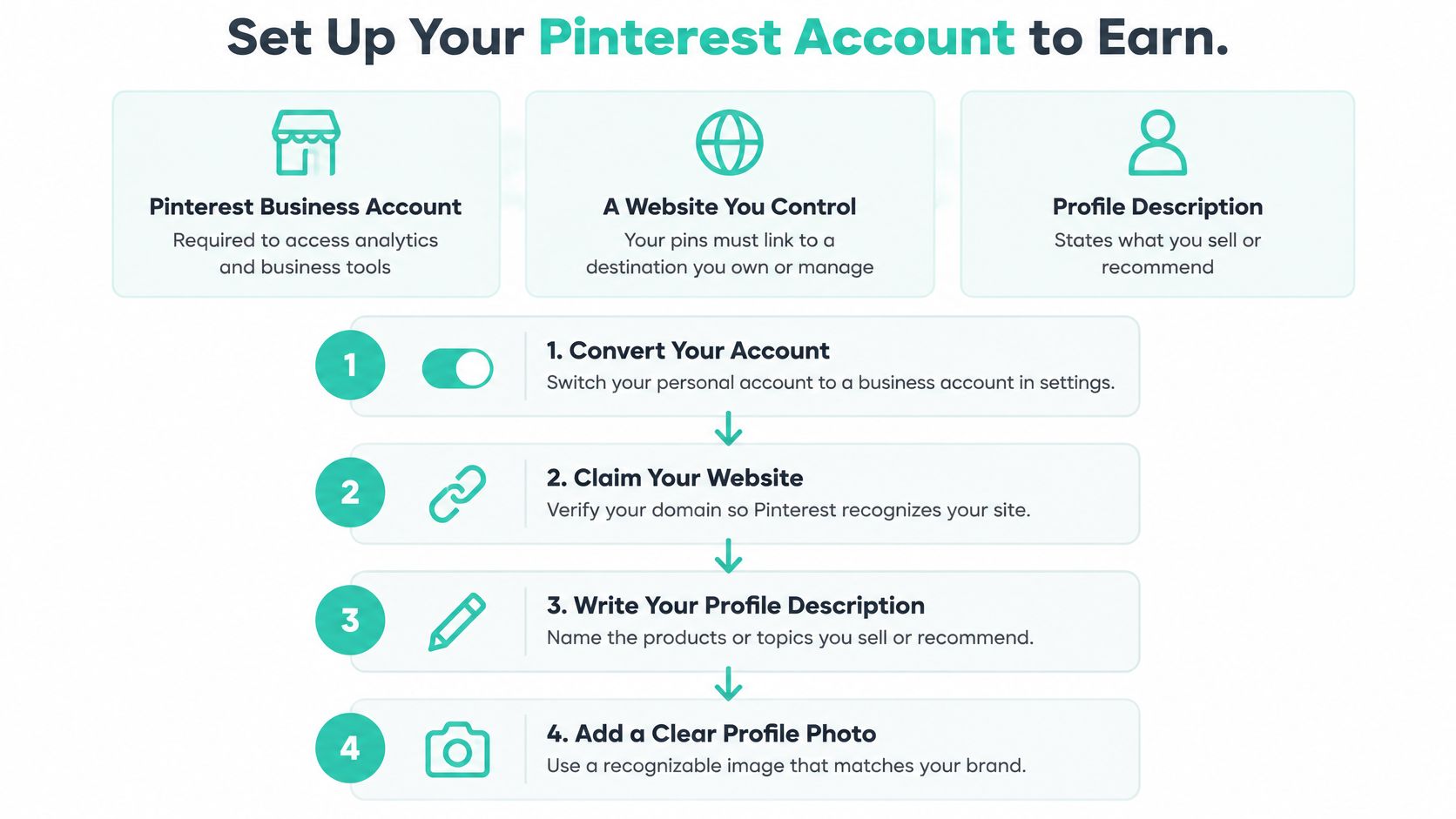
Connect the account to the offer
- Convert to a business account. Follow the guide to switching to a Pinterest business account, then complete your business name and category. Your profile should describe the same business visitors encounter after clicking.
- Claim your website through account settings using an available verification method. This establishes ownership and helps you understand activity around content from your domain. You generally can't claim a marketplace domain you don't own.
- Install the Pinterest tag before launch. Use your store's integration or a tag manager, then test page views and a meaningful conversion event, such as a signup, add-to-cart, or purchase. Confirm the events appear in the reporting interface rather than assuming installation means they work.
- Create a manageable set of specific boards. Small Bedroom Storage Ideas gives people a clearer subject than Home. Write a natural description around the board's main topic instead of adding a string of unrelated keywords.
- Open every destination on your phone. Check loading, popups, product availability, checkout, and whether the headline delivers what the pin promises.
- Keep your identity consistent. Use a recognizable profile image and a bio that names your audience and offer. Start with a publishing cadence you can maintain without recycling weak graphics.
Verify before you publish
Use tagged destination URLs to distinguish Pinterest visits in your website analytics. Keep campaign names consistent so you can compare creative angles without untangling messy reports later.
Test the purchase or inquiry path yourself. A working button isn't enough if the confirmation page never loads or the conversion event fires before someone completes the action.
Installing tracking after launch leaves the earlier behavior unmeasured. Your working setup should have a claimed domain where eligible, verified events, search-specific boards, and destination pages that function on mobile.
Earning Affiliate Commissions Without Breaking Rules
Disclose the affiliate relationship clearly and send readers where the pin says you'll send them. Transparency helps people judge your recommendation and reduces avoidable compliance risk. It doesn't guarantee account safety, so check Pinterest's current policies and each affiliate program's permitted traffic sources before publishing.
Put plain wording in the pin description and near the top of the landing page. For example: I earn a commission if you buy through these links. Don't hide the explanation in a footer or assume an unfamiliar abbreviation communicates the relationship.
Keep the disclosure visible alongside the recommendation.
Build a useful buying page
Say someone saves a pin about small bedroom storage ideas. When they click, they should reach a page comparing organizers suited to cramped rooms, not a generic retailer homepage.
Give each product an honest role: under-bed storage for spare bedding, a narrow shelf for an awkward gap, or a hanging organizer for an overloaded wardrobe. Include dimensions, installation needs, and disadvantages where you can verify them. Add a clearly identified tracked purchase link beside each recommendation.
Don't claim you tested something you haven't used. You can compare published specifications, but distinguish that analysis from hands-on experience.
For an introduction to disclosure and other compliance considerations, Maxijournal's legal basics for new affiliate marketers offers useful orientation. Check the applicable requirements in your jurisdiction and the merchant's agreement rather than treating a general guide as individualized legal advice.
Choose offers by net earnings
A high commission isn't automatically a good offer. Expensive products may need more explanation, while a cheap accessory might convert readily but leave little revenue for the work involved.
Before promoting an offer, check:
- Commission basis. Is payment based on the product price, an eligible basket, or a qualifying customer action?
- Reversals. Understand how returns and cancellations affect credited earnings.
- Traffic permissions. Confirm whether direct Pinterest links, paid promotion, and your intended landing page are allowed.
- Product fit. Recommend an item because it solves the reader's problem, not because its payout looks attractive.
Avoid cloaked or shortened links that obscure the destination. An owned comparison page gives you room to explain the purchase and replace an offer if terms change, but it also adds maintenance. Keep availability, recommendations, and tracking links current.
Selling Products and Services Through Your Pins
Impressions × outbound click rate × conversion rate × revenue per sale = attributed revenue. Subtract production, advertising, and fulfillment costs to find what you really keep. Product sellers and service providers need that distinction because a large order and a profitable order aren't the same thing.
For physical products, link directly to the relevant store page or marketplace listing. The pictured variation, price, and availability should match what the visitor finds. Don't advertise a complete storage set and land shoppers on a listing priced for an individual component.
Same traffic, two offers
The following is a hypothetical monthly example, not a benchmark or earnings forecast. Every amount and rate is an illustrative assumption to replace with your own results.
Same traffic, two offers: example monthly math
| Funnel stage | Affiliate product ($40 commission) | Service package ($150 fee) |
|---|---|---|
| Pin impressions per month | 10,000 assumed impressions | 10,000 assumed impressions |
| Outbound click rate | 1% = 100 clicks | 1% = 100 clicks |
| Conversion rate | 2% = 2 sales | 1% = 1 booking |
| Revenue per sale | $40 | $150 |
| Monthly revenue from this pin set | $80 | $150 |
| Cost to produce pins | Your design and writing time | Your design and writing time |
Under those assumptions, the affiliate offer generates $8 per thousand impressions, while the service generates $15 per thousand impressions. Neither figure is profit. The service still needs delivery time deducted, and the affiliate income may be reduced by reversals.
A service booking can produce more revenue from less traffic, but you still have to deliver the work.
Make the offer easy to verify
For services, show the outcome a buyer wants: a finished room, a coherent brand identity, or a clearly defined consultation deliverable. Put credentials, scope, pricing guidance, and the booking process on the destination page. A pin shouldn't try to carry your entire résumé.
Digital products need tangible previews. A template seller can show an editable layout; a guide seller can show sample pages. For a pin promoting a resource such as Just Cook It's freezer-friendly meal planning cookbook, show an authorized preview or a clearly described meal-planning use case rather than a generic food image.
Seasonal offers deserve their own creative. A Retail Dive sponsored article reported that holiday shoppers spent up to 40% more on Pinterest than on other visual platforms in 2023. That's a reason to investigate seasonal demand, not a forecast for your store.
Before scaling a pin set, calculate its revenue per thousand impressions and the contribution left after variable costs. Scale the profitable offer, not merely the attractive graphic.
Earning From Ads and Sponsored Content
Display advertising usually pays according to ad impressions and the network's revenue arrangements. Publishers often evaluate those earnings per thousand page views or sessions. Sponsors may pay a flat placement fee, so neither model should be confused with payment for Pinterest impressions.
You'll need owned articles or recipe pages with measurable visits and room for advertising that doesn't obstruct the content.
Set up a publisher revenue check
- Pull a consistent reporting window. Match Pinterest outbound clicks with website sessions and page-level earnings. Identify the pages that produce money, not just visits.
- Check sponsor fit. A gardening supplier belongs beside relevant growing advice, not an unrelated article that happens to attract traffic.
- Choose a route. Apply to an ad network whose eligibility requirements you meet, or pitch sponsors using actual page visits, audience relevance, and proposed placement.
- Compare sponsorship economics. In a hypothetical example, a $200 placement on a page receiving 20,000 monthly visits equals $10 per thousand visits. That calculation assumes the fee and traffic stated; it isn't a market rate.
- Translate page earnings back to Pinterest impressions. Website revenue per thousand visits and Pinterest revenue per thousand impressions use different denominators.
- Limit dependence on advertising. Decide how much referral volatility your business can tolerate and develop other acquisition channels.
Keep sponsored-content labels clear and prominent at the top of the page. Spell out who paid for the placement rather than making readers infer the relationship from a logo.
How to Build a Pin Batch That Drives Clicks
A useful batch tests different reasons to visit the same destination. It's not a folder of almost identical graphics exported in different colors.
Organize your source images before designing so each pin has a distinct job.
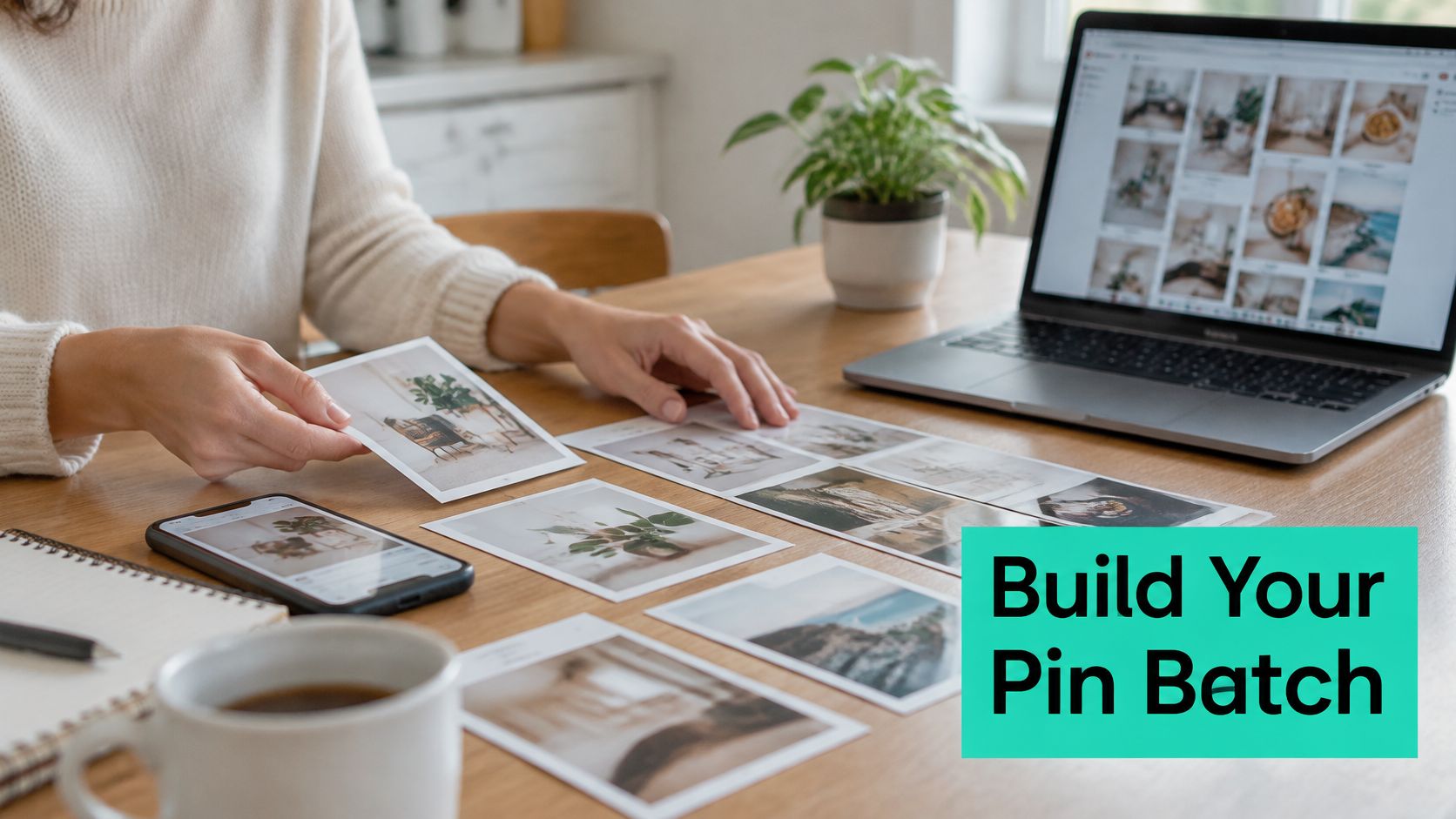
Build around a commercial question
- Choose a non-branded topic. Type small bedroom storage ideas into Pinterest search and inspect the suggestions. Validate that your destination can answer the query before designing anything. Pinterest's shopping insights state that 97% of its top searches are non-branded, which supports starting with the buyer's problem rather than your business name.
- Map the topic to a destination. A storage comparison page needs buying-oriented creative; a room-planning service needs creative that attracts someone seeking help.
- Create distinct vertical layouts. Try a complete room scene, a product detail, a problem-and-solution graphic, and a compact list. Use genuine product assets and readable text rather than imagery that misrepresents what's for sale.
- Lead the title with the topic. Small Bedroom Storage Ideas for Awkward Corners communicates more than You Need These Amazing Finds.
For the production mechanics, use the guide to creating a Pinterest pin while keeping the offer and reader's question fixed.
Finish the metadata and publishing plan
- Write a useful description. Name the problem naturally, explain what the page contains, and give a next step. Don't promise tested recommendations unless the page contains actual testing.
- Describe the image in alt text. For example: Narrow white shelving beside a bed with baskets underneath. Alt text is for describing the visual, not storing extra keywords.
- Choose relevant boards. Save a bedroom-storage pin where people expect bedroom organization advice, not every home-related board on the account.
- Space the batch across your schedule. Give each concept a clear identity in your records so you can compare outcomes later.
If a demonstration would explain the offer better than a still image, you can explore tools to make faceless videos with AI from ClipNova AI. Check every generated visual and claim before using it to represent a product.
Use the video walkthrough alongside your own production checklist.
Trivial edits don't produce a useful test. Keep the offer stable and vary a meaningful element, such as the scene, benefit, or headline.
Allow time for organic discovery before declaring a concept unsuccessful. Evaluate downstream actions over a consistent window rather than chasing whichever pin received attention immediately after publication.
Why Your Pins Earn Nothing and How to Fix It
When impressions climb but outbound clicks stay flat, check whether the image and title answer the searcher's question. A beautiful room photograph might invite saving without explaining why anyone should visit your page.
Don't redesign everything at once. Diagnose the point where people stop, then change the element most closely connected to that behavior.
Pin problems, likely causes and fixes
| Symptom | Likely cause | Fix |
|---|---|---|
| Impressions rise but outbound clicks stay flat | Image or title does not match the search | Rewrite the title around a focused phrase and test a new image angle |
| Clicks rise but sales stay flat | Landing page does not match the pin promise | Match headline, photo, and product to the pin and shorten the path to buy |
| Sales happen but profit is small | Low commission or high ad cost per sale | Choose a higher-value offer or bundle products |
| Saves grow but clicks do not | Pin looks decorative with no clear next step | Add a clear promise in the image text and a call to action in the description |
| Reach drops or account gets a warning | Possible disclosure, destination, or repetitive-content issue | Review the notice, add missing disclosures, remove cloaked links, and reduce duplication |
These are diagnostic starting points, not proof of a particular cause. A sudden reach decline doesn't automatically mean you broke a rule, and fixing disclosure won't necessarily restore distribution.
Check metrics in the right order
Start with impressions and outbound clicks to establish whether people discover the pin and leave Pinterest. Then inspect destination sessions, conversions, and revenue by pin or creative group. Use saves to understand interest, not as a substitute for those commercial outcomes.
Pinterest's conversion insights documentation explains reporting for downstream activity. Compare its attribution with your store or affiliate records, and don't add overlapping attributed revenue together as if each report describes separate purchases.
Saves can inform your creative decisions. They don't belong in the revenue column.
A new account may not generate enough activity to reveal a stable pattern quickly. Seasonal products also need a relevant comparison window: off-season results won't tell you whether holiday creative answered holiday demand.
Broken links, unavailable products, and checkout faults need immediate attention. Search positioning and creative changes require an observation period. Record what you changed and avoid editing the title, image, offer, and page simultaneously, or you won't know which change helped.
Pick One Model and Test It for 90 Days
Choose using profit per sale, an existing offer, and destination control. Product sellers should start with their listings; consultants with a defined service; established reviewers with relevant affiliate offers.
More publishing isn't a substitute for this decision. Pinterest's Q3 2025 results reported 600 million monthly active users, but audience scale doesn't establish your unit economics.
Run a bounded experiment
Use this recommended 90-day test, not as a guaranteed time to profitability:
- Opening week. Verify the destination, tracking events, and offer.
- During the remaining test period, publish distinct batches for the same niche and destination.
- Review weekly. Record impressions, outbound clicks, conversions, revenue, and costs.
- At the end, keep the model if its economics justify the work. Otherwise, change a meaningful variable and retest.
Calculate revenue ÷ impressions × 1,000 for revenue per thousand impressions. Compare contribution after costs as well, especially when service delivery or shipping differs.
Add a relevant, consent-based email signup so interested visitors have a route back to you. If production is the bottleneck, our Keyword Research helps identify Pinterest topics, while AI selects a search phrase and writes titles and descriptions around it. Judge that assistance by commercial results and time saved.
Visit Pin Generator to create on-brand pins and schedule a batch for the offer you want to test. Free accounts include pin credits to try brand analysis, AI pins, and scheduling, with no website needed. Start with a focused offer and measure what its traffic earns before expanding production.