
Human in the Loop AI: The Definitive Guide
8 October 2026
You've probably seen it happen. An AI tool moves fast, drafts at scale, and looks efficient on the surface, until a human opens the queue and finds policy issues, brand drift, or claims that shouldn't have gone live. That's the true test of human in the loop AI. It's not whether the system can produce output, it's whether your team can keep the output safe, useful, and accountable when the stakes are real.
The mistake many teams make is assuming that more automation automatically means better results. The research points the other way in many workflows, especially when oversight is vague or reviewers are reduced to rubber-stamping. The better question is simple. Where does human judgment add value, and where does it just slow things down?
Table of Contents
- Why AI Still Needs Human Guidance
- What Is Human in the Loop AI
- Technical Architectures and Integration Patterns
- The Psychology of Human-AI Collaboration
- How Exerta Can Help
- Benefits and Risks of HITL Systems
- Implementation Steps and Best Practices
- HITL in Practice – Improving Pinterest Automation
- Measuring Success and Continuous Improvement
Why AI Still Needs Human Guidance
A marketing team can produce a hundred pins in minutes and still create a serious cleanup job. Some miss the brand voice, others use policy-sensitive wording, and a few make polished claims that should never go live without review. Speed increases the volume of decisions, so weak controls can spread mistakes faster.

Automation is useful, but it isn't judgment
A large 2024 meta-analysis found that teams combining humans and AI performed better than humans working alone on average. They did not outperform AI systems working alone, however, and the analysis found no general human-AI synergy MIT Sloan. Adding a reviewer helps only when that person has a meaningful decision to make.
Human effort should follow risk. Reviewers can check brand fit, factual claims, policy-sensitive language, unusual products, and strategic choices. AI can handle high-volume drafting, variations, and repetitive formatting. A workflow that sends every low-risk draft to the same approval queue creates delay, while a workflow that skips high-risk checks creates exposure.
A useful control assigns each output a review path. Low-risk content can pass automatically, medium-risk content can receive sampled or threshold-based checks, and high-risk content can pause for explicit approval. The record should show what the system produced, what the reviewer changed, why the decision was made, and who authorized publication.
Practical rule: Don't use humans as generic approval buttons. Use them where their judgment changes the outcome.
Where the partnership pays off
Exception handling often creates more value than blanket review. In decision-heavy workflows, people can worsen results when they misunderstand a model or accept its recommendation without examination. Creative and generative work offers more room for productive collaboration because a human can shape the final result rather than merely validate a prediction.
A content system, customer-support assistant, or moderation pipeline can draft a response or generate a creative variation. A person can catch legally risky wording, an exaggerated product description, or a campaign asset that conflicts with a brand rule. The goal is a selective control system with clear escalation criteria and an audit trail, not a queue where reviewers approve everything without reading it.
What Is Human in the Loop AI
A marketing team can let an AI system draft a Pinterest pin, detect a possible compliance issue, and pause before publication. A reviewer then checks the claim, edits the wording, or rejects the asset. Human in the loop AI is the design choice behind that workflow. A human has a defined role in the process, with clear authority over specific decisions.
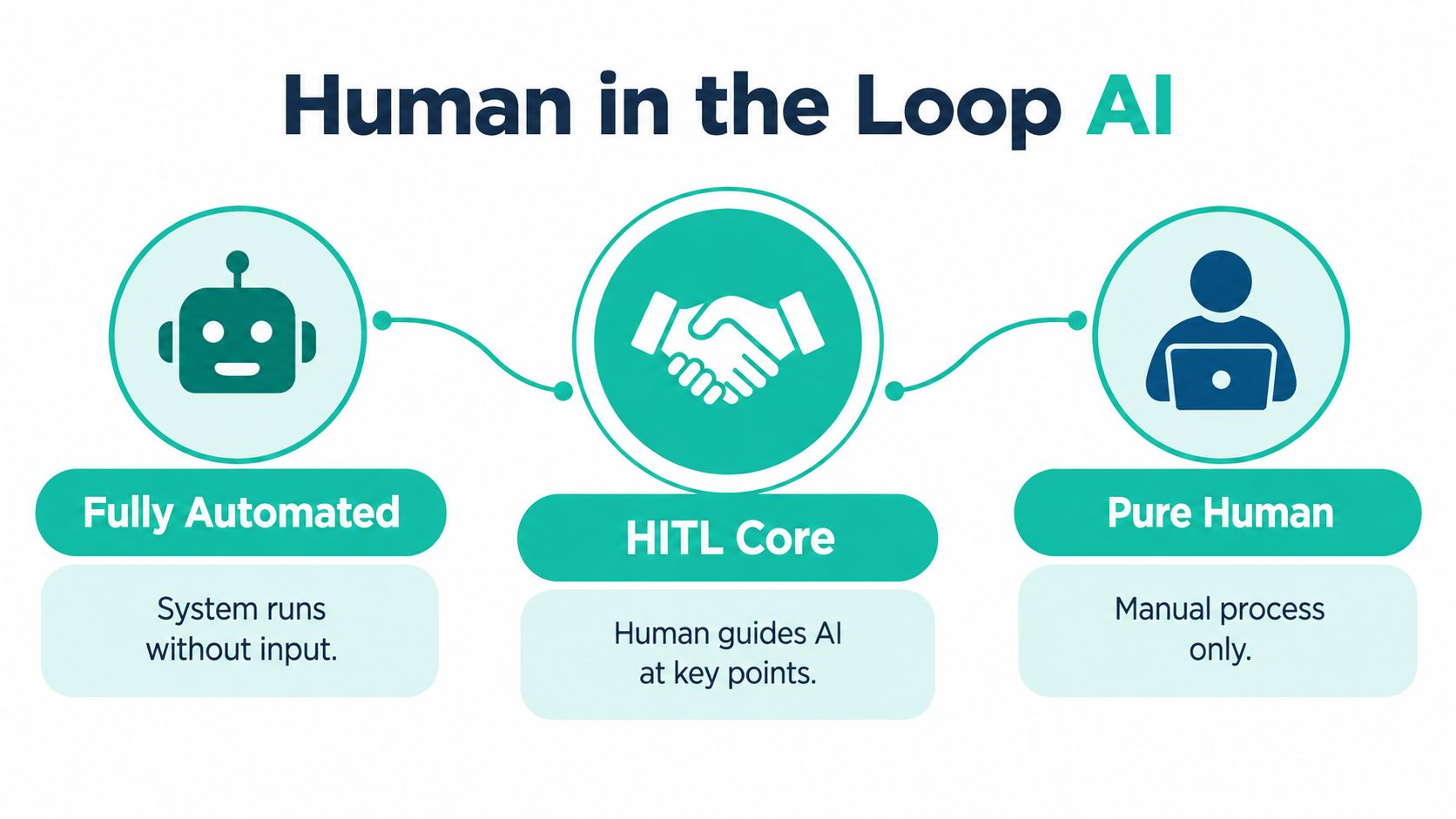
The three levels people often confuse
At one end, fully automated work allows the system to act without a pre-action review. People inspect results later, which can suit low-risk tasks where errors are easy to reverse, such as routine formatting or low-stakes content variations.
A human-on-the-loop workflow keeps the system running while people monitor performance. The system can continue until a confidence score, policy check, or unusual event triggers intervention. NIST's risk-based guidance supports choosing human involvement according to the possible impact of an error NIST AI RMF.
At the stricter end, human-in-the-loop systems pause for a decision before taking action. This suits legal, financial, health, or public-facing brand decisions, where an incorrect output may be difficult to reverse. The point is to place human effort where judgment can change the result, rather than sending every item to the same queue.
A pilot and co-pilot analogy that actually helps
An AI workflow works like a cockpit with assigned controls. The system handles speed, repetition, and routine checks. The human watches for ambiguity, responds to exceptions, and decides whether a particular action should proceed. The important question is not whether a person appears somewhere in the process. It is whether that person can intervene at the right decision point.
Approval alone does not create meaningful oversight. A reviewer needs enough context to understand the output, the reason for review, and the available actions. They should be able to edit, reject, escalate, or request another evaluation. Recent scholarship distinguishes AI's operational agency from human evaluative agency, reinforcing the need for real intervention rights Springer PDF.
If the human can't change the outcome, they're not in the loop. They're standing next to it.
How to map the concept to real work
In healthcare, a system can flag a likely issue while a clinician decides what happens next. In finance, a model can surface fraud risk while a human decides whether to freeze an account. In marketing, AI can draft a pin while a reviewer checks unusual claims, sensitive products, or off-brand language.
The operating principle is straightforward. Automation handles repeatable volume, while people handle decisions that require context, accountability, or interpretation. A well-designed workflow makes that division visible, reviewable, and practical for the team using it.
Technical Architectures and Integration Patterns
The architecture determines whether human oversight can affect an outcome. A workflow may include a review screen, yet still fail if it sends the wrong cases to the wrong people or asks for approval after the meaningful decision has already been made. Design the route first, then decide where automation belongs.
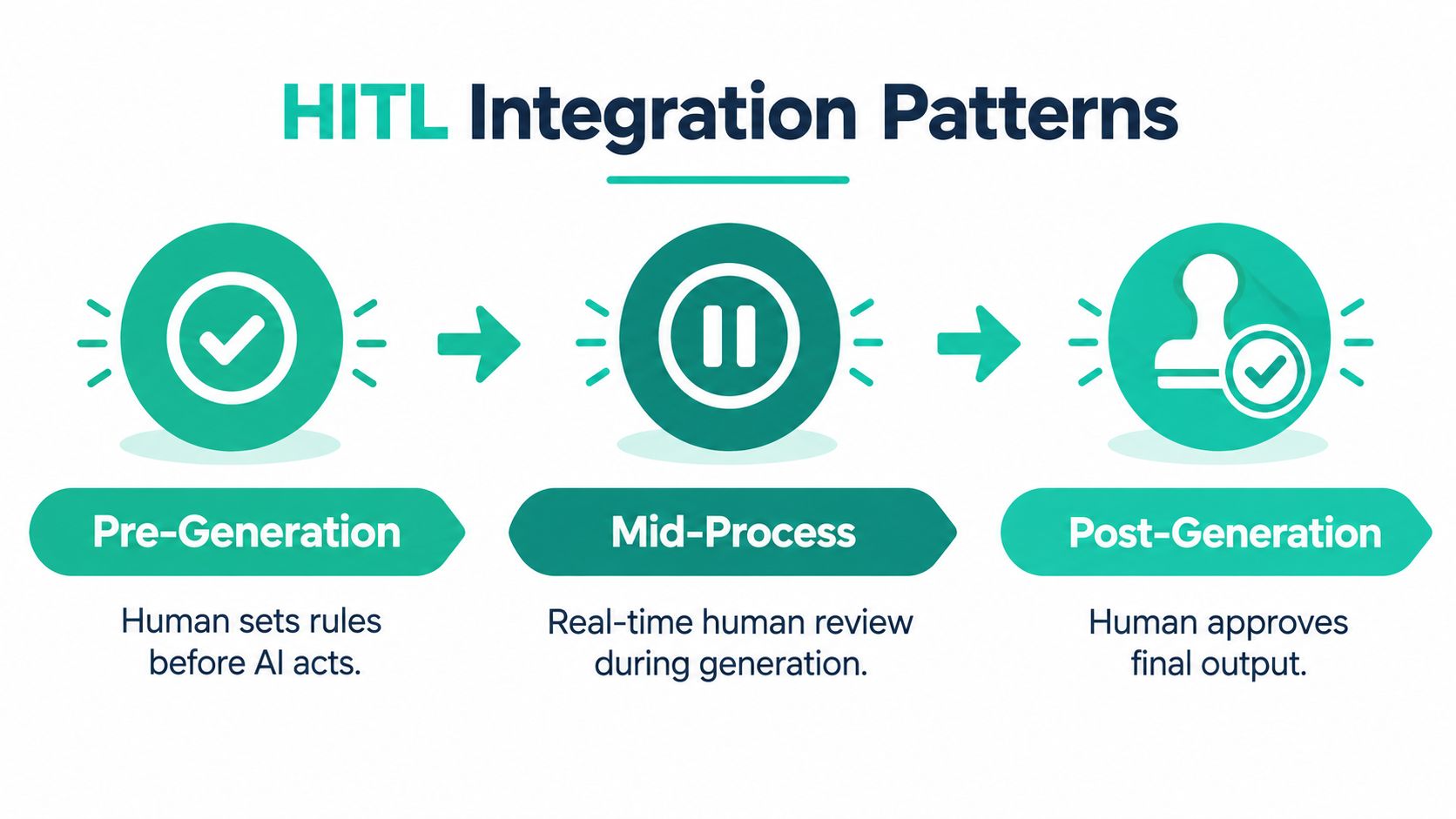
Synchronous approval works for high-risk actions
This pattern pauses a workflow before publication or execution. A human reviews the output and its evidence, then approves, edits, rejects, or escalates it. NIST's risk-based guidance supports this approach for high-consequence or difficult-to-reverse actions NIST AI RMF.
Approval without authority is merely decoration. A reviewer who cannot reject, edit, or escalate is not in control. The interface should show the proposed output, the reason for review, relevant evidence, and the actions available to the reviewer. In marketing, examples include pricing claims, regulated products, unusual benefits, and language that conflicts with brand rules.
Asynchronous sampling keeps throughput high
A review queue should not stop every routine item. High-confidence, repeatable output can move forward automatically, while uncertain or sensitive cases receive human attention. Confidence thresholds work as triage rules. They do not prove that a model is reliable; they specify when the workflow should ask for help.
A medical-imaging example illustrates the allocation problem. Physician-only review reached 80.8% accuracy, AI-only review reached 84.7%, and a workflow that sent uncertain cases to a physician reached 86.9% accuracy, according to the Stealth Agents research summary. The business lesson is broader than healthcare. Human effort has greater value when it is reserved for cases where context can change the decision.
A pilot and co-pilot analogy
Automation can act like a pilot handling a predictable route. The human co-pilot watches instruments, manages exceptions, and has clear authority to intervene. A button marked “approve” does not provide that control if the reviewer lacks context or cannot alter the flight path.
Feedback loops make oversight useful later
Human corrections should change the system that produced the mistake. Repeated rejection of the same output may point to a weak prompt, template, threshold, or policy rule. Without that feedback, the team pays to correct the same error repeatedly.
A practical operating model includes:
- Set escalation rules: Define what pauses, what is sampled, and what ships automatically.
- Define reviewer authority: Specify who can approve, edit, reject, or escalate.
- Log every action: Record the original output, human changes, and final decision.
- Tune by exception: Use recurring review patterns to update prompts, thresholds, and policy rules.
The strongest architecture is the one that makes intervention quick, proportionate to risk, and traceable.
The Psychology of Human-AI Collaboration
People often assume humans make AI safer just by being present. The evidence says it's more complicated. Reviewers can over-trust a system and approve weak suggestions, or under-trust a good one and waste time reversing correct outputs. Both failure modes are common, and both are human problems as much as technical ones.

Calibration matters more than confidence alone
The IEEE study in the brief found expected calibration error below 10% for both conditions, 9.7% for AI and 6.2% for humans, and reported a 6% improvement in initial human accuracy when AI results were interpretable IEEE. That doesn't mean “show a confidence score and you're done.” It means people make better decisions when the system gives them evidence, not just a verdict.
A confidence number is only useful if the team knows what to do with it. If a reviewer sees a high score and still doesn't know why the system made the recommendation, the score can become a false source of comfort. Interpretability turns the review from guesswork into scrutiny.
Automation bias is a workflow problem
Automation bias happens when reviewers stop challenging the machine. They skim, accept, and move on. The fix isn't more nagging. The fix is better interface design and better role design.
Practical rule: Show enough evidence for a reviewer to disagree quickly.
For content teams, that means surfacing the specific product source, the policy trigger, the confidence level, and the reason an output was flagged. For campaign teams, it means showing why a keyword choice or product description looks unusual. For support teams, it means making the escalation path obvious when the AI answer sounds plausible but misses context.
Trust grows when the system earns it
Reviewers work better when they can see why the system is asking for help and what happens if they intervene. That lowers blind approval and reduces unnecessary overrides. It also builds a healthier working relationship between people and machines, because the machine becomes a tool with boundaries rather than a black box demanding trust.
Human-AI collaboration works best when the reviewer is informed, not overloaded. The system should tell people what matters, and leave the rest alone.
How Exerta Can Help
Pinterest content workflows create a familiar operational problem. AI can produce pin descriptions, suggest product angles, answer audience questions, and flag potentially harmful comments faster than a team can review each item. Yet an unchecked recommendation can still misrepresent a product or weaken brand trust. Exerta supports this kind of workflow by combining AI agents with logging, measurement, and human approval. Its human-in-the-loop AI resource explains the operating model in more detail.
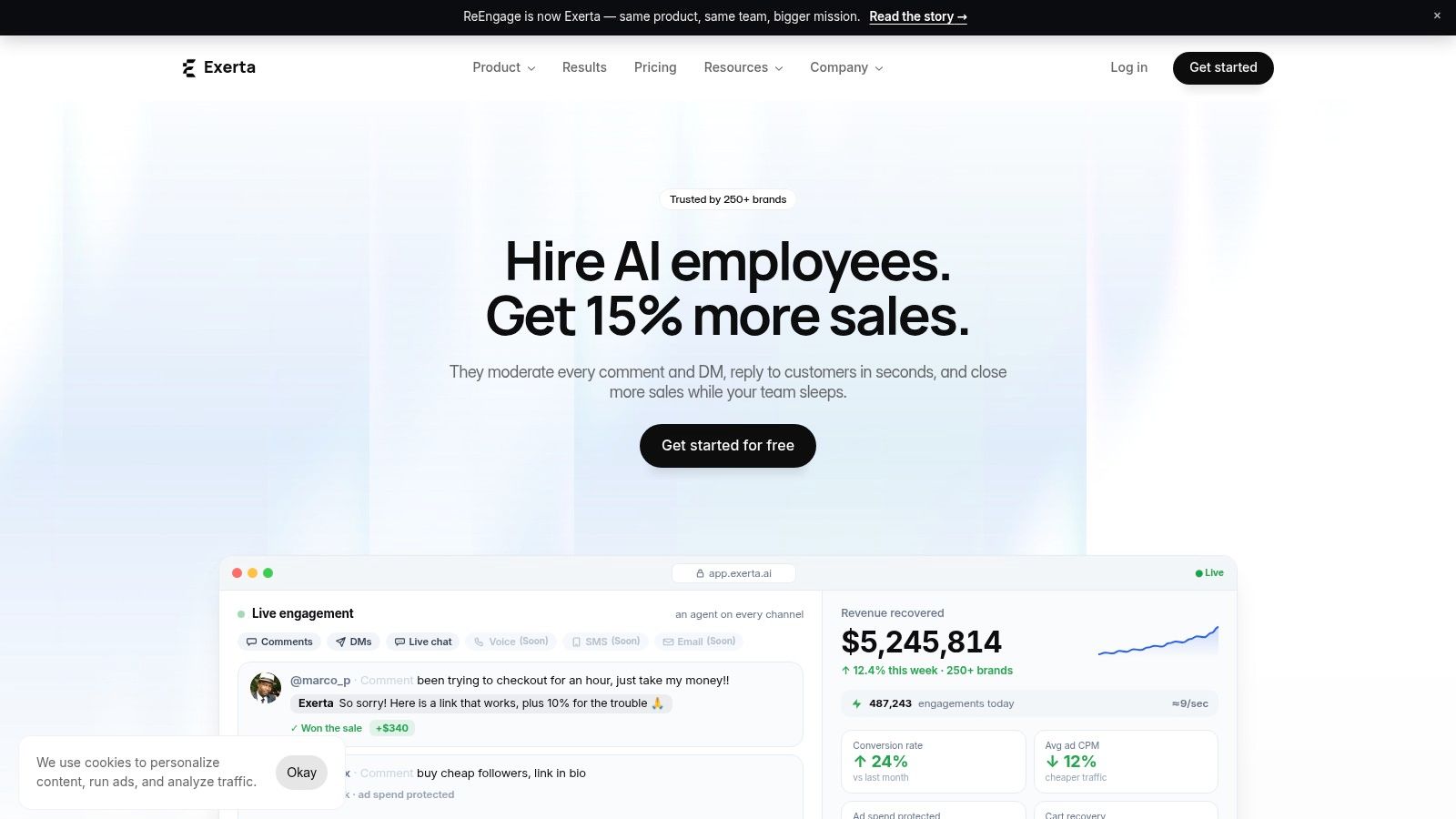
Why this matters for oversight
Exerta fits teams that have too much content and engagement to moderate manually, while still needing careful review for brand-sensitive decisions. In a Pinterest workflow, the system can help prepare content, maintain a consistent brand voice, identify harmful or unsuitable material, and surface buying intent for follow-up. Actions can be logged so the team can examine what the system did and why.
The review queue should work like airport security, not a tollbooth. Low-risk, familiar items can pass through quickly. A product claim, unusual customer question, or policy-sensitive response should receive closer inspection before publication. Teams can set escalation and approval paths around those differences, so human effort follows risk instead of treating every output alike.
When it's the right choice
The platform is a practical fit when content teams lose time to repetitive preparation, delay responses to audience questions, or struggle to keep tone consistent across campaigns. Measurement and action logs give managers a clearer record of what was published, what was escalated, and which activity produced a useful outcome.
Exerta does not remove the need for judgment. It helps concentrate that judgment where it has the greatest effect. Reviewers still need clear approval criteria, defined escalation rules, and enough context to challenge an output rather than rubber-stamp it. With those controls in place, human oversight becomes an auditable part of the workflow instead of a queue that slows every task.
Benefits and Risks of HITL Systems
A marketing team may have an AI system ready to publish a product pin in seconds. A human reviewer catches an unsupported claim before it reaches customers. That is the practical value of human in the loop AI. It directs human judgment toward decisions where an error could damage trust, create compliance exposure, or be difficult to reverse.
HITL works poorly when “human review” means adding another inbox. Without clear ownership, review criteria, and escalation rules, people either approve everything quickly or become a bottleneck. The goal is a control system that records who reviewed an item, what evidence they saw, what decision they made, and whether that decision should improve the workflow.
Where HITL adds real value
Use human review for legal claims, medical-like decision support, regulated products, sensitive customer interactions, and branded content with compliance implications. Risk-based guidance supports selective oversight rather than placing a person in front of every output NIST AI RMF.
Creative work often benefits from a reviewer who can refine a draft without starting again. Decision systems need a different arrangement. A reviewer may focus on exceptions, missing context, and unusual recommendations while routine, reversible outputs follow a lighter check.
The costs are operational, not just technical
Reviewer capacity is the hidden constraint. A systematic review indexed by PubMed identifies scalability, cognitive load, and trust calibration as recurring HITL challenges. Research on MLOps also places human involvement heavily in evaluation, deployment, monitoring, and incident response Springer PDF. The limiting factor may therefore be queue design rather than model quality.
Too many low-risk items encourage skimming. Too few reviewed items can leave people without enough context to judge the system. Risk-based routing, sampling, and clear evidence displays help reviewers spend attention where it matters.
A decision filter that works
Ask three questions before adding review:
- Can the error be reversed easily? If not, use a stricter approval gate.
- Does the reviewer have real authority? If not, the step is inspection, not oversight.
- Will the review data improve the system? If not, the organization is paying for checking without learning.
HITL earns its place when review reduces meaningful risk and produces usable feedback. Otherwise, redesign the workflow before adding people.
Implementation Steps and Best Practices
A good rollout starts with one use case, not a company-wide mandate. One ecommerce team, for example, might begin with Pinterest pins for a small product set, where AI drafts the creative and a human reviews only the risky items. That's a better proving ground than asking every team to adopt the same process on day one.
Step 1 define the risk boundary
Start with the outputs that could hurt the brand, the buyer, or the business if they were wrong. For Pinterest automation, that might include claims about prices, availability, regulated products, accessibility text, and anything that sounds unusual or off-brand. Everything else can be sampled or auto-published.
Pick the smallest workflow where a mistake would be annoying at best and expensive at worst.
Step 2 choose the right review model
Use human-in-the-loop approval where the system must wait. Use human-on-the-loop monitoring where speed matters and the risk is lower. If the output is routine and reversible, don't put a person in front of every item just because it feels safe.
A strong review interface shows the output, the trigger, the source, and the action available to the reviewer. It should also make rejection easier than approval when the evidence is weak. That keeps people from rubber-stamping by default.
Step 3 build a feedback loop, not a dead end
The review queue should teach the system. If people keep correcting the same label, claim, or board choice, update the prompt template, the classification rule, or the content guardrail. Otherwise the same failure will keep coming back dressed as a new item.
The internal guide on reducing repetitive work with Pinterest automation best practices is a good reference point for thinking about the balance between volume and oversight.
Step 4 instrument the process
Track approval latency, rejection patterns, and post-publication errors. If the same reviewer is approving everything with no changes, that may be a training issue or a sign that the queue is too broad. If rejections spike, the model may be drifting or the prompt may be too loose.
Step 5 train reviewers to challenge, not bless
Reviewers need permission to push back. They also need examples of what counts as a real issue. If the only instruction is “approve if it looks fine,” the team will create a rubber stamp. If the instruction is “approve only when you can explain why,” the quality of oversight goes up.
HITL in Practice – Improving Pinterest Automation
Pinterest workflows are a clean example because they mix scale, branding, and judgment. A product catalog can produce a large batch of drafts quickly, but not every draft deserves the same review path. Some are routine. Some are risky. The whole point of human oversight is to tell the difference.
A practical routing model
If a system generates 200 pins from a catalog, it shouldn't throw all 200 into a manual queue. Routine products with standard copy can be auto-approved after sampling. Low-confidence designs, odd board matches, policy-sensitive claims, and unusual product descriptions should go to a person before publishing. That keeps output moving without treating every item as equally risky.
Confidence thresholds become operational, not theoretical, right here. They help separate “safe enough to ship” from “needs a human check.” The review queue should be short enough that people can think, not so long that they start clicking through by habit.
What good oversight catches
Human reviewers are especially useful when a pin looks technically correct but strategically wrong. Maybe the visual is on-brand but the product claim is too aggressive. Maybe the board selection is technically relevant but mismatched to the intent. Maybe the metadata is polished but missing a compliance nuance.
The related guide on AI automated pin generation shows how the creation side works. The missing piece is governance. Generation can produce volume, but HITL determines which outputs deserve a yes, which deserve edits, and which should never go live.
A strong Pinterest workflow doesn't ask humans to review everything. It asks them to review the things that could break trust.
What success looks like
Success isn't “more human work.” Success is fewer exceptions, cleaner approvals, and better consistency across a growing output stream. If the queue stays small while quality stays high, the workflow is working. If the queue keeps growing, the triage rules need to change.
Measuring Success and Continuous Improvement
A HITL system should behave like an operational control, not a vague review habit. That means measuring it the way you'd measure any business process. If you don't track what gets approved, rejected, overridden, and corrected later, you'll never know whether the human layer is helping or just slowing things down.
The metrics that matter
Three numbers tell most of the story. Approval latency shows whether the queue is moving. Rejection and override patterns show whether reviewers are catching real problems or just clicking through. Post-publication error rates show whether bad outputs are slipping past the gate.
Those metrics only make sense together. A low rejection rate can mean good model quality, or it can mean reviewers are rubber-stamping. A high override rate can mean the model is drifting, or it can mean the review rules are too strict. The dashboard has to help people separate those explanations.
How to improve without adding friction
A/B test the workflow itself. Try different confidence thresholds. Compare a stricter approval gate with a lighter sampling model. Watch which setup catches more mistakes without overwhelming the team. That's the fastest way to find the right balance between caution and throughput.
If reviewer feedback keeps identifying the same kind of error, feed that signal back into the prompts, rules, or training data. If the same issue keeps reappearing after correction, the system design is wrong somewhere upstream.
A simple operating standard
Good HITL systems get narrower over time. The machine handles more routine work, and the human queue becomes more selective and more valuable.
That's the end state worth aiming for. Not more review for its own sake, but better review where it counts.
If you're building a Pinterest workflow or any other AI content pipeline, start with one high-risk use case, define the reviewer's authority, and measure what happens after publication. If you want to explore a platform that applies those ideas in a real operational setting, take a close look at Pin Generator, then compare it against your current process and see where human judgment still needs to sit in the loop.