
Is Pinterest Affiliate Marketing Legit? a 2026 Guide
11 November 2026
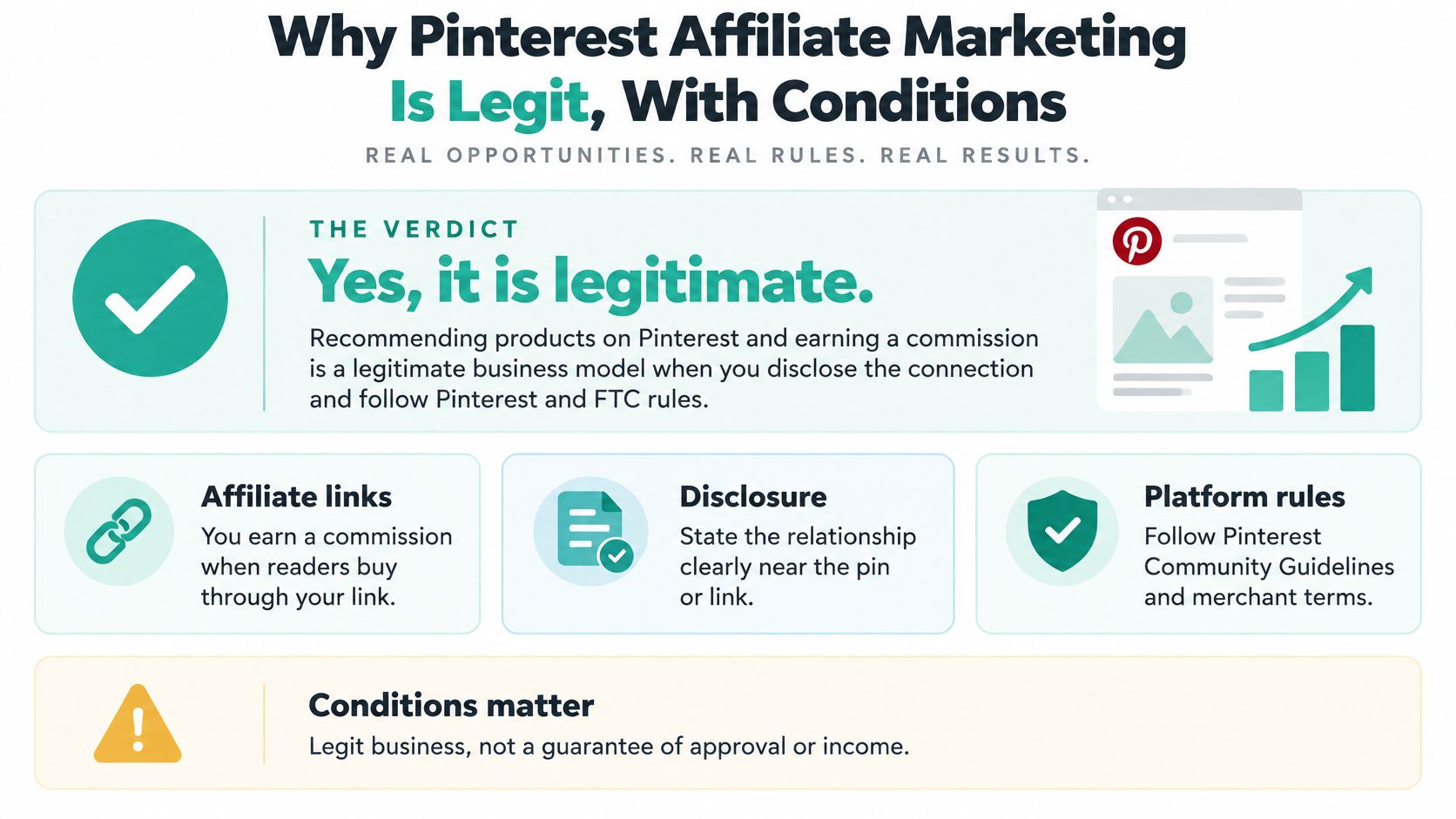
Yes, Pinterest affiliate marketing is legitimate when you follow Pinterest's rules and disclose your commissions, but it isn't a guaranteed income source. The popular advice to copy product links, publish endless pins, and wait for passive income leaves out the work that makes the business legitimate.
The important distinction is the model versus the tactics. Recommending useful products can be a real business. Disguising commissions, inventing product experiences, or flooding boards with near-identical promotions creates a different kind of operation, and a much riskier one.
If you're asking “Is Pinterest affiliate marketing legit?” before investing your time, judge the opportunity by its rules, merchant terms, and trackable sales, not a screenshot of someone's monthly views.
Table of Contents
- Why Pinterest Affiliate Marketing Is Legit, With Conditions
- Pinterest Rules Every Affiliate Must Follow
- Disclosure Wording That Keeps You Compliant
- Red Flags That Signal a Risky Offer or Tactic
- Realistic Earnings and What Drives Them
- Set Up Pinterest Affiliate Pins Safely, Step by Step
- Fixing Low Clicks, Missing Sales and Warnings
- Frequently Asked Questions About Pinterest Affiliate Marketing
- Do I need a website before promoting affiliate products on Pinterest?
- How long before a pin earns its first commission?
- Is Pinterest affiliate marketing a scam?
- Can I recommend a product I haven't used?
- What should I do if my commission reports look wrong?
- Should I prioritize saves or sales?
- Does using a scheduler make the campaign compliant?
Why Pinterest Affiliate Marketing Is Legit, With Conditions
A commission on a pin is allowed. That fact does not clear the pin itself.
Pinterest has hundreds of millions of monthly users worldwide, which is why affiliates keep testing product pins. Scale explains the interest. It does not predict your reach, and it does not approve your method.
A permitted business isn't an approved shortcut
Take a pin about storage for a narrow kitchen. A useful version names what fits, gives the dimensions that matter, and links to the product shown. The commission does not make that recommendation dishonest.
Account trouble starts with the tactics. Claiming you tested a product you never used, swapping in an unrelated item, or hiding why you recommend it can break disclosure and spam rules even when the affiliate program is real. Programs pay on approved sales. Platforms still remove pins, limit distribution, or flag accounts when the publishing method is the problem. Commissions disappear with the traffic.
I separate three checks before I treat an offer as workable:
- Platform permission: Pinterest's rules set what you can publish and how commercial content must be labeled.
- Merchant permission: The affiliate program decides which pins, URLs, and promotional methods still qualify for a commission.
- Customer value: The pin has to help a buying decision. A tracking link is not the content.
Practical rule: A legitimate affiliate link does not make every way of promoting it legitimate.
Treat income claims as a separate question
No reliable public average will forecast your Pinterest affiliate income. Niche, qualified traffic, product choice, and how the merchant converts matter more than another creator's revenue screenshot.
Effortless-income pitches also skip the upkeep. Products go out of stock, landing pages change, merchants rewrite terms, and old recommendations need edits. Miss that work and you keep sending people to dead offers, which wastes the clicks you already earned and can put commissions at risk if the program no longer allows the placement.
I would treat this as a small publishing business, not a passive-income purchase. Before you scale pin volume, prove three things in order: compliant pins, relevant visitors, and sales the merchant approves. None of those follows just because you can open Pinterest.
Pinterest Rules Every Affiliate Must Follow
Pinterest affiliate requirements and what they mean in practice
| Requirement | What It Means in Practice |
|---|---|
| Paid-partnership rules | Follow Pinterest's paid-partnership requirements for sponsored or commissioned content. |
| Clear commercial disclosure | State in plain language that you may earn a commission on each affiliate pin. |
| Link transparency | Make the destination and purpose understandable; don't disguise where someone will land. |
| Spam limits | Avoid mass-pinning the same product, duplicate promotions, and keyword-stuffed descriptions. |
| Accurate claims | Describe products truthfully, without fake reviews, invented results, or misleading prices. |
| Network terms | Check each program's rules on pins, affiliate URLs, and social promotion before publishing. |
The controlling rulebook is Pinterest's Community Guidelines, which require affiliates to follow paid-partnership requirements, disclose the commercial nature of their content, and be transparent about affiliate links and their behavior. Treat these as publishing requirements, not optional additions after a pin starts performing.
The table combines platform obligations with the practical checks needed to run an affiliate campaign. A network can impose restrictions beyond Pinterest's requirements, so platform permission alone isn't enough.
Repetition is a risk, not a strategy
Publishing the same offer across unrelated boards with slightly altered wording doesn't create useful coverage. It creates repetitive promotion. Keyword stuffing introduces another problem: the description stops helping readers understand the product.
There isn't a universal safe posting quota that makes low-value repetition acceptable. Spacing out duplicates doesn't turn them into original content.
Use this distinction when reviewing a batch:
- Meaningful variation: A different image and headline address a distinct use case, such as renter-friendly storage versus compact pantry organization.
- Cosmetic variation: A changed background color repeats the same sales message without adding anything useful.
- Irrelevant distribution: A product appears on boards that don't match its subject just to increase exposure.
Our guide to Pinterest Community Guidelines can help translate policy into a publishing checklist. Review the live platform rules whenever you change your promotional approach.
Your claims remain your responsibility
A merchant's product description is a starting point, not permission to exaggerate. If the listing says a shelf requires wall mounting, your pin shouldn't describe it as damage-free storage.
Keep a record of the product page and approved assets used to create each recommendation. That makes it easier to investigate a complaint or replace an outdated claim.
Pinterest access also isn't an endorsement of the merchant. Assess the seller separately, and don't imply that appearing on the platform means the product has passed a quality review.
Rule-checking belongs in every publishing session. A policy violation can jeopardize the account carrying your traffic, while a network violation can make otherwise genuine sales ineligible for commission.
Disclosure Wording That Keeps You Compliant
Could someone who sees only your pin understand that you may earn a commission from their purchase? That's the practical test to use before publishing, although wording alone can't guarantee legal compliance.
Build the disclosure into your production checklist rather than adding it after the creative is finished.
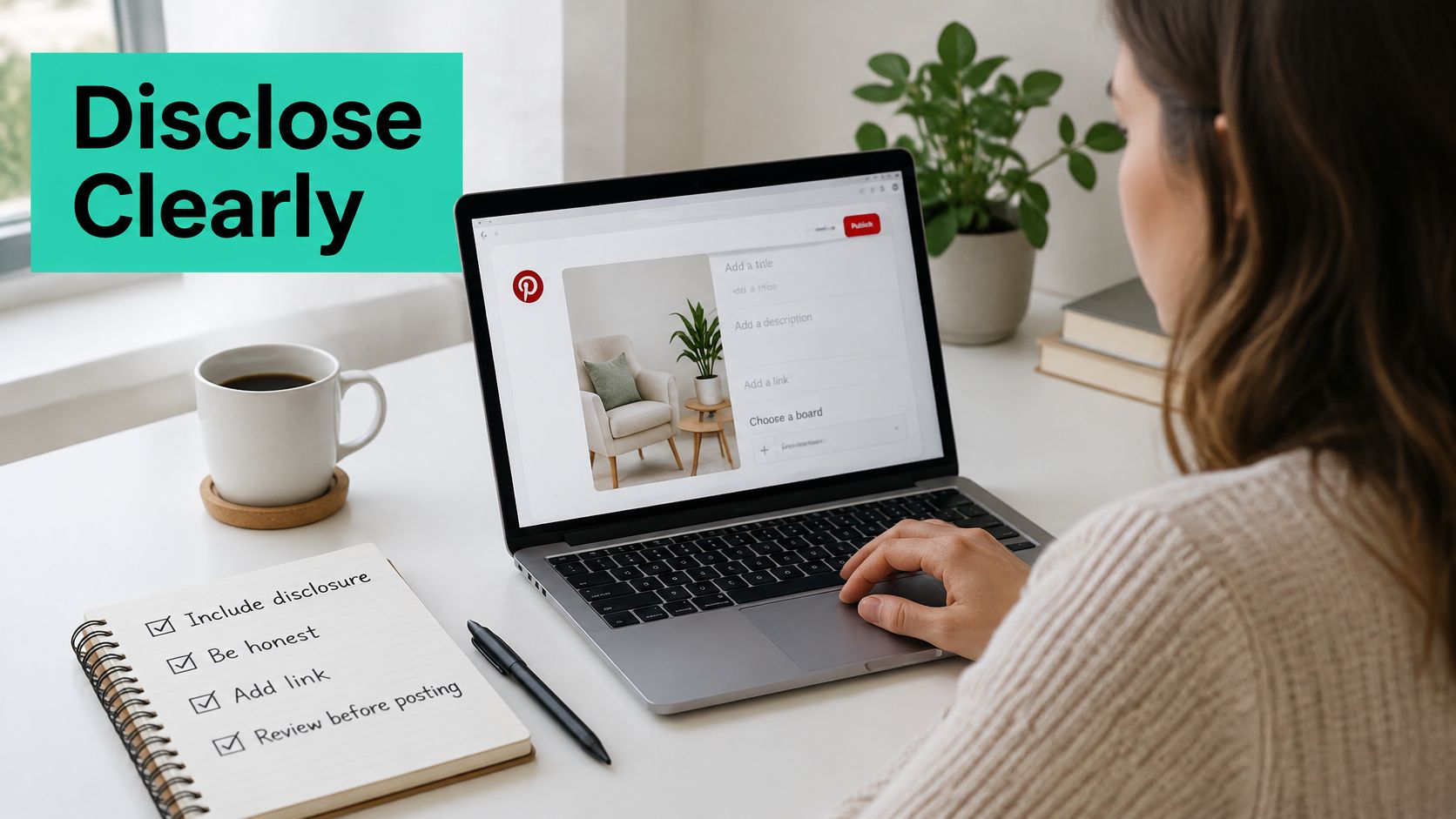
For U.S.-connected endorsements, the Federal Trade Commission's endorsement guidance says an unexpected material connection should be disclosed when it could affect how consumers evaluate a recommendation, and gives this example: “I get commissions for purchases made through links in this post.”
That's clearer than relying on unfamiliar terminology. A reader may understand that a link is commercial without understanding that you receive money when they buy.
Wording you can adapt
- Full commission sentence: I may earn a commission if you purchase through this link.
- Short description version: I earn commissions on qualifying purchases.
- Landing-page version: This page contains affiliate links. I may earn a commission when you buy through them.
Use wording that accurately describes your arrangement. Don't say you're paid for clicks when your program pays only for qualifying purchases, and don't add claims about customer pricing unless you've verified them.
Evidence submitted in a filing to the FTC reported that only approximately 7% of Pinterest pins containing affiliate-marketing URLs included creator disclosures. That finding identifies a disclosure gap, not proof that affiliate marketing itself is fraudulent.
Placement matters as much as the sentence
Put the disclosure near the beginning of the pin description, where readers can encounter it with the recommendation. When the image itself contains the endorsement, include readable disclosure text there too rather than assuming everyone will open the description.
On a landing page, repeat the relationship near the relevant recommendations or links. A footer policy doesn't help someone who has already acted on a product endorsement.
For a companion explanation, use the video below alongside your own disclosure review.
Check the published mobile view, not just the editor. Text can be cropped, visually overwhelmed, or separated from the recommendation.
FTC guidance addresses U.S.-connected endorsements; other markets have their own advertising requirements. The final test remains comprehension: can the reader understand your financial interest before acting on the recommendation?
Red Flags That Signal a Risky Offer or Tactic
An affiliate dashboard isn't proof that an offer deserves promotion. Before giving a merchant access to your audience, inspect what it sells, how it pays, and what it expects you to say.
Warning signs worth acting on
- Guaranteed income: Claims that you can quickly replace your salary without meaningful work are a reason to stop and investigate. They encourage spending before you've established any demand or sales.
- Recruitment-led payments: If the central pitch is recruiting more participants rather than selling a useful product to customers, examine the compensation structure carefully. Don't assume an affiliate label makes the arrangement sound.
- Unpublished commercial terms: Missing commission rules, refund terms, or payment conditions make it difficult to establish what you're owed. A recorded sale isn't the same as an approved, payable commission.
- Questionable products or discounts: Unsafe goods, unsupported licensing claims, and inflated comparison prices expose readers to harm and you to complaints. Refunds and chargebacks can also undermine apparent earnings.
- Concealed destinations: Redirects are not automatically deceptive, but a link that prevents you from understanding the final merchant deserves scrutiny. Don't promote a destination you can't verify.
- Pin-farm instructions: A program that recommends flooding boards with near-identical promotions is asking you to carry the account risk. More output isn't a substitute for useful content.
- Requested deception: Walk away when a sponsor asks you to hide compensation, invent a personal experience, or publish a fake review. Payment doesn't justify misleading readers.
Vet the merchant before the creative
Confirm the network and merchant identity, read the commission agreement, and search the merchant's name alongside complaints. Look for repeated issues involving fulfillment, refunds, or unpaid affiliates rather than judging by an isolated review.
Then follow the link yourself. Check the product, checkout destination, and customer-facing policies before attaching your recommendation.
A generous commission isn't attractive if you can't confidently explain what the buyer will receive.
Save the terms you accepted and the contact details for affiliate support. If something later changes, you'll have a concrete basis for deciding whether to update the campaign or stop promoting it.
Realistic Earnings and What Drives Them
There's no reliable public average that makes a fixed Pinterest affiliate-income promise credible. Revenue screenshots can omit expenses, refunds, other traffic sources, or the work required to build the content.
There is evidence that social discovery can lead to purchases: a 2024 Ipsos survey cited by eMarketer found that 63% of U.S. consumers aged 18 to 34 sometimes or often purchase items discovered through social media. That describes purchasing behavior across social media, not a Pinterest conversion rate or an affiliate earnings benchmark.
Use a model rather than an income promise
Illustrative monthly commission scenarios
Every input below is a hypothetical assumption for explaining the calculation. These aren't observed results, averages, or forecasts.
| Scenario | Monthly Clicks | Conversion Rate | Average Order | Commission Rate | Estimated Monthly Commission |
|---|---|---|---|---|---|
| Starter blog | 5,000 | 1% | $60 | 8% | $240 |
| Growing niche site | 10,000 | 2% | $60 | 8% | $960 |
| Established content site | 20,000 | 2% | $80 | 10% | $3,200 |
| High traffic, low conversion | 40,000 | 1% | $50 | 5% | $1,000 |
In the hypothetical starter example, 5,000 clicks × 1% conversion produces 50 sales. At an assumed $60 average order, those sales total $3,000, and an assumed 8% commission produces $240.
The growing-site example changes traffic and conversion without changing the product value or commission rate. The high-traffic example demonstrates why exposure alone isn't enough: substantial traffic can still produce comparatively modest commissions when purchase conversion and payout are low.
Improve the buyer's decision, not just the payout
A higher commission rate can be attractive, but only if the offer suits the audience. An unfamiliar merchant with weak product information may earn you less than a lower-paying merchant whose offer readers understand and trust.
For an illustrative home-decor scenario, suppose a blogger publishes content about lighting for awkward corners. She explains placement, dimensions, and the difference between plug-in and hardwired fixtures, then creates pins for those specific problems.
Her useful measure isn't how many saves the images receive. It's whether the resulting visitors reach relevant products and make qualifying purchases. Older pins might continue bringing visitors, but that possibility shouldn't become an assumption of permanent income.
Budgeting rule: Treat recorded commissions as provisional until the program approves them, and treat future traffic as uncertain.
Compare approved revenue with your content, software, and advertising costs. Pinterest distribution can change, so don't commit fixed expenses against an assumed stream of future clicks.
The planning formula is qualified affiliate clicks × purchase conversion rate × commissionable average order value × commission rate. Use the network's actual commission basis, then account for reversals and expenses.
Set Up Pinterest Affiliate Pins Safely, Step by Step
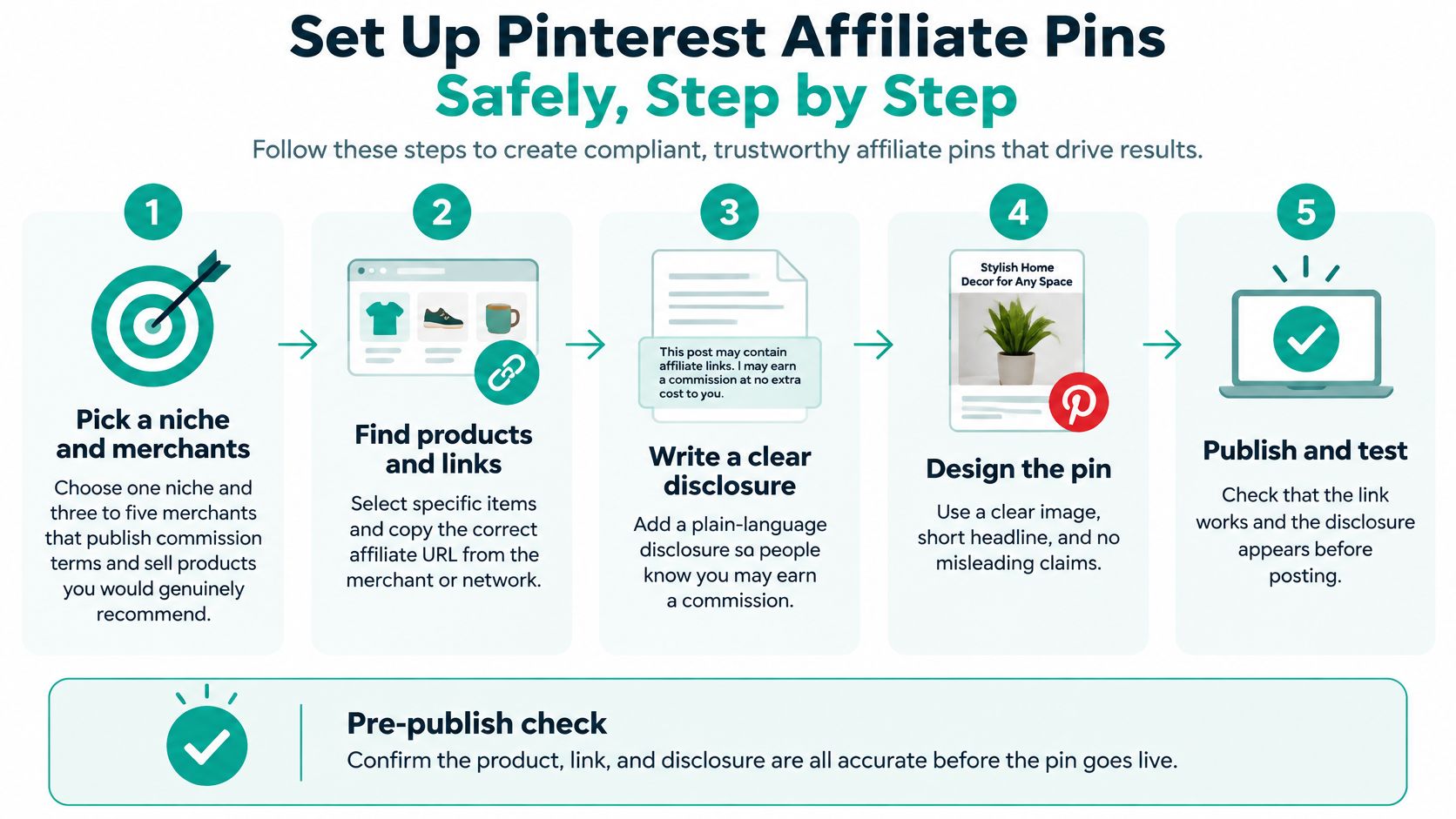
Build a workflow you can inspect before building one you can scale. Your first campaign should make it easy to identify the product, the permitted promotional method, and the page a reader will reach.
The sequence below keeps those checks attached to production.
Build the campaign foundation
Choose a focused niche and credible merchants. Start with a problem you can explain, such as storage for rented homes, rather than an assortment of unrelated high-commission products. Select merchants with published terms and products you would recommend.
Join the programs before preparing promotions. Read their social-promotion rules, image permissions, link requirements, and restrictions on product claims. Save the approved affiliate URL rather than copying an ordinary address from the merchant's browser bar.
Research the language buyers use. Check Pinterest search suggestions and Pinterest Trends. Group queries by need, such as narrow entryway storage, rather than stuffing every related phrase into the same description.
Choose the most useful destination. A comparison article can explain dimensions, trade-offs, and suitability. Direct linking may fit a straightforward product recommendation when the program permits it, but don't insert a thin landing page merely to add another click.
Produce and check the pins
Design around a specific benefit. Use a vertical layout, readable text, and an image you're authorized to use. Create distinct angles for genuine use cases instead of producing cosmetic duplicates.
Write the title and description together. Keep the search phrase natural and make the promise concrete. Include the appropriate commission wording without letting promotional copy bury it.
Match every claim to evidence. Check size, materials, compatibility, and availability against the current merchant page. Avoid embedding a price or discount into an image unless you have a reliable process for keeping it current.
Test the complete route. Open the published destination, check the product, and inspect whether the affiliate parameters survive the journey. Use the network's approved testing method rather than placing a self-purchase that may breach its terms.
Schedule a manageable batch. Distribute relevant creative across matching boards and leave room to inspect what publishes. Automation should reduce repetitive work, not multiply unchecked mistakes.
At Pin Generator, we're an official Pinterest partner. Our free accounts include pin credits to try brand analysis, AI pins, and scheduling with no website needed, and you only create a Pin Generator account when you connect Pinterest.
Make the expansion decision deliberately
Before publishing, verify the product, destination, disclosure, image rights, and board relevance. Keep those fields in a simple spreadsheet so a changed merchant URL doesn't require hunting through scattered notes.
After the initial test period, compare outbound clicks with network activity and approved sales. Keep productive creative, investigate weak destinations, and retire offers that don't serve the audience.
Expand when you understand what's working. Adding more merchants before you can explain your existing results makes diagnosis harder, not the business stronger.
Fixing Low Clicks, Missing Sales and Warnings
When a pin receives impressions but almost no outbound clicks, inspect the image and title before blaming the affiliate offer. Someone who hasn't reached the merchant hasn't yet had a chance to reject its checkout or product price.
Use the stage where activity stops to choose the next action.
Symptom, likely cause and first fix
| Symptom | Likely Cause | First Fix |
|---|---|---|
| Impressions but almost no clicks | Weak image or vague title | Redesign the vertical pin with a clear benefit headline and test a new title. |
| Clicks but no sales | Landing-page mismatch or weak offer | Align the destination with the pin's promise and compare suitable alternatives. |
| Pins removed or account warned | Repetitive publishing, spammy descriptions, or link problems | Pause the affected queue, inspect the notice, reduce duplicates, and review links and disclosures. |
| Commissions missing | Broken parameters or incorrect affiliate URL | Test the route and check the network's tracking and reporting window. |
| Low reach over an extended period | Irrelevant boards or insufficient useful creative | Improve topic alignment and publish distinct, relevant content. |
| Readers ask about the commission | Disclosure is vague or difficult to see | Put understandable commission wording beside the recommendation. |
Diagnose the destination separately
Open the page on a phone and compare it with the pin's promise. If the image promotes compact desks but the page opens on a general furniture category, the reader has to restart their search.
Check loading, product availability, regional shipping, and whether an intrusive overlay hides the content. Fix those obstacles before generating more traffic.
Our Pinterest Analytics guide can help you distinguish visibility from outbound activity. Compare equivalent reporting periods, and don't assume Pinterest clicks will exactly match network sessions or approved purchases.
Handle tracking and warnings methodically
For missing commissions, preserve the original affiliate URL and compare it with the published destination. Check whether a redirect stripped parameters, whether the network recognizes the promotional channel, and whether the transaction is still pending.
Don't declare tracking broken because a click didn't produce a sale. Attribution rules, excluded items, returns, and reporting delays can affect what appears in the dashboard.
If Pinterest issues a warning, read the stated reason before editing everything. Pause the implicated publishing pattern, document your changes, and use the official review process if you believe the decision was mistaken.
- Immediate corrections: Repair a destination, replace an inaccurate description, or make a disclosure readable.
- Longer rebuilding work: Improve topic coverage, replace repetitive creative, or establish whether a different offer better serves visitors.
Change a clearly identified variable and allow time to observe the result. Constantly replacing images, titles, boards, and destinations together leaves you unable to tell which change helped.
Frequently Asked Questions About Pinterest Affiliate Marketing
Do I need a website before promoting affiliate products on Pinterest?
Not necessarily, provided the affiliate program permits direct Pinterest promotion and you meet its approval requirements. A useful article or landing page gives you room to explain product suitability and limitations, but a website doesn't automatically improve an otherwise weak recommendation.
How long before a pin earns its first commission?
There's no fixed timeline, and publication doesn't guarantee distribution, clicks, or purchases. Treat the initial period as a test of discoverability and buyer fit rather than assigning a deadline to your first sale.
Is Pinterest affiliate marketing a scam?
The model itself is legitimate; evaluate the particular merchant, offer, and promotional method. A seller promising guaranteed earnings or emphasizing recruitment over customer value deserves scrutiny regardless of how professional its affiliate portal looks.
Can I recommend a product I haven't used?
You can describe verified features and explain why a product may suit a particular need, but don't present that as hands-on experience. Make the basis of your recommendation clear, and avoid performance or safety claims you can't substantiate.
What should I do if my commission reports look wrong?
Check the affiliate URL, reporting status, and applicable attribution terms before contacting support. Then provide the affected destination, click dates, campaign identifiers, and any order information you're authorized to share so the network can investigate a specific issue.
Should I prioritize saves or sales?
Saves can indicate that someone wants to revisit an idea, but they aren't evidence of affiliate revenue. Use them to understand interest while judging the business through qualified outbound activity, approved commissions, and costs.
Does using a scheduler make the campaign compliant?
No, a scheduler controls publication, not the truthfulness of your claims or the permissions in your merchant agreement. Review the generated text, destination, and commercial disclosure before anything enters the queue.
Build a small, reviewable campaign before scaling your output. Visit Pin Generator to create on-brand pin designs, prepare titles and descriptions, and schedule your affiliate content, while keeping product claims, link checks, and disclosure approval in your hands.