
What Is a Local SEO Platform and How It Works
4 October 2026
You've updated your business hours in Google Business Profile, but a directory still shows the old schedule. A one-star review has been waiting for a reply, and a competitor keeps appearing when customers search for your neighborhood. You can fix each issue, but finding them means opening a long trail of browser tabs, spreadsheets, and separate dashboards.
A local SEO platform brings those jobs into one operating system. It helps you manage your Google Business Profile, keep business listings consistent, monitor reviews, measure local rankings, and turn visibility problems into practical actions. The important shift is that local visibility no longer ends with Google Maps. Customers increasingly discover businesses through review sites, answer engines, social platforms, and AI assistants, so the right platform should help you understand more than one search surface.
Table of Contents
- What a Local SEO Platform Does
- Core Features That Make Up a Local SEO Platform
- Why Local Visibility Is Moving Beyond Google Maps
- How Synup Can Help
- Benefits for Small Businesses and Marketers
- How to Choose the Right Local SEO Platform
- Implementation Workflow and KPIs to Track
- Key Takeaways and Your Next Steps
What a Local SEO Platform Does
A local SEO platform centralizes Google Business Profile management, directory listings, review monitoring, and local rank tracking into a single workflow. Instead of handling each task in a separate dashboard or spreadsheet, your team can maintain business information, watch customer feedback, and connect visibility changes with specific actions.
The platform is less like a cockpit and more like a shared control panel for local search work. It gives your team one place to check whether information is accurate, whether reviews need responses, and whether customers can find each location. It also helps reveal visibility outside the traditional Google Maps 3-pack, including the local pages, review sources, answer engines, and AI assistants that may influence a customer's choice.
The problem it brings under control
Your business name, address, and phone number, often called NAP data, may appear on Google, Apple Maps, Yelp, Facebook, industry directories, and other publishers. An old phone number on one listing or a different address format on another can reduce customer confidence and give search systems conflicting signals.
A platform stores the approved version of your business details, distributes updates, identifies inconsistencies, and flags duplicate listings. Human oversight still matters, especially when a directory or user suggests a change. The difference is that your team can review known issues instead of finding every error by hand.
Review work follows a similar pattern. A platform can collect new reviews in one inbox, notify the right team member, support response drafting, and show which locations or channels need attention. That turns review management into a repeatable routine rather than a task handled only after someone notices a complaint.
For businesses with several locations, this central view can also separate local problems from system-wide ones. One branch may have weak review activity, while another has inaccurate hours or poor visibility in nearby neighborhoods. A platform helps assign the right fix without treating every location as if it has the same problem.
What it measures
A basic rank report may show strong visibility for a city while hiding meaningful variation. Local rankings change according to the searcher's location, so a business can appear prominently near its storefront and lose visibility in another part of its service area.
Geo-grid tracking addresses that blind spot by checking rankings from multiple points around the area you serve. The result is a map showing where visibility is strong, weak, or missing. Platforms that combine Google Business Profile control with geo-grid measurement can therefore provide more useful direction than tools reporting only one average position. An independent analysis cited Google Business Profile signals at 32% of local-pack ranking weight, with review velocity up 47% year over year, supporting active profile and review management (local SEO ranking factors analysis).
A useful platform connects that report to a practical investigation. If rankings fall in one neighborhood, your team can examine category relevance, reviews, local pages, competitor strength, or inconsistent listings in that area.
The right buying question is which recurring local search problem costs your business the most time or customers, not which platform lists the most features.
Core Features That Make Up a Local SEO Platform
A local SEO platform usually works as a stack. The foundation is accurate business information. On top of that come reputation workflows, measurement, content, and reporting. If the foundation is wrong, detailed reports won't tell you how to fix the customer's experience.
Start with the business profile
Google Business Profile management covers the details customers see first, including hours, categories, services, photos, posts, and questions and answers. A bakery that changes its Saturday hours in the profile but forgets a holiday update can lose a visit before a customer ever reaches its website.
Citation and listing management keeps the same core information aligned across directories and mapping services. The problem it removes is not merely untidy data. Conflicting NAP details can confuse customers, weaken trust, and make multi-location reporting unreliable. One tool comparison highlights local rank tracking, citation monitoring across 108+ sources, and Google Business Profile audits as core platform capabilities (local SEO platform comparison).
Add reputation and discovery workflows
Review management gathers reviews from multiple sources, routes them to the right person, and supports response or approval workflows. A dental practice, for example, can stop checking each review site separately and give its front-office team one queue to manage.
Review generation can help a business invite recent customers to share honest feedback through a short link or message flow. It can't manufacture a positive reputation. It can make the request process more consistent.
Local content and social publishing support ongoing updates at the business or location level. A restaurant might publish a seasonal menu update, while a franchise may need each branch to use a slightly different voice. The platform should allow approval rules rather than publishing every generated item without review.
Measure the geography, not just the average
Local rank tracking records positions for selected searches in Maps and local results. Geo-grid views make the data more useful by showing how visibility changes across an area. A service business can see that it performs well near its office but needs stronger local relevance farther away.
Local keyword research helps connect what people search for with the services and areas a business serves. Schema markup support helps teams represent details such as business type, location, opening hours, and services in a structured form on the website. Neither feature replaces useful pages or a good customer experience, but both can improve how systems interpret the business.
Finally, reporting turns activity into decisions. A useful report should show profile changes, listing accuracy, review activity, local positions, calls, direction requests, and unresolved issues by location. It should help an owner answer, “What needs attention this week?” rather than just display a health score.
Why Local Visibility Is Moving Beyond Google Maps
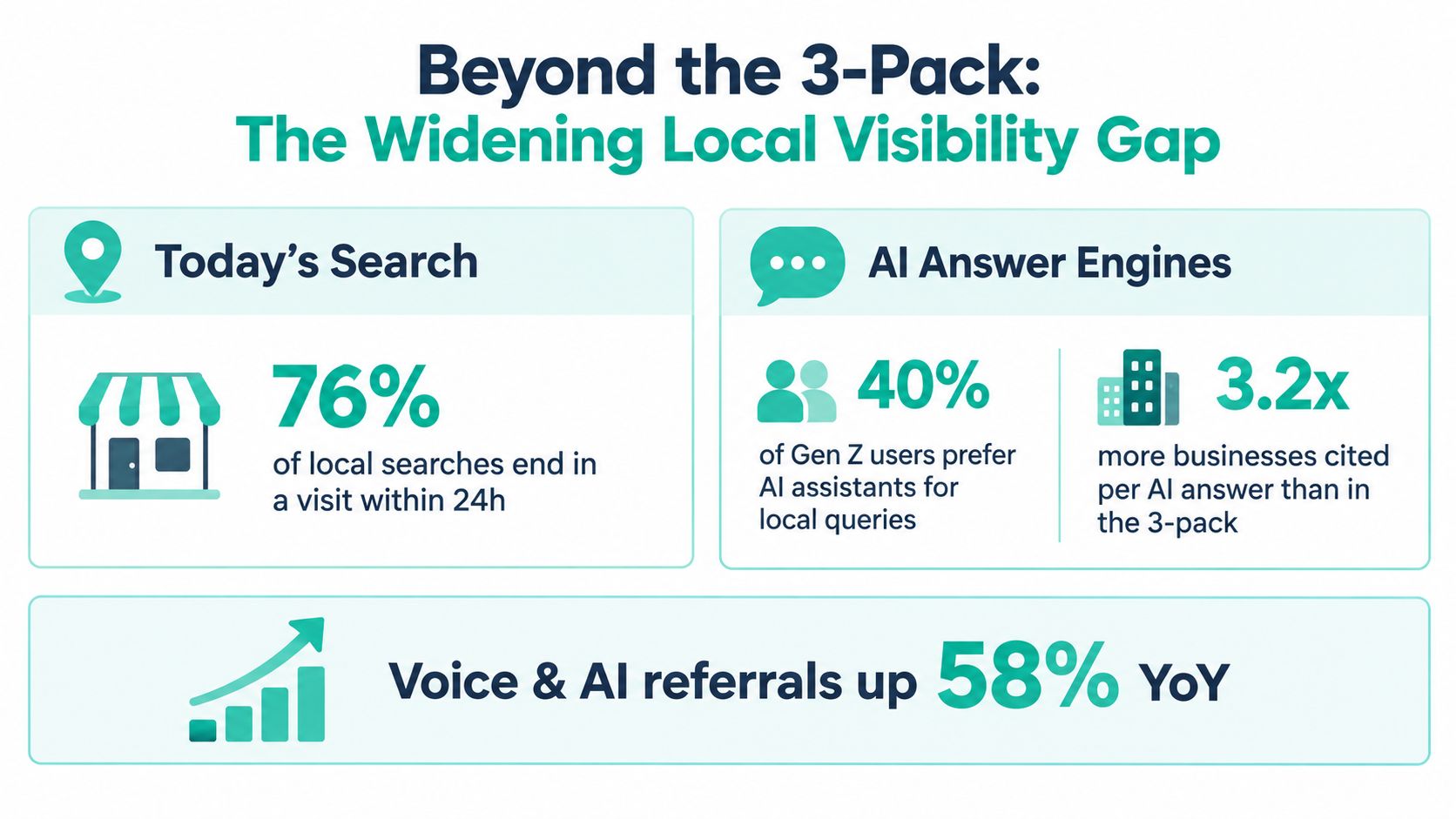
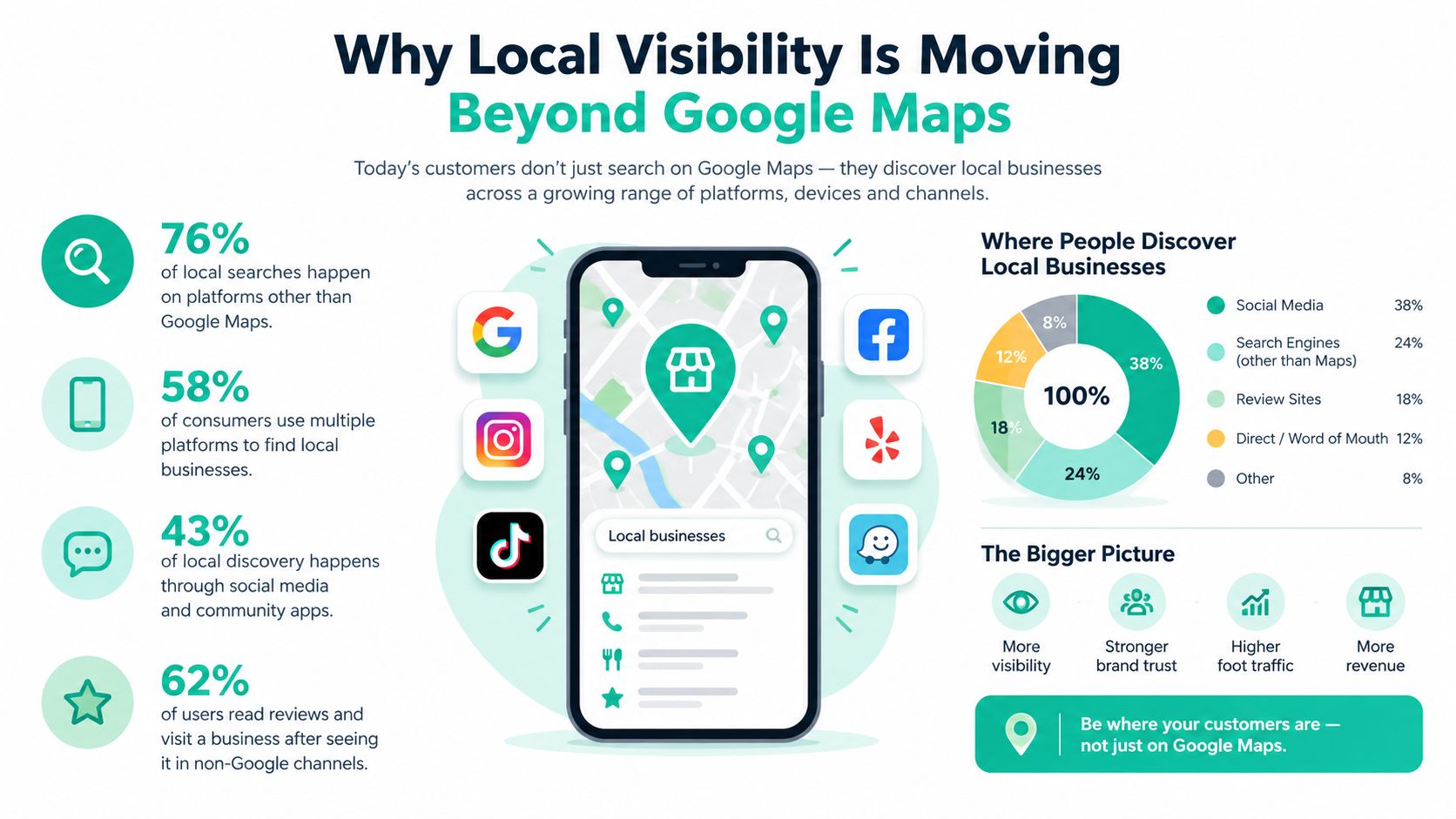
Ranking in Google's local three-pack still matters, but it's no longer a complete definition of being visible. A customer might ask an AI assistant for a nearby provider, compare businesses across review platforms, or use an answer engine to narrow a complicated local request before opening Maps.
The gap between traditional local results and AI recommendations is already visible in independent coverage. A 2026 Local Visibility Index found businesses appeared in Google's local three-pack 35.9% of the time, compared with 11% on Gemini, 7.4% on Perplexity, and 1.2% on ChatGPT (G2's local SEO software category). Those figures don't mean Google visibility has stopped mattering. They show that a strong Maps presence doesn't automatically transfer to every discovery surface.
From listing cleanup to entity verification
Traditional local SEO often focused on citation cleanup. The practical question was, “Do the name, address, and phone number match everywhere?” That still matters, but AI systems also need to determine whether multiple references describe the same real business, what services it provides, where it operates, and whether the supporting information appears trustworthy.
That creates a broader task: AI entity verification. A platform operating in this area should help you identify where an assistant gets your business wrong, which sources it appears to rely on, and what information is missing or inconsistent. It should connect those findings to profile updates, website content, reviews, location pages, and directory data.
This is also why discovery channels outside search engines deserve a place in your visibility plan. A retailer may use Pinterest SEO for product discovery, while a local service company may depend more heavily on review platforms, directories, and map apps.
Questions to ask a vendor
Before buying, ask whether the platform:
- Measures AI visibility: Can it test your presence in ChatGPT, Gemini, or Perplexity for relevant local questions?
- Explains the result: Does it show why you were cited, omitted, or described incorrectly?
- Connects insight to action: Can you update source information, improve content, or manage reviews in the same workflow?
- Separates surfaces: Does it distinguish Maps rankings from organic results, directories, and AI answers?
- Keeps human approval: Can your team review generated content and proposed profile changes before publication?
A vendor that only reports a three-pack position may still be useful. It solves a narrower problem than a platform built for the full discovery journey.
How Synup Can Help
Synup is a local marketing, listings, and reputation management platform that brings profile accuracy, reviews, publishing, rank tracking, location pages, and AI visibility into one workspace. Its AI agent, Sydekick, can support research and execution through skills, playbooks, approval workflows, memory, and an audit trail. That combination matters because automation without oversight can create as many operational problems as it solves.
For a small business, the practical benefit is consolidation. Instead of checking Google Business Profile, review sites, and directories separately, the team can monitor listings across Google Business Profile, Apple Business Connect, Bing, Facebook, and 100+ publishers, review proposed corrections, and manage responses from a shared workflow. Synup also supports review-generation campaigns, location-level social posts, a store locator, and location landing pages that stay connected to business records.

The more distinctive feature for this topic is its Answer Engine Optimization capability. Synup evaluates presence in ChatGPT, Gemini, and Perplexity and helps identify citation gaps. That gives a business a way to investigate the visibility gap described earlier instead of assuming a strong Maps position covers every answer surface.
For an agency, the operating model is more important than any individual feature. A multi-client command center, branded portals, white-label delivery, scoped permissions, scheduled reporting, APIs, and a full audit trail can reduce the need to move data between disconnected tools. The agent can execute approved research, content, and publication tasks while preserving client-specific voice and rules.
Synup is a sensible option when listing accuracy, reputation, multi-location operations, and AI visibility belong in the same program. It may be more platform than a single-location owner needs if the only unresolved issue is one incorrect directory listing. Review the product's current capabilities and fit directly through Synup before deciding.
Benefits for Small Businesses and Marketers
A local SEO platform earns its place when it turns recurring work into a reliable habit. It doesn't make a weak business look excellent. It helps a real business present accurate information, respond to customers, and learn where visibility breaks down.

Consider a single-location bakery. Before using a platform, the owner updates hours in one place, forgets a directory with the old schedule, and answers reviews between customer orders. After centralizing the workflow, the owner can maintain profile completeness, monitor listings, publish timely updates, and route reviews into a response queue. The ranking signals are indirect but practical: accurate details reduce confusion, review activity stays visible, and a regular post cadence keeps the profile active.
An agency faces a different burden. Its marketer may manage several clients, each with different locations, brand voices, approval rules, and reporting requirements. A platform can replace scattered spreadsheets with location-level dashboards, geo-grid comparisons, citation alerts, review queues, and scheduled branded reports.
The value depends on the weak link
| Business need | What a platform improves | Signal or outcome to monitor |
|---|---|---|
| Outdated profile details | Centralized updates and audits | Profile completeness and accuracy |
| Slow review handling | Shared inboxes, drafts, and approvals | Review volume and response rate |
| Conflicting directory data | Citation monitoring and syncing | NAP consistency |
| Irregular profile activity | Post scheduling and publishing workflows | Post cadence |
| Uneven neighborhood visibility | Geo-grid rank tracking | Local positions by area |
| Unclear AI discovery | Answer-engine diagnostics | Presence and citation gaps |
The trade-off is important. Automation can remind you to request feedback, but it can't provide a good customer experience for you. It can draft a review reply, but a staff member should check whether the tone fits the situation. It can identify a ranking gap, but only the business can improve service, relevance, local content, or reputation.
Core principle: A platform amplifies consistent operational effort. It doesn't replace the operation.
Small businesses should therefore pay for the part of local SEO they struggle to maintain. If listings are clean and reviews are manageable, geo-grid tracking may be more useful than an all-in-one suite. If an agency loses hours to reporting and profile updates, consolidation may create value even before rankings change.
How to Choose the Right Local SEO Platform
Start with the constraint, not the brand name. A single-location business with occasional review activity needs a different platform from an agency managing many profiles or a brand coordinating locations with different hours and teams.
Ask six practical questions:
- How many locations need management? More locations increase the value of bulk updates, permissions, location pages, and multi-location reporting.
- Where does review work happen? If customers review you across several sites, a unified inbox may be worth paying for.
- Do you need geographic precision? Choose geo-grid tracking if a citywide average hides neighborhood-level differences.
- Which directories matter? Look for coverage relevant to your country, industry, and customer behavior, not just a large publisher count.
- Who needs the reports? Owners may need a short action summary. Agencies may need white-label reports, portals, scheduled delivery, and audit trails.
- What will the team use? A complex platform is poor value if nobody maintains the workflows after setup.
Category ratings can help with initial research, but they don't settle the decision. G2 lists an average rating of 4.56 out of 5 across local SEO software, while the category includes very different products for rank tracking, citations, reviews, and reporting (local SEO software comparison and market overview). The same source describes market growth from USD 9.12 billion in 2025 to USD 10.34 billion in 2026, listings management projected at a 14.80% CAGR through 2031, and consumers checking an average of 6 review sites before choosing a business. Treat those figures as market context, not proof that every business needs a full suite.
Matching your business to the right platform capabilities
| Business situation | Core capabilities needed | Priority features |
|---|---|---|
| One location with basic needs | Profile control and reputation monitoring | Google Business Profile tools, review alerts, simple reporting |
| One location in a competitive area | Measurement and diagnosis | Geo-grid tracking, competitor views, local keyword research |
| Inconsistent directory information | Citation correction | Listing audits, publisher syncing, duplicate monitoring |
| Several branches | Centralized operations | Bulk updates, location pages, permissions, location-level reports |
| Agency with multiple clients | Delivery and governance | White-label portals, approvals, scheduled reports, audit trails |
| Brand testing AI discovery | Cross-surface measurement | AI answer tracking, entity diagnostics, citation-gap workflows |
Build a shortlist of two or three platforms. For each, create the same test account or product walkthrough, connect one representative location, and ask the vendor to demonstrate the exact workflow you care about. If reviews are the problem, watch how a response moves from alert to approval to publication. If rankings are the problem, inspect whether the report shows individual locations or merely an attractive average.
The right platform is the one your team can operate repeatedly, not the one with the most impressive menu.
Implementation Workflow and KPIs to Track
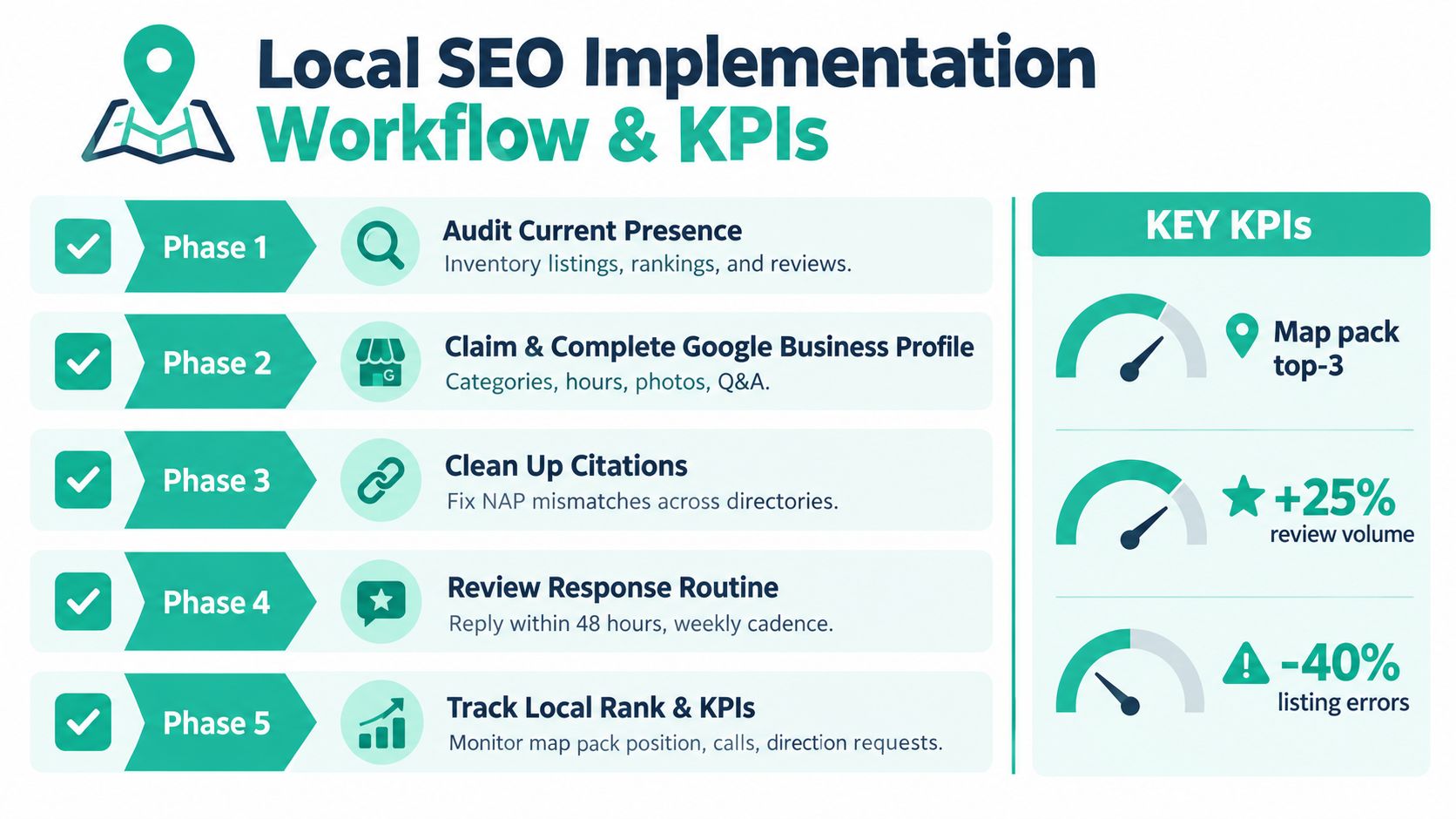
A local SEO platform works best when implementation follows a clear order. Fix the source information first, then improve reputation and measurement. Otherwise, you may spend time analyzing rankings while the underlying business data remains unreliable.
Phase one starts with an audit
Inventory your current Google Business Profile, website, directories, reviews, location pages, and local rankings. Record incorrect hours, duplicate listings, missing categories, unanswered reviews, and gaps between your website and profile.
Track profile completeness, citation accuracy, and the number of unresolved issues. The audit creates a baseline for the work that follows.
Phase two establishes the source of truth
Claim and complete the Google Business Profile. Confirm the business name, address, phone number, categories, services, hours, photos, questions and answers, and profile description. For multiple locations, assign ownership and approval responsibilities before making bulk changes.
Monitor profile completeness and profile actions such as calls and direction requests. These metrics show whether customers can understand and act on the information you provide.
Phase three cleans the wider ecosystem
Correct NAP mismatches across relevant directories, remove duplicates, and confirm that important publishers received the approved details. Do not chase every directory just because a platform lists it. Prioritize sources customers use and publishers that influence local discovery.
Measure citation accuracy, unresolved listing errors, and the time required to correct new discrepancies.
Phase four creates a review routine
Set up alerts, response ownership, approval rules, and an honest review-request process. Drafts can save time, but someone who understands the customer relationship should check sensitive replies.
Track review volume, response rate, response speed, and recurring themes in customer feedback. Those themes can inform service improvements and website content.
Phase five measures local and AI visibility
Configure local keywords, map locations, competitors, and geo-grid points. Review results by neighborhood rather than relying on one citywide position. If the platform supports it, add AI answer queries that reflect real customer questions and compare those results with Maps visibility.
Monitor local-pack and geo-grid positions, calls, direction requests, unresolved citation issues, and AI citation gaps. Use monthly reporting to decide which action deserves attention next.
A practical launch checklist is simple:
- Audit first: Record profile, listing, review, website, and ranking problems.
- Complete the profile: Establish accurate categories, hours, services, photos, and contact details.
- Clean citations: Correct important directories and remove duplicates.
- Assign review ownership: Decide who monitors, drafts, approves, and publishes replies.
- Configure measurement: Add local searches, geo-grid points, competitors, and AI queries where available.
- Review regularly: Turn the report into a short list of actions, not a monthly archive.
Key Takeaways and Your Next Steps
A local SEO platform is more than listings software. It's a control center for Google Business Profile management, citations, reviews, local measurement, and reporting. The most useful platforms connect those jobs so a ranking problem can lead to an action instead of another spreadsheet.
Local visibility has also expanded. Google Maps remains important, but AI assistants and answer engines can describe, recommend, or omit a business before the searcher ever opens a map. That makes AI visibility, entity consistency, and citation gaps relevant questions when you compare platforms.
The right purchase depends on the part of local SEO worth paying for in your situation. A single-location business may need review monitoring or citation correction. A competitive service business may need geo-grid tracking. An agency or multi-location brand may need approvals, bulk management, location reporting, and AI diagnostics in one workspace.
Take these three actions this week:
- Audit your profile: Check hours, categories, services, photos, questions, and contact details.
- Count your review surfaces: Identify where customers can review you and whether each source receives regular attention.
- Choose one paid capability: Decide whether your biggest operational gap is listings, reviews, geo-grid measurement, reporting, or AI visibility.
Then test a shortlist against that one problem. If a platform can make the work accurate, repeatable, and visible to the people responsible for it, it's probably solving a real business need rather than adding another dashboard.
Open your Google Business Profile today, record every inconsistency you find, and request a focused demonstration from one or two platforms using that real data. Choose the system that shows you exactly how it will correct the problem, who approves the change, and how you'll measure the result across Maps and emerging AI discovery surfaces.