
Shopify SEO Experts: 10 Agencies Worth Vetting in 2026
11 October 2026
Your Shopify store looks polished, but organic traffic still feels stuck. Products are indexed through several variant paths, collection pages contain little useful copy, and an app or theme update has added scripts that slow commercial pages. Publishing more blog posts won't fix those problems.
Shopify SEO experts work at the intersection of search strategy, ecommerce merchandising, and platform implementation. They need to understand collection architecture, product templates, Liquid edits, metafields, structured data, redirects, internal links, and the difference between a warning and a revenue-threatening defect.
This directory profiles 10 agencies and specialists worth vetting in 2026, grouped by the Shopify problems they claim to solve. The list starts with Shopify-focused practitioners, then moves toward full-service and enterprise partners suited to larger catalogs, broader marketing programs, or complex international operations. Each profile covers services, public positioning, practical strengths, limitations, and pricing signals.
Most firms don't publish fees. Treat any price indication as a starting point for a proposal, not a quote. Get to the shortlist quickly, then use the final section to test whether a provider can work on your actual store rather than sell a generic SEO package.
Table of Contents
- 1. seopaslaugos.io
- 2. Inflow
- 3. 1Digital Agency
- 4. Coalition Technologies
- 5. OuterBox
- 6. Logical Position
- 7. SEO Brand
- 8. WebFX
- 9. Ignite Visibility
- 10. NP Digital
- Top 11 Shopify SEO Experts Comparison
- From Shortlist to Signed Scope, Vetting Your Shopify SEO Partner
1. seopaslaugos.io
seopaslaugos.io, led by Lithuanian SEO specialist Mantas Tamošaitis, is a direct-specialist option for businesses that want SEO tied to calls, enquiries, and sales, rather than traffic and rankings alone. Its ecommerce work addresses technical SEO, commercial page optimization, internal architecture, duplicate prevention, and catalog visibility. That combination matters for Shopify merchants whose biggest problems sit below the content layer.
Best fit for commercial and catalog problems
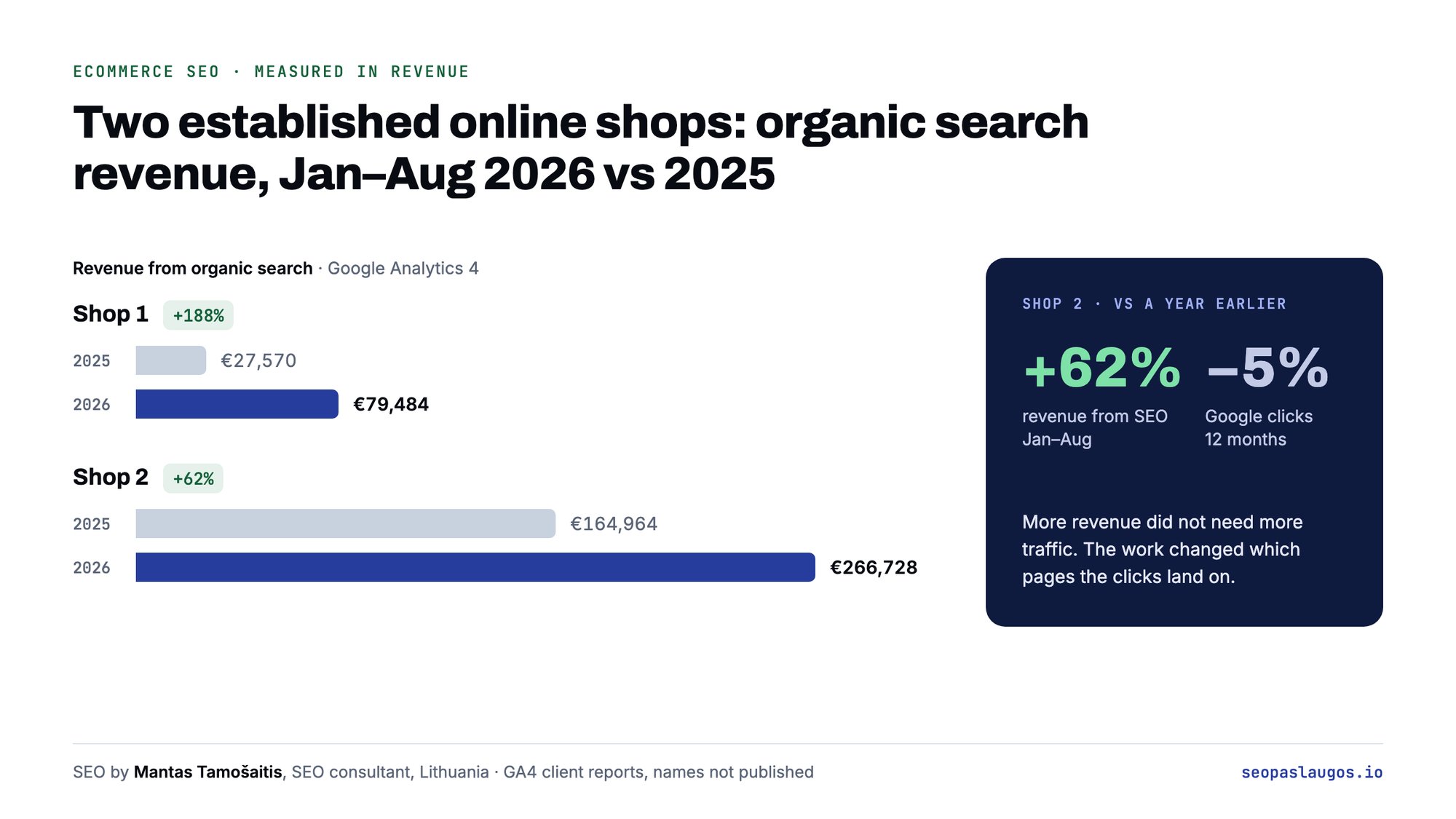
The strongest differentiator is its outcome-oriented measurement. Reporting is positioned around calls, forms, ecommerce conversions, and sales. The firm also describes direct specialist involvement rather than a large account-management layer, which can make technical decisions faster when the store needs changes to architecture, content, or tracking. More than five agencies resell its SEO services to their own clients, which is unusual proof of the work. Published ecommerce results include organic search revenue up 188% year to date at one online store, and up 62% at another while Google clicks fell.
The broader offering also includes local search, Google Business Profile work, service-area pages, conversion tracking, and AI search visibility. That makes the firm more flexible than a Shopify-only technical consultancy. A merchant with both an online store and local sales operation may prefer one partner that can connect ecommerce pages, map visibility, enquiries, and revenue reporting.
Practical rule: Ask whether the proposed roadmap ranks pages by commercial value, not by the number of warnings found in a crawler.
What stands out, and what to verify
The strongest differentiator is its outcome-oriented measurement. Reporting is positioned around calls, forms, ecommerce conversions, and sales. The firm also describes direct specialist involvement rather than a large account-management layer, which can make technical decisions faster when the store needs changes to architecture, content, or tracking. More than five agencies resell its SEO services to their own clients, which is unusual proof of the work. Published ecommerce results include organic search revenue up 188% year to date at one online store, and up 62% at another while Google clicks fell.
There are trade-offs. The public positioning spans service businesses, local SEO, ecommerce, and AI visibility, so a Shopify merchant should confirm how the engagement fits their store. Theme and Liquid changes are implemented by the store’s own developer or IT specialist, and seopaslaugos.io can recommend one if the store has none. Variant URL duplication, filter handling, metafield data, structured markup, and large product inventories are worth raising on the first call. If the store needs a full Shopify development team, confirm that capacity separately rather than assuming an SEO roadmap includes it.
This is a good choice for merchants who want commercial SEO, technical cleanup, AI search preparation, and conversion tracking in one engagement. It’s less obvious for a Shopify Plus team that needs a large engineering bench.
2. Inflow
Inflow is built around ecommerce rather than general business SEO. That focus suits Shopify brands that want technical audits, product and collection strategy, internal linking, and measurement from a senior team without adding a large number of unrelated services.
Strong on strategy and measurement
Inflow's Shopify relevance is clearest in the way its work connects technical findings to ecommerce templates. A useful engagement should distinguish between a weak blog page and a collection template that affects commercial search demand across many products. The agency's stated services include platform-aware audits, technical SEO, collection and product content strategy, internal linking, and analytics implementation.
Its measurement support covers Google Analytics 4, Google Search Console, and Google Tag Manager. That can help a merchant move beyond ranking reports and connect organic landing pages with engagement and revenue signals. The agency also appears comfortable working alongside an internal development or design team, which is useful when the merchant already has people who can edit the theme.
The main limitation is capacity. A boutique senior model can produce sharper thinking and more direct access, but it may not provide a large implementation bench when a store needs simultaneous content production, development, outreach, and international expansion. Pricing isn't published, so scope and staffing need to be clarified during the proposal stage.
A strong measurement plan should show which collections attract organic demand, which product templates convert, and which technical changes were actually deployed.
Inflow is a sensible fit for a growing ecommerce brand with internal execution support. Pair its search work with a Pinterest publishing workflow such as Pinterest for Shopify if the store needs discovery traffic while category pages build authority.
3. 1Digital Agency
Shopify stores with variant duplication, weak structured data, and a theme that needs development work should look closely at 1Digital Agency. Its public Shopify positioning goes beyond titles and descriptions. It specifically addresses Shopify Online Store 2.0, Shopify Plus, metafields, schema, variants, and technical cleanup.
Where the development connection helps
That combination is valuable because many SEO recommendations fail at implementation. A consultant can identify that product variants create confusing signals, but the store still needs someone to adjust templates, data fields, canonical handling, or structured markup. An agency that combines Shopify development with SEO can shorten that handoff.
The agency also presents experience with enterprise Shopify Plus stores. That makes it relevant to merchants with complex templates, multiple teams, or a substantial product catalog. Metafield-driven schema can be particularly useful when product attributes need consistent treatment across templates, although the proposal should specify exactly which properties will be populated and validated.
Its weakness is less about platform fit than about scope. Technical cleanup alone won't create demand for products in a competitive category. The store may still need original content, digital PR, product reviews, and strong merchandising input from the client. Public pricing isn't listed, and a discovery call is required.
Ask for a sample implementation plan. It should show how the team would handle variant URLs, collection duplication, redirects, product schema, image assets, and Liquid changes. Avoid accepting a vague promise to “optimize Shopify SEO” without template-level deliverables.
1Digital is best for a merchant that needs SEO and Shopify development in the same project, especially during a redesign, theme change, or Shopify Plus build. A smaller store with a stable theme and limited technical debt may find the full development capability unnecessary.
4. Coalition Technologies
Coalition Technologies is a larger ecommerce SEO partner with Shopify and Shopify Plus experience. It covers the full chain from technical fixes and Liquid work to collection optimization, product content, internal linking, content production, link acquisition, and conversion support.
A broad partner for stores outgrowing a boutique
The agency's scale is its main advantage. A merchant can potentially keep technical SEO, content, CRO, and broader ecommerce growth work within one relationship. That matters when a store has several concurrent priorities and doesn't want to coordinate separate specialists for theme edits, content, analytics, and outreach.
Its public resources and case-study positioning also give prospects more material to inspect before a sales call. Look for evidence that the named team understands Shopify-specific constraints, not just general ecommerce language. Ask who handles Liquid, who approves content, and whether link acquisition points to commercial pages or only to informational assets.
The trade-off is attention. A larger agency can support bigger programs, but a small brand may receive a process designed for a more complex account. Pricing isn't public, so the proposal should identify the senior strategist, technical implementer, content lead, and reporting owner. If several people touch the account, you need to know who is accountable for decisions.
Coalition makes sense when the store needs a multi-discipline ecommerce program rather than an isolated audit. It may be too heavy for a merchant that only needs a specialist to fix canonical signals and rewrite a handful of collection pages. Compare the proposed work against the store's actual bottleneck before buying the wider service menu.
5. OuterBox
OuterBox is an ecommerce-focused agency that combines SEO with conversion rate optimization, content, and technical implementation. That positioning fits stores where search traffic exists, but product and collection pages fail to turn visits into useful commercial activity.
The CRO connection is useful
Shopify SEO specialists should care about more than rankings. A page can attract impressions and still lose buyers because the product information is unclear, the mobile layout shifts, the filters are difficult to use, or the page loads unnecessary scripts. OuterBox's combined SEO and CRO approach gives merchants a way to examine discoverability and on-page behavior together.
The agency also describes in-house content and technical support. That can reduce dependence on a merchant's already-busy developer or copywriter. Its resources address core updates and AI or large language model visibility, which may be useful for brands trying to understand how product information appears across newer search interfaces.
The limitation is engagement size. A broad team and ecommerce process can be valuable for an established brand, but a small catalog may not justify the overhead. Pricing isn't fully public, and potential engagement minimums should be confirmed before the strategy work begins.
Ask for a split between SEO deliverables and CRO deliverables. You should be able to see which collection pages receive content changes, which templates receive technical work, and how testing priorities are selected. If the proposal only promises “conversion optimization” without identifying the page types or evidence used, the scope is too vague.
OuterBox is a good fit for a merchant that needs organic acquisition and storefront efficiency addressed together. It isn't the obvious choice for a store seeking a narrow technical fix with minimal ongoing involvement.
6. Logical Position
Logical Position suits merchants that need Shopify SEO alongside broader ecommerce development or local search. Its services cover technical fixes, content, on-page optimization, link acquisition, Shopify builds, and local SEO for businesses with physical locations.
Useful for blended local and ecommerce demand
A store with showrooms, service areas, or local pickup may need more than product-page rankings. Local landing pages, business profile management, and ecommerce collections can serve different search intents, and the provider needs to keep those systems distinct. Logical Position's wider performance-agency model can help when one business serves both local customers and online buyers.
The agency also presents a substantial resource library and case-study base. Use that material as a starting point, then ask for Shopify-specific proof. A general ecommerce case doesn't necessarily demonstrate competence with Liquid edits, product variants, collection paths, app-generated scripts, or metafield schema.
Its main trade-off is platform specialization. Logical Position supports Shopify implementations, but it isn't positioned as narrowly Shopify-only as some of the specialists on this list. Pricing isn't published, and proposals are required. That makes the sales process important. A strong proposal should name the platform risks it found and explain which fixes need developer access.
Choose Logical Position when the store needs SEO, development, and local visibility under one U.S.-based partner. If the only problem is a complicated Shopify catalog with variant and filter duplication, a more focused Shopify technical specialist may offer a tighter fit.
7. SEO Brand
SEO Brand takes a full-service ecommerce approach across technical SEO, on-page work, content, authority building, CRO, and broader digital marketing. It can suit a store that wants SEO tied to revenue goals and supported by other acquisition channels.
A general ecommerce partner with Shopify capability
The agency's strength is breadth. It can help a brand coordinate keyword research, technical cleanup, content, conversion work, and authority building instead of treating each activity as a separate project. That can be useful when organic search is only one part of a wider growth plan.
The platform-specific evidence is less prominent than it is for Shopify-only boutiques. That doesn't make the agency unsuitable, but it does mean the vetting burden is higher. Ask how its team handles collection and product templates, variant duplication, canonical signals, pagination, redirects, app scripts, and structured data. Request examples where the team changed Shopify code or worked directly with a Shopify developer.
SEO Brand supports varied ecommerce categories and broader U.S. operations. Pricing isn't public, and onboarding is consultative. The proposal should connect work to the store's commercial priorities, such as high-margin collections, new product launches, or underperforming category pages.
This provider is best for a brand that wants a full digital marketing relationship, not a narrowly scoped Shopify audit. It may be less suitable when the merchant needs a deep Liquid intervention from a specialist who spends most of the engagement inside Shopify's theme and data model.
8. WebFX
WebFX is the scale option for merchants seeking Shopify audits, implementation, content, tracking, and broader channel coordination. Its proprietary marketing technology and reporting systems are positioned for mid-market and enterprise teams that need attribution and stakeholder visibility.
Reporting and orchestration are the draw
WebFX can pair SEO with paid search, social, email, and other marketing services. That model is useful when a merchant wants one agency to coordinate campaign timing, landing pages, reporting, and channel-level performance. It also gives larger teams a formal operating process rather than relying on a single consultant's availability.
The trade-off is standardization. A large agency may bring reliable workflows, but smaller stores can receive a program that feels broader than their needs. Tooling and reporting can also become overhead if the team only needs clear Google Search Console, Google Analytics 4, deployment, and revenue reporting.
A proposal should separate platform work from marketing operations. Ask for the exact Shopify templates included, how implementation access works, whether developers edit Liquid directly, and which metrics appear in the recurring report. Confirm whether the assigned team has handled product feeds, collection architecture, and catalog changes similar to yours.
WebFX is a strong candidate for a multi-channel ecommerce program with formal reporting. It is less compelling for a small merchant that needs a fast, hands-on correction to a single theme or a limited set of collection pages. If Pinterest is part of the acquisition mix, an automation tool such as an AI Pin Generator for Shopify can support publishing without turning the SEO agency into a social-content production team.
9. Ignite Visibility
Ignite Visibility is suited to growth-oriented brands that need technical SEO, information architecture, conversion-focused content, and broader channel support. Its larger team and defined processes can help when the store has several markets, multiple stakeholders, or a substantial content backlog.
Good for architecture and full-funnel programs
Information architecture is where many large Shopify catalogs become difficult to manage. Collections, filters, product relationships, editorial content, and internal links need to reinforce one another. Ignite's positioning around large-site technical SEO makes it worth considering when the problem is not one broken template but the way the entire catalog is organized.
The agency also discusses AI search and answer-engine initiatives. Treat that as a conversation starter rather than a substitute for standard SEO. Ask how the team will separate classic organic rankings from AI citation or inclusion, and how it will improve product attributes, merchant policies, reviews, and supporting content for machine-readable completeness.
Its limitation is fit. An enterprise-oriented process can exceed the needs of a small store with a narrow range of products. Pricing isn't listed publicly, so the merchant should establish team size, minimum commitment, implementation ownership, and reporting cadence before approving a strategy.
Ignite is a strong option for a complex growth program involving SEO, paid media, social, and email. A smaller business may get better value from a specialist who can spend more time on direct Shopify changes and fewer hours coordinating a large account structure.
10. NP Digital
NP Digital is designed for larger brands that need SEO at template scale, digital PR, authority building, and visibility monitoring across generative search surfaces. Its operating model is more appropriate for funded, multi-market, or enterprise merchants than for a small catalog.
Best for scale and authority
Large stores need repeatable systems. A team can't manually treat every product page as a separate strategy problem. NP Digital's emphasis on template-level technical SEO can help merchants define rules for products, collections, markets, and content types, then apply those rules consistently across the catalog.
Digital PR is another differentiator. Product pages rarely attract strong editorial links without a useful story, original insight, research, or a compelling brand angle. A PR-led authority program can support competitive category pages, although the merchant should ask where links will point and how success will be measured.
NP Digital also positions itself around generative and AI referral-surface monitoring. This is valuable only when the reporting distinguishes AI visibility from conventional organic visibility. Ask for separate views of rankings, citations, referring domains, assisted conversions, and branded demand. Don't accept one blended visibility score that hides what changed.
The drawbacks are clear. Premium pricing and enterprise processes can be excessive for a small merchant. The team may also be less hands-on with theme or Liquid work than a Shopify-only boutique, so confirm who implements platform changes and who owns technical QA.
NP Digital is the better fit for a large catalog, multi-market operation, or brand that wants digital PR alongside technical SEO. It isn't the practical first call for a store whose immediate problem is a broken product template or a handful of duplicate variant URLs.
Top 11 Shopify SEO Experts Comparison
Shopify stores tend to hire SEO agencies for different platform problems. One may focus on variant URL duplication and metafield schema. Another may be better suited to Liquid theme edits, conversion work, large catalogs, or Pinterest automation. The table below compares the ten providers reviewed above by technical focus, audience, automation fit, and operating scale. Fuel Online is excluded because it was not part of the reviewed shortlist.
| Provider | Core focus & strengths | Pinterest / automation fit | Target audience 👥 | Standout ✨ / Excellence 🏆 | Price & scale 💰 ★ |
|---|---|---|---|---|---|
| seopaslaugos.io | Ecommerce, local and AI‑driven SEO, with analytics and conversion tracking | Moderate, with ecommerce, catalog, and AI visibility skills that support pin automation workflows | 👥 Merchants, ecommerce stores, and local service businesses | ✨ AI SEO and AI visibility measurement, focused on calls and sales 🏆 | 💰 Flexible, ROI‑oriented · ★★★★ |
| Inflow | Ecommerce‑first technical SEO and content strategy for product and category demand | Good, connecting product and category demand with content that can support automated pin generation | 👥 DTC brands and ecommerce teams | ✨ Platform‑aware audits and a senior, hands‑on team 🏆 | 💰 Custom proposals · ★★★★ |
| 1Digital Agency | Shopify and Shopify Plus development with SEO, including variant duplication and schema work | Good, because Shopify fixes and schema can produce cleaner feeds for pins | 👥 Shopify and Shopify Plus merchants | ✨ Shopify‑specific SEO and metafield schema, with development and SEO paired together 🏆 | 💰 Mid, custom · ★★★★ |
| Coalition Technologies | Large ecommerce SEO, content, linking, and Liquid fixes | Strong, with scalable on‑page programs and technical fixes for large pin catalogs | 👥 SMB to enterprise ecommerce teams | ✨ Scalable on‑page SEO with CRO integration and proven case studies 🏆 | 💰 Mid‑high, proposal · ★★★★ |
| OuterBox | Ecommerce SEO and CRO with in‑house content and technical implementation | Good, with conversion work that complements pin traffic and shoppable creatives | 👥 Mid‑market ecommerce brands | ✨ In‑house implementation and conversion optimization 🏆 | 💰 Mid‑high · ★★★ |
| Logical Position | SEO, site builds, and local SEO, supported by a wide resource library | Moderate, useful for combining local listings and product feeds for pins | 👥 Merchants needing local and ecommerce support | ✨ Local SEO and site‑build capabilities for omnichannel sellers 🏆 | 💰 Mid · ★★★ |
| SEO Brand | Full‑service ecommerce SEO coordinated with CRO and content | Good, with a cross‑channel approach that can include Pinterest through content feeds | 👥 Brands seeking integrated digital marketing | ✨ Revenue‑aligned SEO strategies and multi‑channel coordination 🏆 | 💰 Mid‑high · ★★★ |
| WebFX | Large agency with proprietary martech for reporting and attribution | Strong, with martech and reporting for multichannel orchestration, including Pinterest | 👥 Mid‑market to enterprise teams seeking one partner | ✨ Established reporting stack and documented playbooks at scale 🏆 | 💰 Mid‑high · ★★★★ |
| Ignite Visibility | Ecommerce SEO, information architecture, and AI/AEO initiatives | Good, with growth and AI work that can surface pinable content linked to conversion | 👥 Growth‑oriented DTC brands | ✨ Measurable growth programs and AI search readiness 🏆 | 💰 High, proposal · ★★★★ |
| NP Digital | Global agency covering template‑scale SEO, digital PR, and AI search monitoring | Strong, with template optimization and PR supporting large pin catalogs and discovery | 👥 Enterprise and funded brands with large catalogs | ✨ Digital PR, enterprise scale, and AI visibility monitoring 🏆 | 💰 Premium · ★★★★ |
The right choice depends on the platform issue blocking growth. A store with duplicate variants or schema gaps may need Shopify development paired with SEO. A large catalog may prioritize template rules, content production, and reporting capacity. A merchant testing Pinterest should examine whether the agency can turn product data and category demand into usable creative inputs, rather than treating Pinterest as a generic social channel.
Agency size also changes the trade‑off. Larger firms can coordinate reporting, content, CRO, and multiple markets, but their process may suit enterprise teams better than a small store needing a fast theme fix. Smaller or specialist providers may offer closer implementation support, while requiring the merchant to manage more channels internally. The price labels are relative comparisons from the provider profiles, not fixed quotes.
From Shortlist to Signed Scope, Vetting Your Shopify SEO Partner
A shortlist is only useful if it helps you reject the wrong provider. Start by removing any firm whose Shopify work you can't inspect. Ask for two relevant Shopify examples, then confirm whether the proposed team edits Liquid and structured data or only supplies briefs and recommendations.
The best evidence is specific. You want to hear how the provider handled variant URLs, collection duplication, filters, redirects, product schema, app bloat, internal links, and theme changes. A general statement about “technical SEO” doesn't prove platform competence.
Pass one, check platform proof
Ask each remaining agency for a sample first-phase roadmap. It should identify affected templates, the business importance of those templates, the implementation owner, and the validation method. A useful audit doesn't treat every crawler warning equally.
Technical performance deserves field validation. Google defines good Core Web Vitals thresholds as LCP of 2.5 seconds or less, INP of 200 milliseconds or less, and CLS of 0.1 or less, assessed at the 75th percentile of real-user visits. Google's benchmark guidance as reported by Shopify explains why an expert should segment results by device, page type, and URL instead of trusting one laboratory score. Shopify also reports that each additional 100 milliseconds of page-load delay can reduce conversions by as much as 3.5%, so performance belongs in the commercial conversation, not just the developer backlog.
Pass two, test execution
Use the same questions with the three or four firms that remain:
- Hands-on ownership: Who edits the theme, Liquid templates, metafields, and structured data?
- Variant control: How will the team prevent duplicate signals from variants, filters, tags, and alternate collection paths?
- Reporting: Will reports connect Google Search Console and GA4 data with landing-page engagement, orders, and revenue?
- Prioritization: How will the team rank issues by revenue, indexability, affected templates, and migration risk?
- Link quality: Which sites and tactics will support authority, and what methods are explicitly excluded?
- Commercial terms: What is the minimum engagement, what are the exit terms, and who owns the work produced?
Migration deserves special attention. One published ecommerce migration case described more than 10,000 broken internal links and other technical failures, yet organic revenue increased 61.1% after high-impact fixes even as organic traffic declined 18.3% year over year. The migration case details support a useful lesson: don't judge an SEO program by error counts or traffic alone. Ask whether the agency can prioritize revenue-critical pages.
Pass three, compare alternatives honestly
A freelance Shopify SEO specialist usually costs less and can move quickly. Capacity is thinner, however, and theme work may require a separate developer. This route works well when the store has a capable internal team that can implement recommendations and maintain the theme.
An in-house hire keeps knowledge inside the business and can connect SEO decisions with merchandising, product, and customer support. Recruitment takes time, and the hire still needs developer support for Liquid changes, app conflicts, performance work, and larger migrations. An agency offers a wider bench, but you pay for coordination and must protect against generic delivery.
AI search adds another selection test. Recent ecommerce analysis found that AI Overviews appeared for roughly 16% of ecommerce searches, while about 80% of cited sources didn't rank organically for the same query. The analysis of AI Overview visibility suggests that agencies should track traditional rankings and AI citations separately. Ask how they audit product attributes, reviews, policies, comparison content, and factual consistency across the catalog.
Whichever route you choose, add Pinterest as a traffic-diversification channel while organic rankings develop. Pins can continue generating discovery after publication, and Pin Generator can create on-brand designs, titles, descriptions, alt text, board choices, and recurring schedules from connected Shopify catalogs. It can also ingest product feeds and content sources, support reusable templates, and provide history and leaderboard views for reviewing output.
Pinterest won't repair crawlability, indexing, duplicate URLs, or weak site structure. Every pin should link to a product, collection, or editorial page that loads quickly, answers the visitor's intent, and gives search engines clear information.
Book one shortlist call this month. Bring your top collections, highest-value products, Search Console access, recent theme or app changes, and migration history. Require a written 90-day scope with owners, implementation details, reporting fields, and exit terms before you sign.