
A Practical Guide to Affiliate Marketing on WordPress
10 August 2025
Ready to dive into affiliate marketing on WordPress? It's a fantastic way to build a real online business by promoting products you genuinely believe in to earn a commission. By setting up a WordPress site, you’re not just chasing quick cash; you’re building a valuable digital asset that you own and control completely, setting the stage for sustainable income.
This guide will walk you through exactly how affiliate marketing on WordPress is done, from picking the right products to creating content that converts. We’ll cover the best sites to find affiliate programs and show you how to set up your WordPress site for success. Finally, we'll tie it all together with a powerful strategy using Pin Generator to drive free, targeted traffic from Pinterest to your affiliate posts, turning visitors into revenue.
Your Foundation for Affiliate Marketing on WordPress
Pairing affiliate marketing with WordPress isn't just a good idea—it's a powerhouse combination for making money online. Think about it: when you rely on social media, you're at the mercy of algorithms and rule changes that can tank your income overnight. A self-hosted WordPress site puts you in the driver's seat. You own the content, you own the data, and most importantly, you own the relationship with your audience.
This control is everything. It's the foundation of any successful affiliate strategy, allowing you to create authentic niche blogs or detailed review sites that actually connect with people. When readers trust your advice, they're far more likely to click your links and make a purchase. That’s the heart of this business model. As you get started, it's worth exploring all the different ways you can generate revenue, including learning how websites make money beyond just affiliate sales.
Why WordPress Is the Go-To for Affiliates
The partnership between WordPress and affiliate marketing wasn't an accident. Affiliate marketing is a massive industry, and WordPress’s incredible scale is a huge part of that success.
As of early 2025, WordPress powers a staggering 43.4% of all websites. That makes it the undisputed king of content management systems. This dominance creates the perfect environment for affiliate marketers who need its flexibility to build their empires. With the industry valued at over $18.5 billion, it's clear that countless affiliates are using WordPress to build trust and drive sales.
What does this mean for you? It means you get access to a massive ecosystem of tools built specifically to help you succeed.
Here are a few key benefits I've seen firsthand:
- Total Customization: You can design your site to perfectly match your brand. No cookie-cutter templates here. You have the freedom to optimize every detail for a better user experience and, ultimately, more conversions.
- Real Ownership: Your website is your digital property. No platform can pull the rug out from under you. This gives you long-term security and a stable base for your business.
- SEO Power: WordPress is built to be SEO-friendly right out of the box. With amazing plugins like Yoast or Rank Math, you can fine-tune your content to climb the search rankings and attract organic traffic—which is pure gold for affiliate sales.
The real secret sauce is building a brand people trust. Your WordPress site is the home for that brand, where you can publish genuinely helpful content that solves your audience's problems.
At the end of the day, choosing WordPress is about playing the long game. You’re not just chasing quick commissions; you’re building a valuable digital asset that can pay you back for years to come. That’s how you create a reliable income stream built on a foundation of authenticity and trust.
Finding Affiliate Products You Can Stand Behind
The affiliate products you promote are the absolute cornerstone of your business. It's so much more than just grabbing the link with the highest commission; this is about building real, lasting trust with your readers.
Think about it. If you push a garbage product, that trust disappears in a heartbeat. But when you recommend something that genuinely solves a problem for them, you don't just make a sale—you create a loyal fan.
Before you even start looking at products, you first need to be crystal clear on your niche. Knowing how to find a profitable niche that actually interests you is a non-negotiable first step. Once you've got that figured out, your product search becomes laser-focused and way more effective. The goal is to find things you can stand behind because you truly get their value.
Where to Discover Quality Affiliate Programs
When you start searching for products, you'll generally find two paths: big affiliate networks and independent programs run by the companies themselves. Both have their pros and cons.
Here are some of the best sites and networks to find products for your affiliate marketing business:
- Amazon Associates: The undisputed giant. With a 46.21% market share, it's the go-to for countless WordPress bloggers. Its massive, trusted inventory means you can find a product for almost any niche, making it an incredible starting point.
- ShareASale: A massive network with thousands of merchants across every category imaginable, from fashion to software. It’s known for its reliable tracking and easy-to-use platform.
- CJ Affiliate (formerly Commission Junction): One of the oldest and most established networks, CJ connects you with major global brands and offers powerful reporting tools.
- Impact: A modern and rapidly growing platform that is popular with SaaS and tech companies. It provides excellent tracking and partnership management features.
- ClickBank: A major player in the digital products space, especially for e-books, online courses, and supplements. It often features high commission rates.
- Independent Programs: Don't sleep on these. Many companies, especially in software and digital services, run their own in-house affiliate programs. A quick Google search for "[Your Niche] affiliate programs" can uncover some real hidden gems with better commission rates and more direct support.
Key Takeaway: The most successful affiliate marketers I know use a hybrid approach. They use the big networks for variety and convenience but also forge direct relationships with companies whose products they absolutely love and use themselves.
Evaluating Products Beyond the Commission Rate
A fat commission check is nice, but it’s just one part of the equation. Here’s a quick mental checklist I run through when vetting potential products:
- Product Quality and Reputation: Is this something you'd personally use or recommend to a friend? Do your homework. Read reviews, search for it on social media, and see what actual customers are saying. A product with a solid, positive reputation is infinitely easier to promote with genuine enthusiasm.
- Cookie Duration: This is a big one. It's the length of time after someone clicks your link that you'll get credit for a sale. Longer is always better. A 30, 60, or even 90-day cookie gives your readers plenty of time to think things over before buying.
- Vendor Support: Look for programs that arm you with marketing materials, send out regular updates, and have a dedicated affiliate manager you can talk to. Good support is a clear sign that the company values its partners.
The affiliate marketing world is booming, with projections showing it could hit a staggering $31.7 billion by 2031. This explosive growth is happening because more and more companies are shifting to performance-based marketing. For you, this means a constant flow of new opportunities.
Setting Up Your WordPress Site for Success
Alright, you've found some promising products to promote. Now comes the fun part: turning your WordPress site into a machine that actually makes you money. Simply throwing affiliate links into a standard blog post just doesn't work anymore. You need to be more strategic.
It's about creating a professional, trustworthy space that makes people want to click your links. Before you even think about installing a single plugin, you need a solid game plan. I've always found it helpful to think about the process visually, like in this flow diagram. It all starts with your product research—evaluating demand, commission structures, and even the nitty-gritty details like cookie duration.
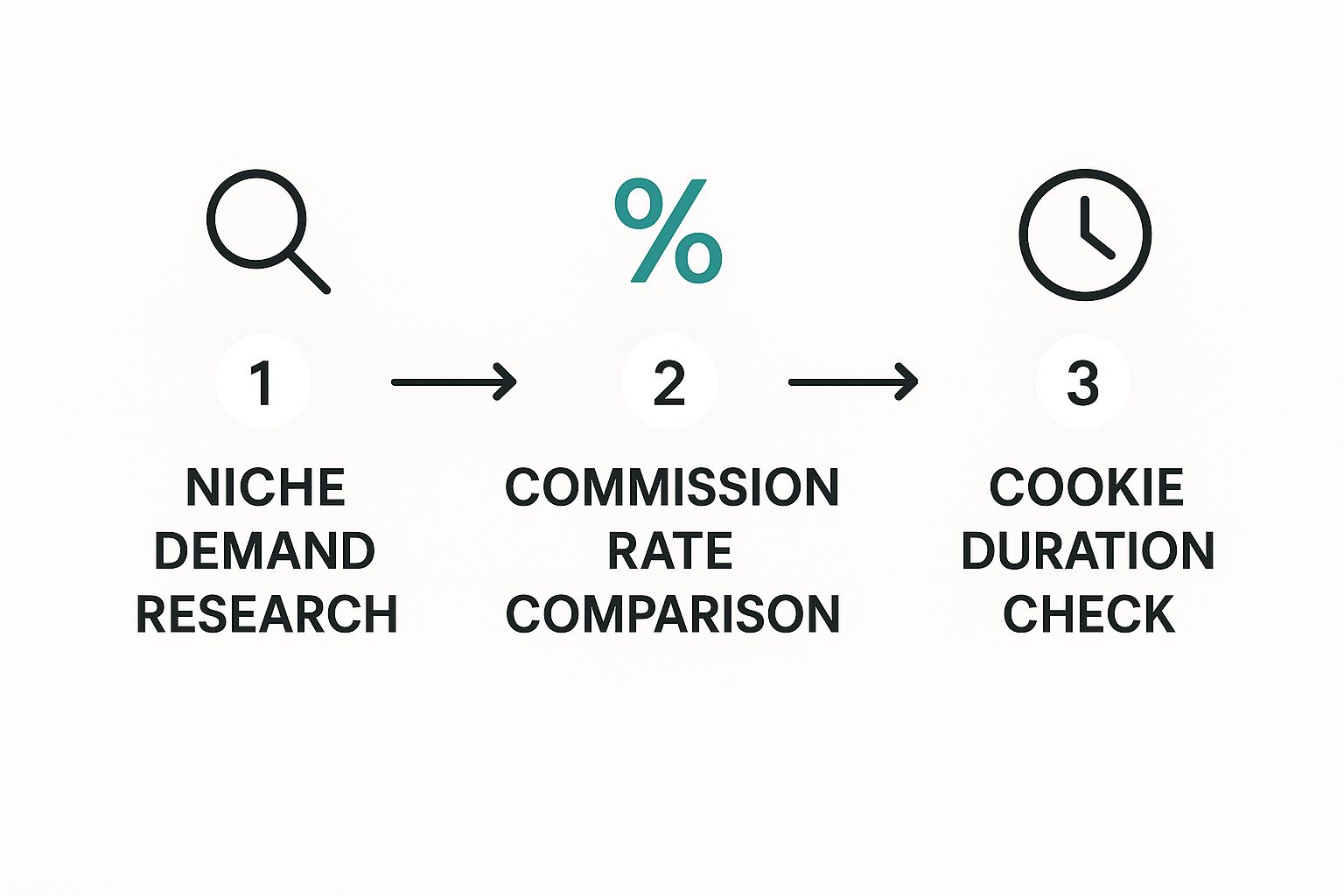
This workflow really hammers home the point: your success is built on the research you do before you get bogged down in the technical setup. When you systematically check niche demand, compare commission rates, and understand the cookie policies, you're laying a rock-solid foundation for everything that follows.
The Essential Plugins Every Affiliate Needs
The right tools can make or break your affiliate marketing efforts. This is where WordPress really shines—its massive plugin library lets you add incredibly powerful features without ever touching a line of code. For affiliates, a few plugins are absolutely non-negotiable if you want to stay sane and look professional.
Your most critical tool will be a link management plugin. My go-to has always been Pretty Links, but ThirstyAffiliates is another fantastic option. I honestly can't imagine running an affiliate site without one.
Here’s why they’re so crucial:
- They Clean Up Your Links: These plugins take those long, messy affiliate URLs (like
brand.com/product/?affid=12345&utm…) and turn them into clean, branded links (e.g.,yoursite.com/recommends/product). It instantly looks more trustworthy to your audience. - They Make Updates a Breeze: Imagine an affiliate program changes its link structure. Instead of manually editing dozens of old posts, you just update the link once in the plugin's dashboard. Boom. It’s fixed everywhere. This is a genuine lifesaver.
- They Track Clicks: You get basic data on how many clicks each link is getting. It’s a quick way to see what's resonating with your audience without having to log into five different affiliate dashboards.
Pro Tip: When you set up Pretty Links, be consistent with your link prefix. I like using something memorable like
/go/or/recommends/. It keeps things organized and adds another layer of professionalism.
Designing Your Site to Convert
Plugins are only half the battle. Your website's design plays a massive role in whether a visitor trusts you enough to make a purchase. You don't need some flashy, over-the-top design. In my experience, simplicity almost always converts better.
Focus on creating clean, distraction-free layouts that guide the reader's eye naturally through your content. A simple product review template can be your best friend. Use clear headings, sprinkle in bullet points to highlight key features and benefits, and always include high-quality images or, even better, videos of the product in action.
Finally, every single affiliate post needs a strong call-to-action (CTA). Don't just hyperlink a product name and hope for the best. You need to tell people what to do next. Use compelling buttons with action-focused text like "Check Price on Amazon" or "Get Started Today." A plugin like MaxButtons can help you create eye-catching CTA buttons that pop off the page and encourage readers to take that final step.
When you combine the right plugins with a thoughtful, conversion-focused design, you’re no longer just a blogger—you’re running a well-oiled affiliate marketing business.
Creating Content That Actually Converts
Alright, your WordPress site is live and you’ve picked out some solid affiliate products. Now for the most important part: creating the content that actually convinces someone to click "buy."
Think of your content as the engine of your entire affiliate marketing machine. The goal isn't just to talk about a product; it's to solve a real problem for your audience. People are out there searching for answers, and your articles need to be the place they find them.
When you genuinely help someone, introducing an affiliate product as the perfect tool for the job feels natural and valuable, not like a sleazy sales pitch. That's how you build trust, which is everything in this game. People buy from people they trust, and your content is your handshake.
Crafting High-Converting Affiliate Articles
So, what kind of content actually works? Over the years, I've found that a few specific formats consistently outperform others. They work because they tap directly into what a potential customer is thinking at different points in their journey. And if you're looking for an edge, you can even use ChatGPT prompts tailored for digital marketers to spark some creative ideas.
Here are the heavy hitters I always come back to:
- In-Depth Product Reviews: I'm not talking about a quick summary. Get your hands on the product. Use it. Share your real, honest-to-goodness experience with high-quality photos and maybe even a quick video. Don't be afraid to list the cons—a balanced review is a believable one.
- Comparison Posts: Nothing helps a hesitant buyer more than a "Product A vs. Product B" smackdown. These articles are gold for people who have narrowed it down but are stuck on the final decision. Use a simple comparison table to make the key differences pop.
- "Best Of" Listicles: You've seen them everywhere for a reason: they work. An article like "The 5 Best [Product Type] for [Your Audience]" is an SEO powerhouse, catching readers right at the beginning of their research.
- How-To Guides & Tutorials: Show, don't just tell. Create a step-by-step guide that solves a nagging problem and position your affiliate product as a key part of the solution. This demonstrates its value in a practical, undeniable way.
Here's a mistake I see all the time: focusing way too much on the product and forgetting about the reader's problem. Always, always frame your content around the "why." Why should they care? How does this product make their life better? That's what gets the click.
At the end of the day, your success with affiliate marketing on WordPress boils down to how helpful your content is.
Once you’ve published these awesome articles, the next piece of the puzzle is getting eyeballs on them. Consistent traffic is crucial, and visual platforms can be a huge help here. For instance, if you learn how to sell on Pinterest, you can tap into a massive audience that's actively searching for ideas and solutions—the perfect warm-up for your affiliate content.
Automating Free Traffic with Pinterest
Once your high-converting content is published on WordPress, your next job is to get a steady stream of the right kind of visitors. This is where advertising your WordPress posts on a platform like Pinterest becomes a game-changer.
Think of Pinterest not as a social media site, but as a visual search engine where millions of users are actively looking for solutions, ideas, and products. This searcher intent is a goldmine for affiliate marketers. By creating Pins for your affiliate articles, you create visual doorways that lead motivated users directly from Pinterest back to your WordPress site. This is how you generate free traffic to your website and, in turn, make money with affiliate marketing.
This unique blend of visual appeal and search functionality makes Pinterest the perfect partner for your affiliate content, turning your hard work into a sustainable traffic system that fuels your earnings.
Introducing Pin Generator for Automation
Creating one Pin for each blog post is a good start, but it's not enough to win on Pinterest. The secret to success on the platform is consistency and volume. You need a constant flow of fresh, unique Pins to stay visible in your audience's feeds and search results.
Manually creating dozens of Pins for every article is incredibly time-consuming and a sure path to burnout.
This is exactly where Pin Generator comes in. It’s a powerful automation tool designed to put your Pinterest marketing on autopilot, creating a seamless bridge between your valuable WordPress content and a continuous flow of traffic. Instead of spending hours in a design tool, you can generate an entire batch of unique, eye-catching Pins for any WordPress post in just a few seconds.
By connecting Pin Generator to your site, it can automatically pull your article's title, description, and images to create multiple Pin variations. This lets you effortlessly test different designs and headlines to see what truly resonates with your audience—all without the manual grunt work.
Building a Hands-Off Traffic Machine
The real magic of using Pin Generator for advertising your WordPress posts is the automation. You don't just create Pins; you schedule them to be published over days, weeks, or even months. This ensures your WordPress site gets a steady drip of free traffic long after you’ve hit "publish" on a new article.
Here’s how this hands-off system works to supercharge your affiliate marketing on WordPress:
- You Publish Amazing Content: You write an in-depth product review or a helpful guide on your WordPress blog.
- You Generate and Schedule Pins: You use Pin Generator to instantly create and schedule dozens of unique Pins that advertise that new article.
- You Drive Consistent Free Traffic: These Pins are automatically published to Pinterest over time, constantly reaching new people and leading them back to your website.
- You Earn Affiliate Commissions: The targeted traffic from Pinterest reads your helpful content, clicks your affiliate links, and makes purchases, earning you commissions around the clock.
This isn't about getting a one-time traffic spike. It's about creating an evergreen traffic system. A Pin you schedule today can continue driving visitors to your affiliate articles for months or even years, making it one of the most effective long-term strategies for monetizing your WordPress blog and making money with affiliate marketing.
Common Questions About WordPress Affiliate Marketing
As you dive into affiliate marketing on WordPress, you're bound to run into a few common questions. I see them pop up all the time. Getting these sorted out early on will save you a ton of headaches and help you build your business on solid ground. Let's tackle some of the most frequent ones I hear.
Do I Need a Special WordPress Theme for Affiliate Marketing?
Nope, you definitely don't need a theme that's specifically labeled "for affiliate marketing."
What you really need is a theme that's fast, mobile-friendly, and built with SEO in mind. Popular, lightweight options like Astra, GeneratePress, or Kadence are fantastic choices. They're lightning-fast, highly customizable, and won't bog your site down with unnecessary code.
Your main goal should be a killer user experience. A clean, easy-to-read layout for your reviews and guides is way more important than any theme that just slaps an "affiliate" sticker on its marketing. Focus on performance and readability—that's what keeps people on your site and clicking your links.
Is It Necessary to Disclose My Affiliate Links?
Yes. 100%. This is not optional.
In many countries, like the United States, the Federal Trade Commission (FTC) legally requires you to disclose that you might earn a commission if someone buys through your link. But even beyond the legal stuff, it's all about trust.
Being upfront with your audience builds incredible credibility. People aren't stupid; they know how this works and they appreciate honesty. A simple disclosure at the top of your posts or in your site's footer is all it takes.
How Long Does It Take to Make Money?
Okay, let's get real for a second. This is the big one. Affiliate marketing is a marathon, not a sprint. It’s absolutely not a get-rich-quick scheme, and anyone who tells you otherwise is selling you something.
Realistically, you should expect it to take anywhere from 6 to 12 months to start seeing any kind of meaningful income. Your timeline really depends on a few key things:
- Your Niche: How competitive is it? Are you a small fish in a huge pond?
- Content Quality: Is your content genuinely helpful, or just a rehash of what's already out there?
- SEO Efforts: How good are you at getting your articles to show up on Google?
- Promotion Strategy: Are you actively driving traffic to your site?
Concentrate on building an amazing, helpful resource for your audience first. Once you establish authority and get a steady flow of traffic, the income will naturally follow.
Can I Do Affiliate Marketing Without a Website?
Technically, yes, you can try using platforms like YouTube or social media. But having your own WordPress site is hands-down the smartest long-term strategy. Why? Because you own it.
A social media account can get shut down tomorrow. An algorithm can change overnight and completely tank your reach. Your WordPress site, on the other hand, is your digital real estate. It’s a stable foundation where you can build your brand, grow an email list, and control exactly how you make money.
And if you're using a visual platform like Pinterest to get traffic, having a website is crucial. It’s the destination for all those clicks. Our guide on how to monetize Pinterest breaks down how these two pieces work together perfectly.
Ready to drive consistent, free traffic to your WordPress affiliate articles? Pin Generator automates the creation and scheduling of unique Pinterest Pins, turning your content into a hands-off traffic machine. Stop spending hours on manual Pin creation and start growing your affiliate income on autopilot. Try Pin Generator today and see the difference