
10 Best Review Management Software for 2026
18 October 2026
You're probably living with the same mess right now. Review requests go out from one team, responses pile up in another inbox, and no one can say which location, product, or channel is slipping until the complaints are already public. Good review management software fixes the workflow, not just the inbox, by pulling requests, monitoring, routing, approvals, response drafting, and reporting into one system.
The best way to compare these tools is by buyer fit, not feature count. A single-location service business needs speed and simplicity. An agency needs white-label control and clean client reporting. Multi-location operators need governance, while eCommerce and retail brands care more about product reviews, syndication, and on-site proof. Below, each platform is sorted by the buyer it fits, with the trade-offs that matter in real use.
The right platform should help you collect authentic feedback, respond fast, and keep an audit trail that holds up under scrutiny.
Table of Contents
- 1. EmbedMyReviews for agencies and client-facing operators
- 2. GatherUp for single-location service businesses and small teams
- 3. Podium for SMS-first local businesses
- 4. Birdeye for multi-location service businesses and franchise operators
- 5. Grade.us for agencies that need white-label review funnels
- 6. Yotpo Reviews for eCommerce brands
- 7. Trustpilot for brands that want recognizable public proof
- 8. Bazaarvoice Ratings & Reviews for retail syndication
- 9. Chatmeter for multi-location brands that want unlimited users
- 10. SOCi for franchises and enterprise multi-location brands
- 11. Reputation for enterprise customer experience and review governance
- Top 11 Review Management Tools Comparison
- Choosing Your Platform Before the Next Review Lands
1. EmbedMyReviews for agencies and client-facing operators
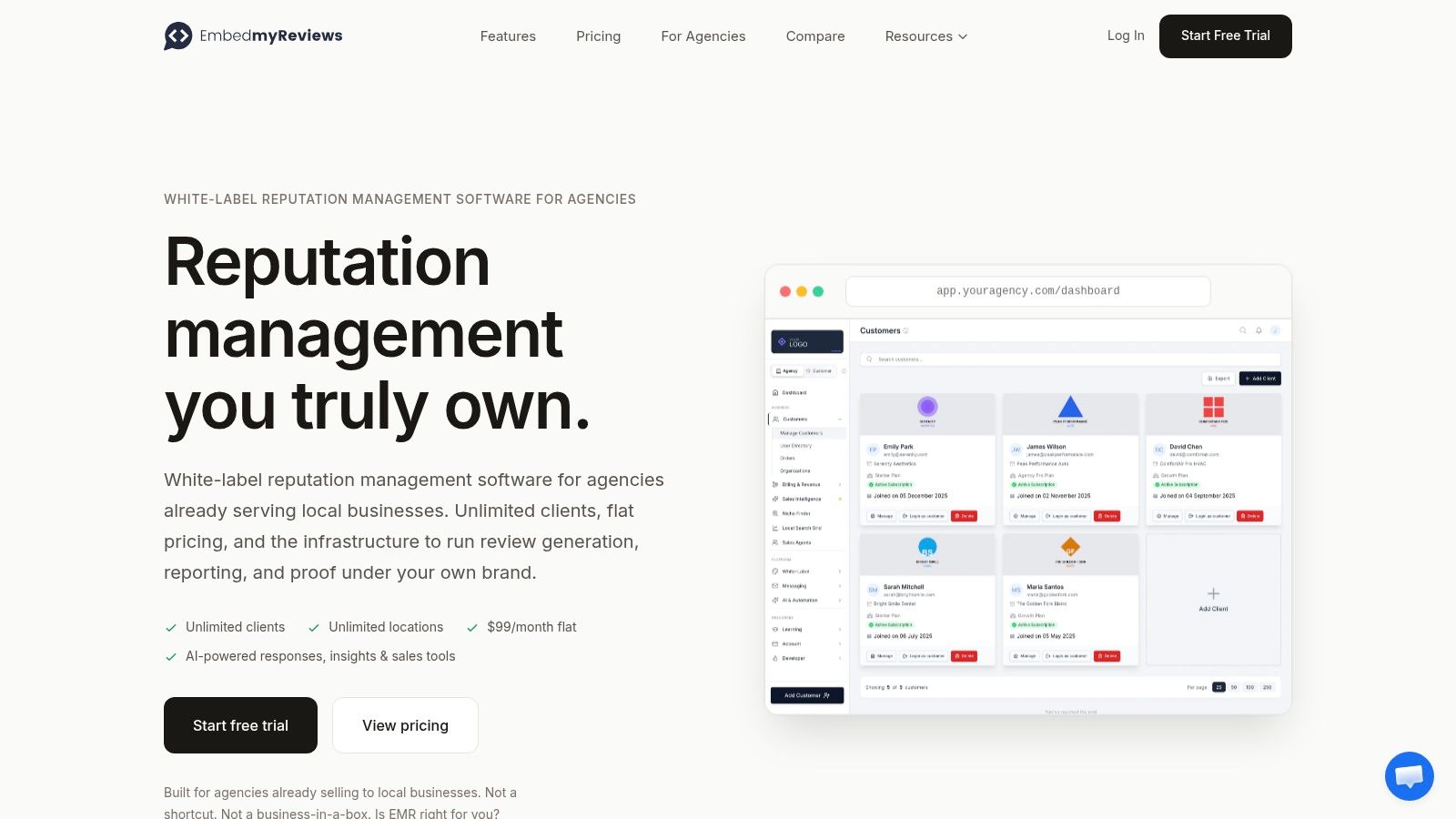
EmbedMyReviews is built for agencies, consultants, franchises, and operators who sell review services to local businesses under their own brand. The big advantage is ownership. The platform runs on a white-label setup with a custom domain, branded UI, custom help center, and agency-controlled billing, so clients see your business, not the software vendor. You can review the platform details on the review management software for agencies page.
The fit is strongest when review management is only one part of a broader local growth offer. EmbedMyReviews combines review collection, response workflows, Google Business Profile posting, local rank tracking, analytics, widgets, and sales intelligence. That makes it a better operational hub than a point tool for teams that also need proof of work, reporting, and client-facing deliverables.
Best for agencies that want to own the client relationship, not resell someone else's dashboard.
Where it stands out
The flat pricing model is the practical hook. Instead of pricing that climbs with every new location or seat, the base platform is positioned for unlimited clients, locations, and users. That makes margin planning easier if your book of business grows unevenly.
It's also unusually flexible on messaging and AI. You can bring your own keys for email, SMS, WhatsApp, and AI responses, which helps preserve provider choice and keeps the workflow aligned with different regions. The trade-off is that this is a platform for operators who want to set up structure and govern it, not a lightweight app for casual review monitoring.
What to watch
The breadth is the upside and the risk. If you only need basic review requests and replies, EmbedMyReviews may feel bigger than necessary. If you manage multiple brands, local locations, and recurring client reporting, the extra surface area is the point.
2. GatherUp for single-location service businesses and small teams
GatherUp is a solid fit when you want the essentials without buying into enterprise overhead. It covers review requests by email and SMS, customer feedback collection, NPS, survey reporting, widgets, badges, and AI-assisted replies. That mix works well for a small operation that wants to centralize feedback without turning the process into a project.
Its biggest strength is rollout speed. Single locations and small groups can usually stand this up without a long implementation cycle. The main limitation is governance, it's lighter than franchise-first systems, and listings management sits as an add-on rather than a core part of the bundle.
One practical reason teams like this kind of setup is that it keeps review management close to the operating rhythm. If you're already using a tool stack for service delivery, a simpler feedback platform can be enough to keep response times short and customer signals visible.
Use a lighter platform when your team needs consistency more than enterprise controls.
I'd put GatherUp on the shortlist for operators who care more about getting the basics right than building a large reputation program. It's also one of the cleaner choices if you don't want your software to sprawl into listings, social, and local SEO tools you won't use.
Internal workflow note
For a merchant or donor program that already runs on structured outreach, the implementation mindset is similar to what you'd see in Pin Generator's automation model, keep the workflow narrow, repeatable, and easy for staff to follow.
3. Podium for SMS-first local businesses
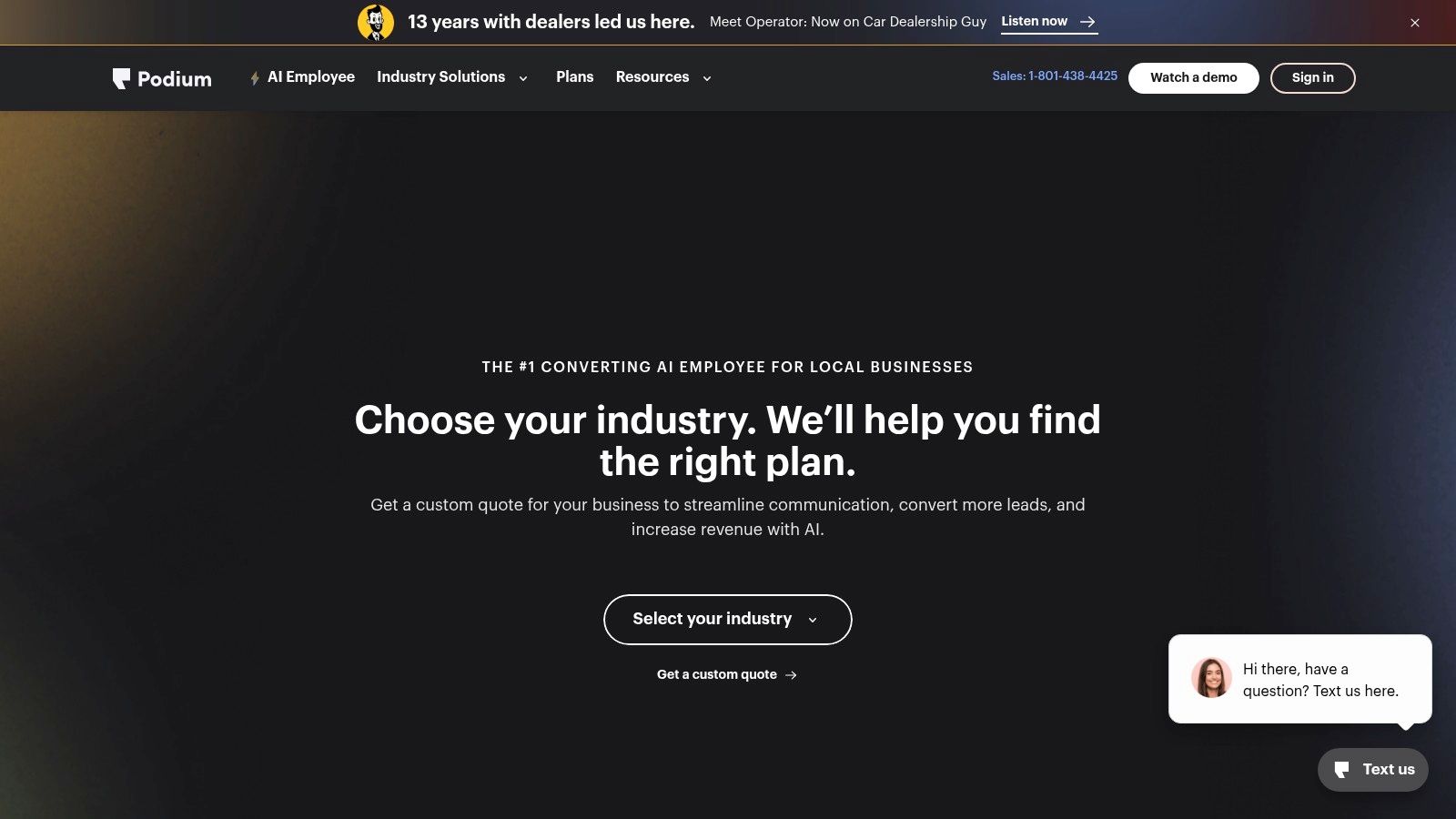
Podium fits businesses that live in text messages. It pulls review requests, messaging, team collaboration, payments, and a unified inbox into one place, which is useful when the operational challenge is keeping up with customer conversations, not just collecting more reviews. If your team already communicates by SMS, Podium's workflow feels natural.
The upside is speed. Text-based review invites and reminders are easy to deploy, and the inbox gives staff one place to manage Google, Facebook, and SMS-driven conversations. The downside is price visibility, which is quote-only, and the platform can be more than a basic review tool if your business doesn't need payments or webchat.
Podium makes the most sense when review requests are part of customer communication, not a separate marketing task.
That distinction matters. A lot of local businesses don't need a deep reputation stack. They need staff to follow up quickly, ask for feedback at the right moment, and avoid losing customer conversations across multiple channels. Podium is built around that reality.
If you're comparing it against lighter review tools, ask one question first. Do you need a messaging hub, or do you just need review capture and response? If it's the former, Podium belongs near the top of the list. If it's the latter, it may be more platform than you need.
4. Birdeye for multi-location service businesses and franchise operators
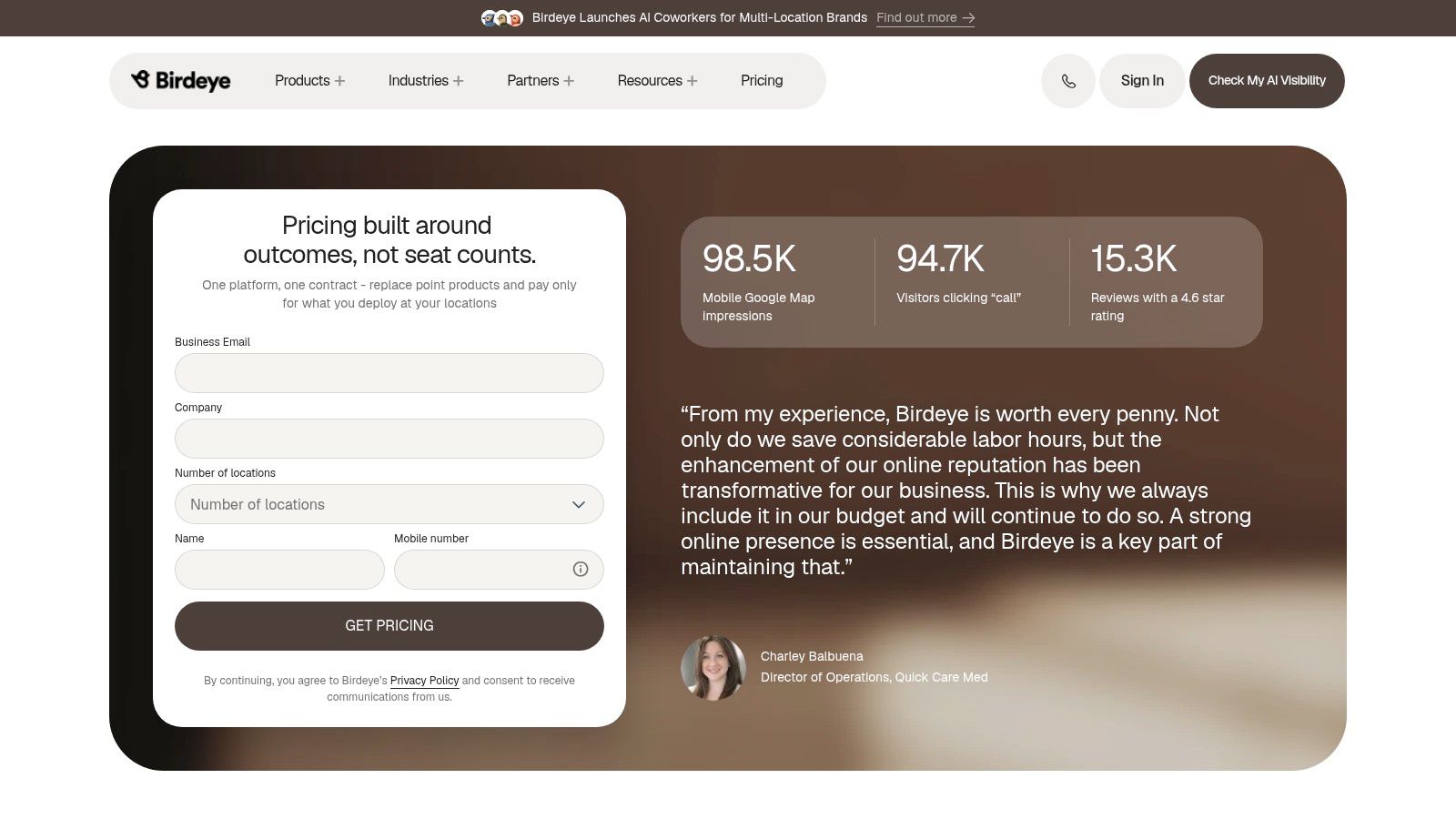
Birdeye is a broad reputation platform for businesses that need review management to scale across locations. It centralizes review collection, response, listings, messaging, surveys, and multi-location reporting, which makes it a strong fit for service brands, franchises, and operators who need visibility across a large footprint. The platform is less about one inbox and more about standardized control.
The trade-off is scope. Birdeye can cover a lot of ground, which is good if you need one system for many customer-facing tasks, but it can also be more than a small team wants. Pricing is not publicly itemized, so buyers should expect a sales conversation. That's normal in this category, but it does make early budget planning harder.
Why teams choose it
The best reason to consider Birdeye is governance at scale. If local managers, regional leaders, and corporate teams all need different views into reviews, it's easier to keep the program aligned inside a more structured suite. The platform also brings surveys and listings into the same environment, which reduces tool sprawl.
That said, breadth doesn't equal simplicity. Smaller teams sometimes buy a big platform, then use only a fraction of it. That's wasted money and extra admin. For a single-location business, Birdeye is usually overkill. For a multi-location operator, the extra structure can be exactly what keeps the program from falling apart.
5. Grade.us for agencies that need white-label review funnels
Grade.us fits agencies that sell review management as a packaged service. Its main strengths are white-labeling, review funnel landing pages, review request campaigns, monitoring, and branded reporting. That gives agencies a way to run client programs under their own name without building every step from scratch.
The platform works best when you need the same process across many accounts. The funnel setup keeps requests organized, while the templates and reporting support delivery to clients instead of just internal use. The trade-off is clear. Pricing is not public, and the interface is more functional than polished compared with newer suites.
Choose Grade.us if your team sells review acquisition and reporting as a managed service.
That is the fit. Agencies usually need a workflow they can repeat, not the most polished interface in the category. Grade.us is stronger on operational use and client packaging than on visual appeal. If white-label delivery and straightforward campaign management matter most, it deserves a close look.
Agencies that feel pressure from scattered tools should compare this service model with a broader local SEO and listings platform before deciding whether review management should stand alone or sit inside a larger package.
6. Yotpo Reviews for eCommerce brands
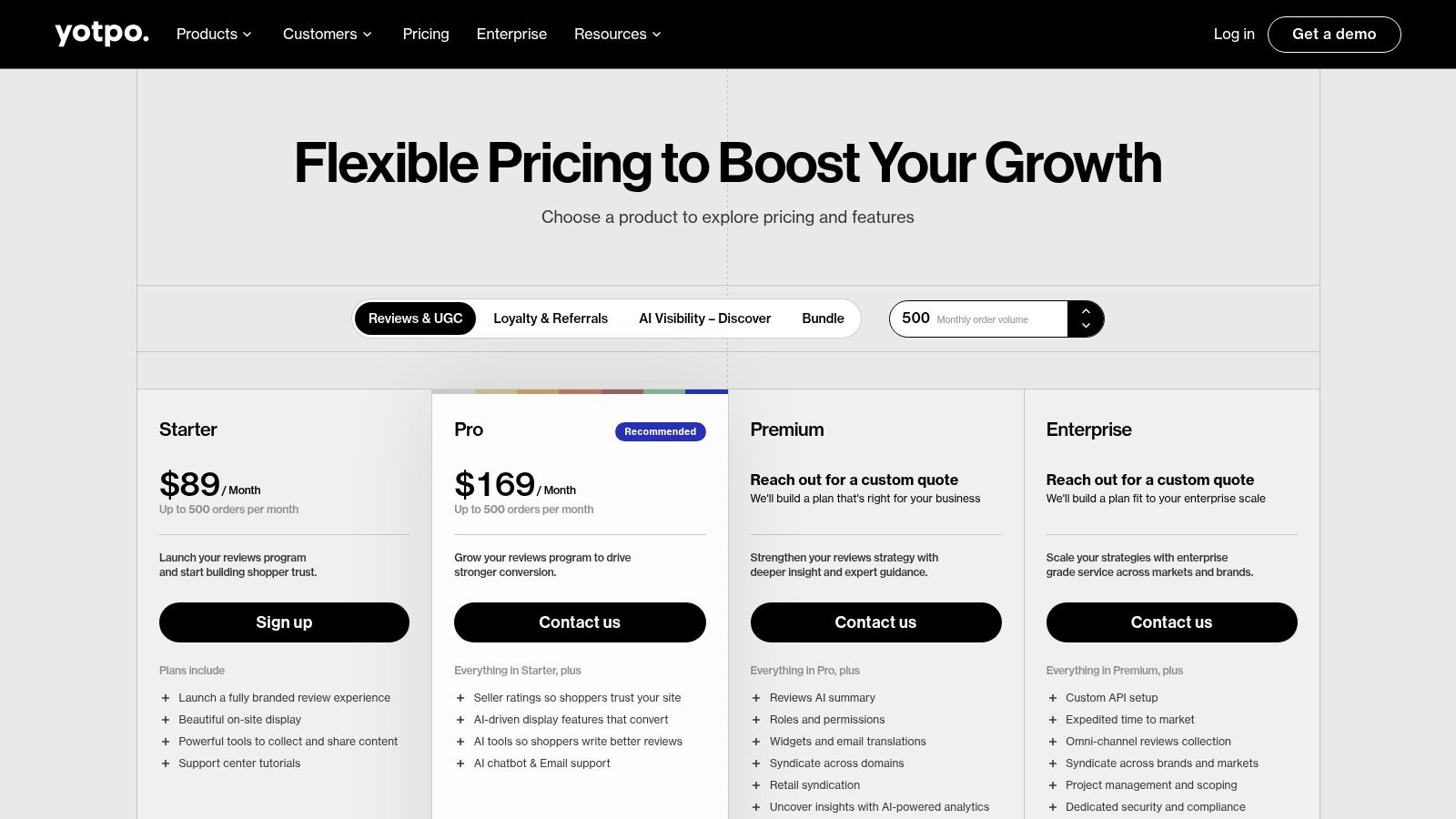
Yotpo is the right fit when reviews are part of product marketing. It's built for eCommerce brands that want automated post-purchase review requests, product pages with social proof, photo and video reviews, moderation, and broader retention tools like loyalty and SMS. If your store runs on Shopify or a similar commerce stack, Yotpo usually feels more native than a general-purpose reputation tool.
The upside is depth where commerce teams need it. Product reviews, visual UGC, and on-site displays are central here, and the ecosystem around loyalty and messaging makes sense for brands that treat customer content as a conversion asset. The downside is complexity. If all you need is a clean request-and-reply workflow, the suite can feel larger than necessary.
What works and what doesn't
Yotpo works when review management is tied to merchandising, conversion, and retention. It doesn't work as well if your main need is local reputation control across physical locations. That's where a retail or multi-location platform is usually a better fit.
The pricing model also varies with usage, so buyers should expect different thresholds as volume changes. That's normal for commerce tools, but it means the platform needs a close look before you commit. For brands that want reviews, UGC, loyalty, and SMS in one commercial system, it's still a strong contender.
7. Trustpilot for brands that want recognizable public proof
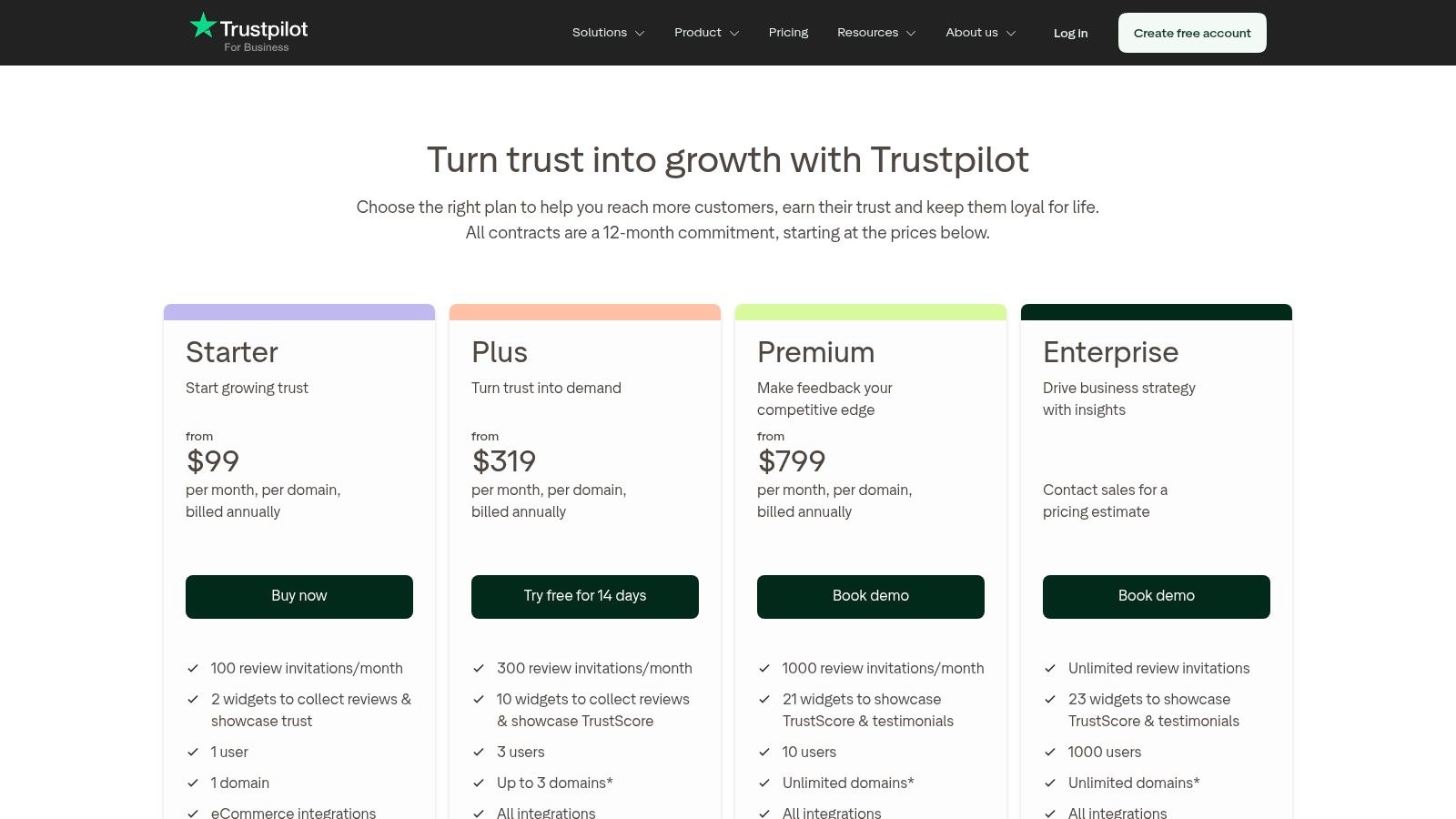
Trustpilot works best for DTC and eCommerce brands that want a name customers already recognize. It combines automated review invitations, public profile pages, TrustBox widgets, analytics, integrations, and moderation workflows. That recognition can matter when trust needs to be visible fast on product pages and landing pages.
The practical advantage is display. Trustpilot is good at turning review activity into on-site proof, and its public profile format is easy for customers to understand. The trade-off is pricing, which is often quote-based in the U.S., and advanced functionality usually sits behind paid tiers.
If you're choosing based on consumer familiarity, Trustpilot has a real edge. If you're choosing based on workflow depth, it's more useful as a review trust layer than a full operational system. That's not a criticism. It just means it's strongest when social proof is part of the conversion path.
Public recognition helps, but only if your team can keep the response process consistent.
That consistency matters more under the FTC rule than it used to. Businesses now have to think about authentic solicitation, documentation, and what happens when review handling becomes part of compliance rather than pure marketing. Trustpilot can support that broader brand trust story, but the internal process still has to be disciplined.
8. Bazaarvoice Ratings & Reviews for retail syndication
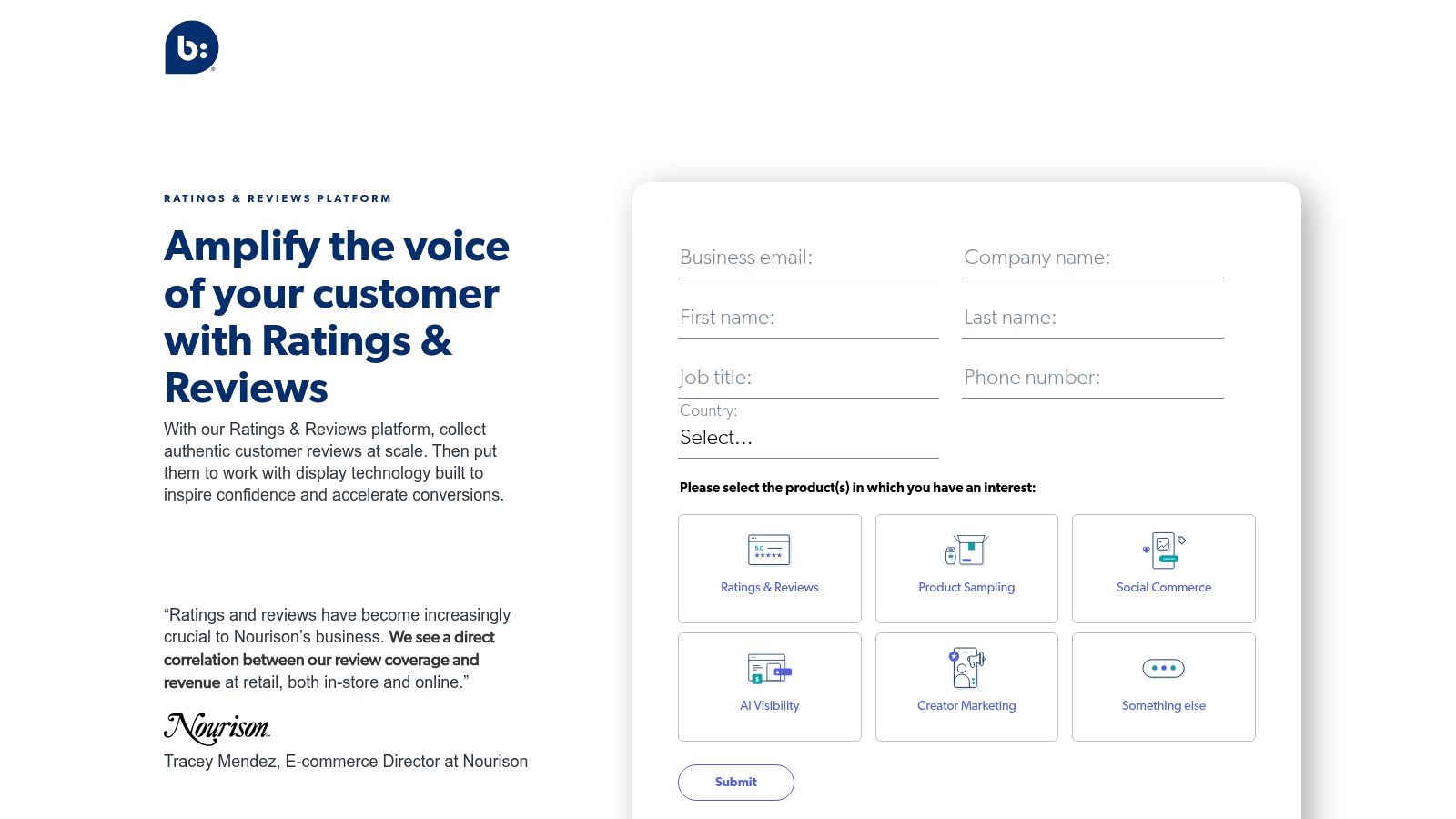
Bazaarvoice is the enterprise choice for brands that sell through retail channels and need review syndication at scale. It's known for collecting ratings and reviews, moderating them, and distributing them across retailer networks. That makes it especially valuable when the same product appears across multiple retail environments and the brand needs consistent UGC everywhere.
The fit is strongest for manufacturers and retail brands, not small direct-to-consumer catalogs. It's enterprise-oriented, quote-based, and likely overkill if all you need is a simpler on-site review layer. But if retail syndication is part of your distribution strategy, the platform's maturity is hard to ignore.
Where it earns its keep
Bazaarvoice solves a problem smaller tools often miss, review portability across retail channels. That matters when teams need product evidence to travel with the SKU. The moderation and enterprise controls also make it easier to govern large volumes of consumer content without losing structure.
The trade-off is implementation weight. This is not a quick self-serve tool for a lean marketing team. It's a platform for organizations that need retail-grade infrastructure and are willing to buy into that operating model. If that describes your business, it belongs on the shortlist.
9. Chatmeter for multi-location brands that want unlimited users
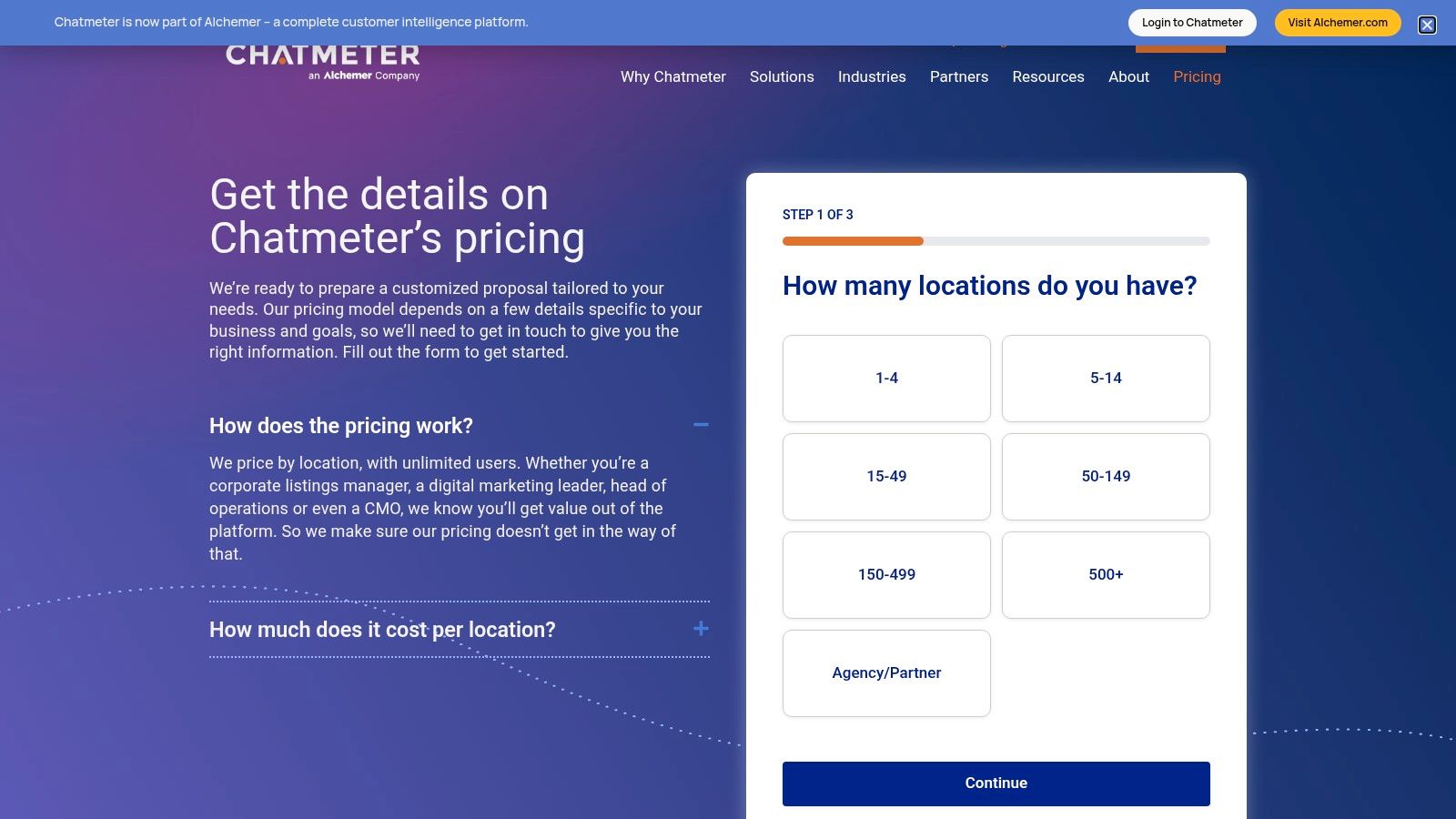
Chatmeter is built for multi-location operators that need review management tied to listings and local SEO. It centralizes review monitoring and response, supports templates and bulk actions, and adds AI-assisted response automation, competitive insights, and optional managed response services. The appeal is clear if you have a lot of locations and want a cleaner governance model.
The pricing structure matters here. Chatmeter positions itself with per-location pricing and unlimited users, which can be attractive when multiple people across corporate and local teams need access. The platform is less compelling for a single-location business, where the overhead is unnecessary.
Unlimited users are useful only when your team structure actually needs them.
That's the trade-off. Some platforms charge by seat, some by location, and some by both. Chatmeter makes more sense when access needs to be broad and the program is distributed across the business. If your operations team wants consistent response control and local SEO visibility in one place, it's a practical fit.
The managed response service is also worth noting. Some brands don't want every review reply to depend on local staff. If that's your situation, having an optional service layer can reduce bottlenecks. If you prefer total internal control, you'll want to evaluate how much of the workflow stays in-house.
10. SOCi for franchises and enterprise multi-location brands
A franchise system with dozens of locations usually needs more than review inboxes. SOCi fits that buyer. It brings review management, local listings, and localized social execution into one place, so corporate teams can keep standards tight while local teams still have room to respond.
That governance layer is the main reason larger operators consider it. Review monitoring, response workflows, per-location dashboards, and permissions are built for distributed teams. The platform also makes sense when review work sits alongside local social publishing, because the same team often handles both.
There is a clear trade-off. SOCi is useful when fragmented local execution is a real problem, but it is too much platform for a single-location business. Pricing is sales-led, so buyers need a conversation before they can judge fit, which can slow evaluation.
Unlimited users are useful only when your team structure needs them.
SOCi also fits buyers who care about local search and location-level control. That is why it often pairs well with the discipline described in a local SEO platform guide, where consistency and local relevance matter more than feature overload.
11. Reputation for enterprise customer experience and review governance
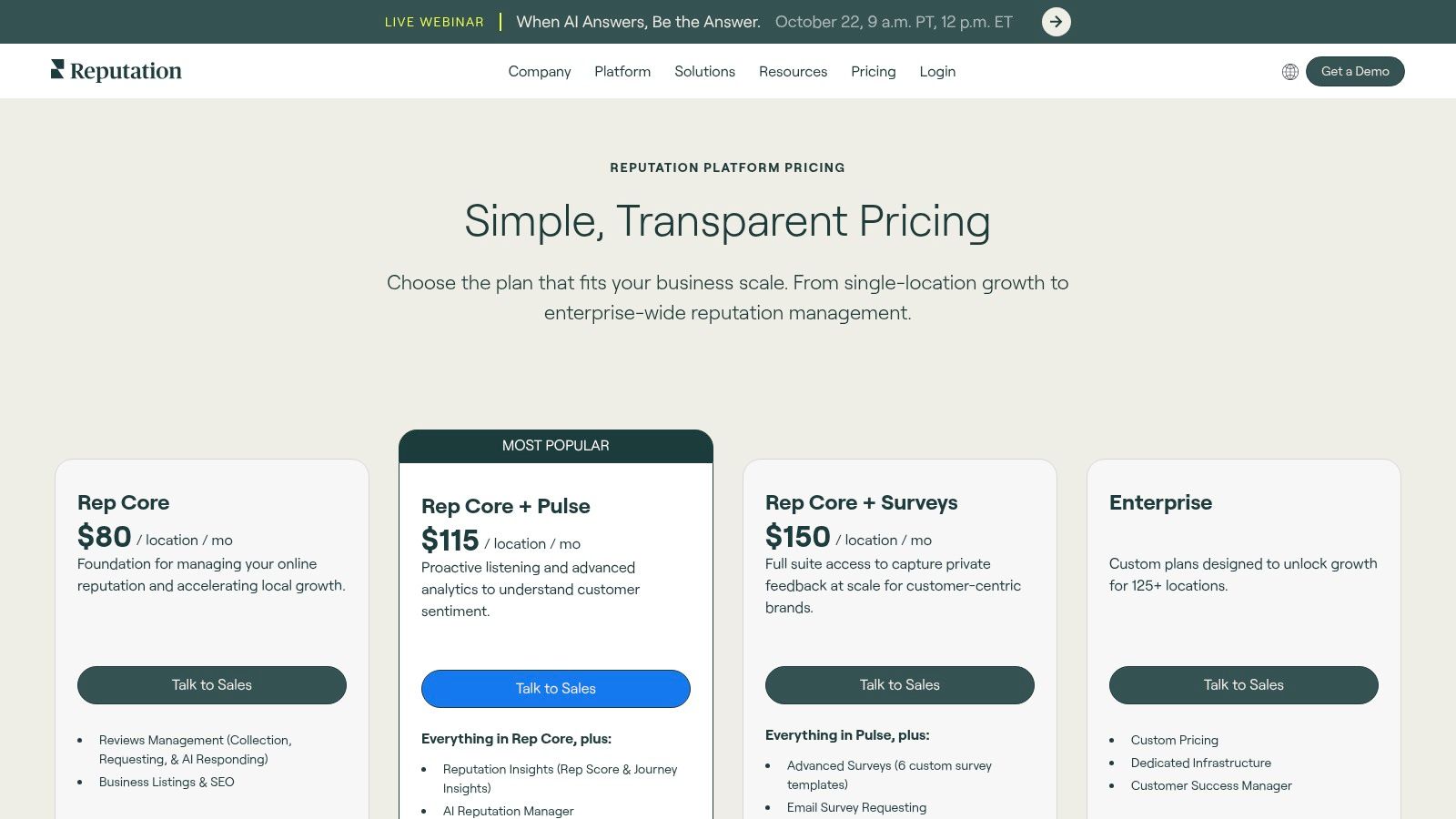
Reputation is the broad enterprise suite in this group. It brings review management, surveys, listings, social, analytics, and managed services into one platform, which is why larger multi-location brands often evaluate it alongside other enterprise options. The platform is most useful when review management is part of a larger customer experience program.
Its main strength is breadth with governance. AI-assisted responses, location-level dashboards, and managed services make it easier to keep large organizations moving without leaving every task to local staff. The downside is predictably enterprise-like, quote-based pricing and complexity that can overwhelm smaller businesses.
Enterprise tools pay off when process discipline matters as much as response speed.
That's the key. Reputation is not a small-business tool dressed up for big accounts. It's for organizations that want the infrastructure to manage feedback, surveys, listings, and response workflows together. If your business already thinks in terms of operational governance, the fit is strong.
If you don't need that level of control, the platform can feel heavy. That's not a flaw, it's a mismatch. Buyers should be honest about whether they need a reputation system or just a reliable way to collect and answer reviews.
Top 11 Review Management Tools Comparison
| Product | ✨ Key features | 👥 Target audience | 🏆 Unique selling point | ★ Quality/UX | 💰 Pricing/value |
|---|---|---|---|---|---|
| EmbedMyReviews | White‑label review mgmt, BYOK AI, GBP posts, widgets, local rank | Agencies, franchises, consultants | 100% agency‑owned platform + flat unlimited plan 🏆 | ★★★★★ | 💰 $99/mo flat (unlimited clients/locations) |
| GatherUp | Email/SMS requests, NPS/surveys, widgets, AI reply suggestions | Small businesses & local teams | SMB‑friendly, easy rollout and transparent pricing | ★★★★ | 💰 Transparent SMB pricing (value‑oriented) |
| Podium | SMS invites, centralized inbox, payments, templates | Local service businesses, operators | SMS‑first workflows + text‑to‑pay integration 🏆 | ★★★★ | 💰 Quote-based; typically higher‑tier |
| Birdeye | Review inbox, listings sync, surveys, multi‑location dashboards | Franchises, multi‑location SMBs | Deep local listings + per‑location reporting | ★★★★ | 💰 Per‑location pricing (sales‑led) |
| Grade.us (Traject) | Review funnels, white‑label pages, widgets, API | Agencies managing multiple SMB clients | Agency‑focused white‑labeling & funnels | ★★★ | 💰 Agency plans; pricing limited/public info |
| Yotpo (Reviews) | Post‑purchase review requests, photo/video UGC, syndication | eCommerce merchants (Shopify/BigCommerce) | Strong eCommerce integrations & modular add‑ons 🏆 | ★★★★ | 💰 Freemium + usage/order‑based tiers |
| Trustpilot | Public reviews, TrustBox widgets, moderation, analytics | DTC & eCommerce brands seeking recognizable proof | High consumer recognition; Google Seller Ratings lift | ★★★★ | 💰 Paid tiers; advanced features behind quotes |
| Bazaarvoice | Ratings & reviews, retail syndication, moderation, APIs | Brands/manufacturers selling via retailers | Market‑leading retail syndication & enterprise controls 🏆 | ★★★★ | 💰 Enterprise/quote‑based |
| Chatmeter | Review monitoring, AI responses, listings, local SEO | Multi‑location brands & chains | Per‑location pricing with strong automations | ★★★★ | 💰 Per‑location; sales‑led pricing |
| SOCi | Local social, review mgmt, listings, per‑location governance | Franchises & multi‑location enterprises | Governance + local execution at scale 🏆 | ★★★★ | 💰 Enterprise/sales‑led (per‑location) |
| Reputation | Reviews, surveys, listings, unified CX, managed services | Large multi‑location & enterprise brands | Comprehensive CX suite + managed response services | ★★★★ | 💰 Quote‑based enterprise pricing |
Choosing Your Platform Before the Next Review Lands
The right shortlist starts with three filters. First, count your locations. A single site, a small group, and a multi-location brand usually need different levels of governance. Second, look at where customers leave feedback. Google, product pages, retail networks, and industry directories all point to different tools. Third, decide whether you need on-site widgets, retail syndication, white-label reporting, or just clean review requests and fast replies.
Then test the workflow, not the brochure. Ask for quotes from two or three vendors and run real reviews through the system. See how quickly alerts arrive, how easy it is to route sensitive feedback, and whether the reply process feels manageable for the people who'll use it every day. If the platform needs weeks of setup before it becomes useful, that cost matters even if the feature list looks strong.
Be careful with pricing structure. Quote-only plans can hide cost creep, especially when vendors charge by location, seat, or add-on. Flat pricing can be a better fit for agencies and growing client bases, while per-location pricing can make sense for enterprises that need tighter support and governance. The only way to know is to map your current footprint against the vendor's billing model before signing.
Compliance also matters more than it used to. The FTC's Consumer Reviews and Testimonials Rule shifted review management from a simple marketing task to a governance issue, so your platform should help preserve authentic solicitation, records, and review history. That doesn't mean you need a legal team in every workflow, but it does mean the tool should support neutral requests, editable responses, and traceable handling.
The final check is exportability. If you ever switch platforms, you'll want your review history, location data, and performance reporting to come with you. Ask that question early. A good review management system should make your reputation easier to run today and easier to move tomorrow.
If you're ready to tighten review operations before the next bad review lands, build a shortlist now, run live testing with your own locations, and compare the tools against how your team works. The best platform is the one your staff will use consistently, your clients or leaders can trust, and your business can grow with without rebuilding the process six months later.