
ShareASale Affiliate Marketing in 2026: How It Works Now
23 November 2026
The first task in ShareASale affiliate marketing isn't finding a merchant. It's checking whether the account, links, and reporting you plan to use still belong in your workflow. The standalone platform has closed, so a guide that starts with signing up for ShareASale can send you in the wrong direction before you publish a single pin.
For Pinterest affiliates, the useful starting point is operational: establish your Awin access, verify merchant relationships, track individual pins, and measure approved earnings against the cost of producing content.
Table of Contents
- Where ShareASale Affiliate Marketing Stands Today
- How the Network Model Pays Publishers and Merchants
- How to Join Programs and Get Approved
- Choosing Merchants Worth Promoting on Pinterest
- Tracking Sales Pin by Pin
- Measuring Profit Per Click, Not Just Commission
- Promoting Products Responsibly and Staying Compliant
- Audit Your Legacy Links Before You Promote Again
Where ShareASale Affiliate Marketing Stands Today
ShareASale no longer operates as an independent network. AffMaven's account of the Awin transition reports that migration completed in August 2025, moving more than 9,500 advertisers and 250,000 active publishers, before the standalone platform closed on October 6, 2025.
That changes what a working affiliate should do. You're not choosing whether to start on the old platform or the new one. You're checking your current publisher account, program approvals, tracking links, and payment records within Awin.
ShareASale timeline and what it means for affiliates
| Milestone | Date | What it means for affiliates |
|---|---|---|
| Founded in Chicago | 2000 | Built to handle tracking, attribution, and merchant–publisher relationships |
| Awin acquires ShareASale | 2017 | Became part of Awin's international affiliate-network group |
| Migration to Awin | August 2025 | More than 9,500 advertisers and 250,000 active publishers moved over |
| Standalone platform closes | October 6, 2025 | Account access ended; historical reports needed to be exported beforehand |
| Current route for new work | Ongoing | Use an Awin publisher account and Awin links for new campaigns |
The migration totals describe a substantial marketplace, not a guarantee that your particular merchant relationship is ready to use. A publisher still needs to confirm that the right account holds the approval, that the merchant accepts the intended traffic source, and that transactions appear where expected.
Old ShareASale references remain useful for identifying merchants and understanding past arrangements. They aren't reliable instructions for navigating current application screens or interpreting current terms.
What to check before publishing
- Account access: Confirm you can enter the correct Awin publisher account and identify its publisher ID.
- Merchant status: Look for an active relationship rather than assuming an old approval is sufficient.
- Records: Locate saved reports, payment statements, and previous program terms.
- Campaign setup: Generate new campaign links through the current platform instead of copying an old URL from a spreadsheet.
Treat old login instructions as historical documentation. If you still hold a ShareASale account reference or legacy link, confirm your Awin status before building more content around it.
How the Network Model Pays Publishers and Merchants
An affiliate network works like a referral desk. Merchants want customers, publishers want payment for qualified referrals, and the network provides the tracking and administration between them.
Graphiq's ShareASale history describes how Brian Littleton founded the business in Chicago in 2000, and how Awin acquired it in 2017. Its practical value was infrastructure: smaller merchants could run affiliate programs without building proprietary referral tracking and relationship-management systems.

Follow the money, not just the click
- Publish a tracked link. Place it in an approved channel, such as a pin, article, or email.
- A visitor follows it. The network identifies the referring publisher using the supported tracking method.
- The visitor completes a qualifying action. The action must satisfy the merchant's attribution window and eligibility rules.
- The transaction receives an attribution. The merchant and network record the referral and calculate the provisional commission.
- The merchant validates the action. Returns, cancellations, or invalid leads can affect approval before payment becomes available under the applicable schedule.
Pending commission isn't spendable income. Keep it separate from approved and paid commission when planning cash flow.
Commission models and where each fits
| Commission model | How the merchant pays | Best fit | Main risk |
|---|---|---|---|
| Percentage of sale | A share of each qualifying order | Products with a clear, stable price | Returns or excluded items reduce commission |
| Flat fee per sale | A fixed amount per eligible order | Offers with predictable acquisition value | Eligibility limits can exclude otherwise completed purchases |
| Per lead or action | Payment for an accepted signup or form | Services, subscriptions, trials | Rejected or duplicate leads don't earn |
| Tiered rate | A higher rate after defined volume targets | Established, high-volume publishers | Targets may be difficult to reach consistently |
Cashback is another way publishers share referral value with shoppers. If your audience asks how that differs from creator recommendations, FruitPunch's resource lets them compare Rakuten with other cashback apps. Keep the distinction clear: a shopper's reward and your publisher commission are different parts of the arrangement.
A large advertised rate means little until you know which actions qualify and which commissions survive validation.
How to Join Programs and Get Approved
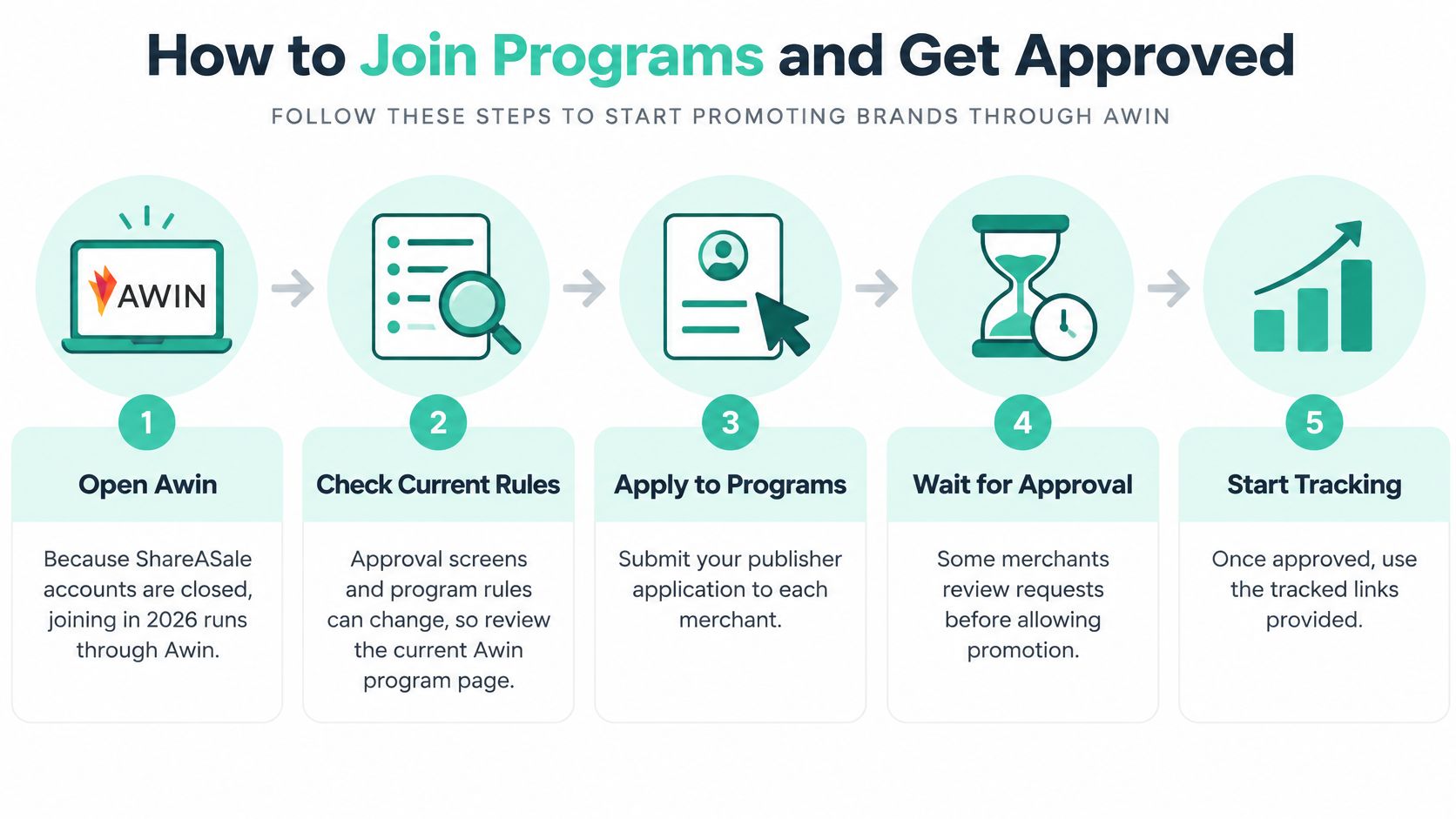
Start with your current Awin account, not an old ShareASale signup tutorial. Application screens, verification requirements, and individual merchant rules can change, so follow the instructions displayed in your account rather than copying screenshots from an older guide.
Network membership and merchant approval are separate decisions. A complete publisher profile helps a merchant understand your business, but it doesn't automatically authorize every offer or promotion method.
Build an application a merchant can evaluate
Create or confirm your publisher account. Complete the requested business, payment, and channel information. If you already migrated, resolve access to the existing account before creating another account that could complicate your records.
Show your actual publishing channels. Include your website and the Pinterest profile you intend to use. Describe the audience, subject areas, and whether pins lead directly to merchants or to your own editorial pages.
Find programs that match your content. Browse by relevant category and market, then inspect available commercial terms. Check delivery regions and customer eligibility before treating a recognizable brand as a useful opportunity.
Read the program agreement before applying. Record the attribution window, qualifying actions, promotional restrictions, validation process, and payment conditions. Permission to publish on your website doesn't necessarily mean permission to use direct affiliate links on Pinterest.
Submit a specific application and await the decision. Explain which content will introduce the product and why that audience would find it useful. Don't claim traffic, product experience, or promotional capabilities you can't demonstrate.
Generate and test an approved tracking link. Open it in a clean browser session and confirm that it reaches the intended product or landing page. Check available click reporting, while remembering that a working destination alone doesn't prove conversion attribution.
Handle rejection without scattering applications
Applying indiscriminately makes it harder to understand why merchants decline you. A thin profile, unclear traffic source, unsuitable market, or mismatch between your content and the product calls for a different fix.
If a rejection includes a reason, address that reason first. Where none appears, send a concise inquiry through the available program contact and respect any stated reapplication conditions.
Practical rule: Your first usable setup is a manageable set of approved merchants, each with a tested destination and a saved record of its terms.
Keep those records somewhere you control. A spreadsheet with the merchant name, approval status, permitted channels, link location, and review notes is more useful than a folder full of unexplained screenshots.
Choosing Merchants Worth Promoting on Pinterest
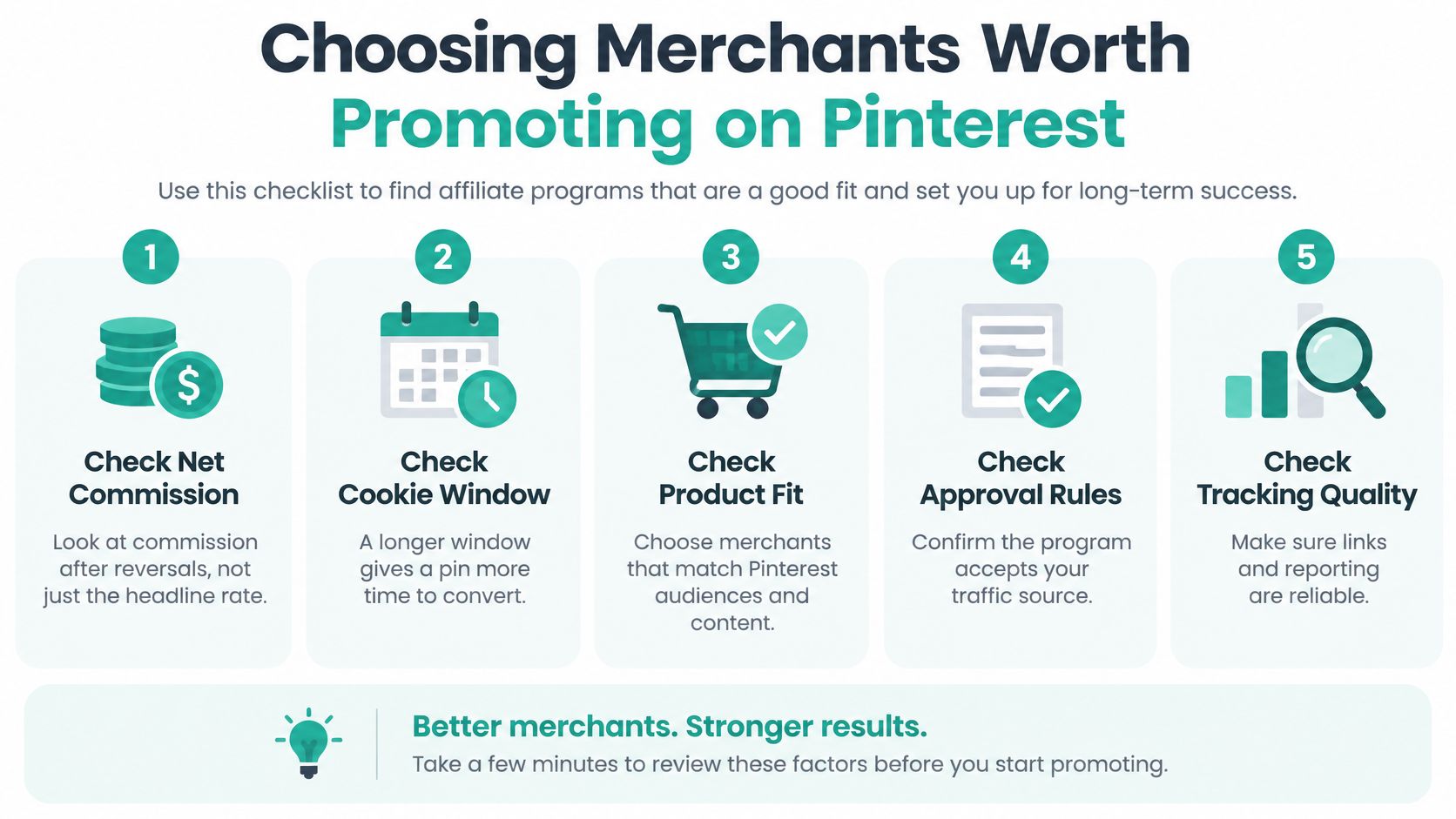
A merchant can be an excellent fit for an editorial website and a poor fit for direct Pinterest promotion. Judge the offer against the audience's intent, the landing page, and the program's permission to use your publishing method.
Say your board helps readers organize small kitchens. A compact storage product with clear dimensions may be easier to recommend than an unrelated subscription with a more attractive commission.
Compare the whole offer
- Net commission: Ask what remains after cancellations and rejected transactions, not just what the advertised rate promises.
- Attribution window: Check whether the allowed decision period suits the purchase. A longer window can accommodate slower decisions, but it doesn't guarantee attribution.
- Product fit: Match the item to what the audience wants to solve. Inspect dimensions, compatibility, delivery coverage, and stock availability.
- Approval friction: Establish whether your account and traffic source are accepted before preparing a batch of creatives.
- Returns policy: Look for product characteristics that could cause disappointed buyers, such as unclear sizing or misleading images.
- Creative assets: Confirm images are current, licensed for your use, and consistent with the actual destination.
- Payment conditions: Record the applicable threshold, validation process, and payment timing.
- Channel restrictions: Check Pinterest, paid promotion, coupons, brand-name bidding, and link-format restrictions explicitly.
Drop offers that create avoidable risk
A high rate attached to a rare qualifying action may be less useful than a modest rate on an offer your readers understand. An unreachable program contact, unclear exclusions, or creative rules that conflict with your workflow also deserves scrutiny.
Don't use a short calendar test as a final profitability verdict. First check link quality and audience response, then allow enough time for the offer's purchase cycle and validation process before comparing approved earnings.
Shortlist a small group that passes every essential check. Expand only when you can explain why a merchant deserves more of your publishing effort.
Tracking Sales Pin by Pin
Merchant-level revenue tells you where money came from. It doesn't tell you which creative, board, or product deserves more work.
Awin's tracking and migration guidance maps the former ShareASale afftrack field to clickref2 in Awin reporting. Use the supported click-reference fields to distinguish campaigns rather than creating separate publisher accounts for every experiment.
Give every pin a stable identifier
A useful structure is productID_templateID_boardID_date. For example, basket_leaf_smallspaces_publishdate can identify a storage basket, a leaf-themed template, the small-spaces board, and its publishing batch.
The identifier should connect to a separate campaign log containing the exact pin, destination, creative version, and publication details. If several pins share those attributes, add a unique pin token so they don't collapse into the same reporting row.
Don't encode personal information or depend on a descriptive title that you might later edit. Keep the reference short, consistent, and readable in exported reports.
Understand what tracking can establish
Awin describes browser-cookie tracking, which stores a publisher identifier after an affiliate click, and server-to-server tracking, which communicates conversion information directly between servers. Server-side tracking can improve resilience, but it doesn't mean every device change or customer journey will be attributed.
Publishers also can't assume they control a merchant's tracking implementation. Ask the program contact to investigate unexplained gaps with concrete examples and timestamps rather than assuming a tracking method solves every discrepancy.
Validate the entire route
- Redirects: Confirm the generated affiliate URL reaches the expected destination without losing required parameters.
- Mobile browsers: Test the actual journey a Pinterest visitor encounters, including browser handoffs where applicable.
- Checkout domains: Note whether checkout moves elsewhere and ask how the merchant validates that journey.
- Reporting: Verify that your reference appears in the appropriate reporting field.
- Creative comparisons: Compare AI-generated and manually designed variants using approved earnings, not attractive click totals alone.
Track missing-reference rate by dividing reported records without a usable reference by the relevant total records. Separately monitor unattributed orders only where a merchant or another reliable record lets you establish that an order should have been attributed.
A blank reference is a reporting problem you can investigate. An unseen order isn't automatically proof that the network lost a sale.
Measuring Profit Per Click, Not Just Commission
A commission percentage isn't a profit calculation. A publisher needs contribution margin after reversals and the cost of creating, distributing, and maintaining content.
Use this model:
Net earnings per click = conversion rate × average qualifying order value × commission rate × retained-commission share.
Then subtract the content and campaign costs allocated to each click. If the merchant pays a flat bounty, substitute that bounty for order value multiplied by commission rate.
Illustrative net earnings per 100 clicks
These are hypothetical inputs for arithmetic, not reported merchant results or benchmarks. Each scenario assumes a conversion rate of 2%, with reversals removing the same proportion of commission as sales.
| Scenario | Average order | Commission rate | Sales per 100 clicks | Reversal rate |
|---|---|---|---|---|
| Low-price product | $40 | 5% | 2 | 10% |
| Mid-range product | $80 | 10% | 2 | 10% |
| High-price product | $120 | 15% | 2 | 5% |
Under those assumptions, net commission before content costs is $3.60, $14.40, and $34.20, respectively. Divide each by the hypothetical 100 clicks to calculate earnings per click.
The arithmetic doesn't establish that a higher-priced offer will perform better. In practice, its conversion rate might be lower, the qualifying basket might exclude certain products, or validation might take longer.
Preserve the evidence behind the calculation
Awin's ShareASale transition announcement warned that historical reports would become unavailable after closure and described an intended automatic transfer of relationships and tracking links. That makes saved reports and transaction records important when comparing historical earnings with current results.
Keep pending, approved, reversed, and paid commission separate. Compare cohorts at equivalent stages of validation rather than placing fresh pending sales beside fully settled older sales.
The distinction between network access and campaign economics also applies when evaluating Impact affiliate marketing. A broad catalog doesn't make an unsuitable offer profitable.
Before scaling, compare the contribution from each merchant with direct partnerships and other channels. Include content maintenance, paid distribution if used, and the cash-flow effect of waiting for payment, not just the displayed rate.
Promoting Products Responsibly and Staying Compliant
Trust protects your ability to recommend products. A visitor who finds an exaggerated claim, an expired offer, or an unexplained commercial relationship has a reason to distrust the next pin too.
Make the affiliate relationship easy to understand before the click. Put a clear disclosure in the pin description, close to the commercial link or recommendation, and check the advertising and platform requirements that apply to your audience and location.
Use disclosure people can understand
| Approach | Example | Why it works or fails |
|---|---|---|
| Clear relationship disclosure | Affiliate link. I may earn a commission if you buy through this link. | Explains the financial relationship plainly |
| Inadequate disclosure on its own | My favorite finds. Partner vibes. | Doesn't clearly explain that purchases can earn commission |
A clear disclosure doesn't make an unsupported claim acceptable. Don't imply you've used a product when you haven't, invent before-and-after results, or describe a discount as current without verifying it.
Use product specifications to explain suitability. For a storage basket, dimensions and material help a buyer more than an unprovable claim that it will transform every home.
Respect both the merchant and the platform
- Promotion permissions: Follow restrictions on direct Pinterest links, paid search, brand-name bidding, and coupon use.
- Link presentation: Don't cloak or alter links in ways the program prohibits.
- Useful descriptions: Explain what the product does, who it suits, and any material limitation.
- Offer maintenance: Update or retire content when the destination no longer supports the promise in the creative.
For the publishing workflow, use the step-by-step guide to affiliate marketing on Pinterest alongside the actual terms of each program.
Keep a saved copy of the terms you accepted and record material changes. If a requirement is unclear, pause the affected promotion while you obtain written clarification instead of interpreting silence as permission.
Audit Your Legacy Links Before You Promote Again
Automatic transfer doesn't mean no work is required. A URL can open a live page while pointing to the wrong product, carrying an unusable campaign reference, or belonging to a relationship you haven't confirmed.
Start with the content that has the most commercial value. Include pins that still receive outbound clicks, not just those that were published recently.

Work through the audit in order
Recover the records you already hold. Search saved exports, cloud folders, bookkeeping records, and merchant correspondence. You can't rely on exporting reports from a closed account now.
Inventory legacy placements. List Pinterest pins, blog posts, editable email templates, and syndicated content. Mark delivered emails and third-party placements you can't directly change rather than treating them as editable assets.
Map each old link to its current destination. Record the merchant, active approval, intended product, replacement Awin URL, and campaign reference. Don't replace every old link with a merchant homepage.
Test the redirect path. Open destinations on desktop and mobile, check regional behavior, and confirm product availability. Separate a successful page load from evidence that tracking works.
Preserve disclosures. Keep the commercial explanation beside each recommendation when editing descriptions or rebuilding content. Check that the updated creative still matches the landing page.
Reconcile performance. Use saved historical records and current click references to investigate changes at pin and merchant level. Allow for differences in seasonality, traffic mix, and transaction validation before blaming migration.
Replace links with a controlled process
Keep an audit status for every placement: verified, replacement needed, awaiting merchant clarification, or retired. After making changes, test a sample from each replacement batch and retain the mapping file.
Our Affiliate Links bulk update lets you bulk update affiliate links in the outbound URL of pins. Use it after the destination mapping is complete, and distinguish changes to managed pin URLs from edits to already-published placements that may require separate action.
This week, audit your highest-earning pin destinations first, replace the failures you can verify, and pause new promotion where attribution remains unresolved.
Pin Generator helps you create and schedule Pinterest content, and its Affiliate Links bulk update supports replacing outbound affiliate URLs once you've verified your Awin mapping. Visit Pin Generator to organize your next batch around tested destinations and identifiable campaigns rather than unverified legacy links.